ATTENTION, READERS in the 28 EUROPEAN VAT COUNTRIES: Because of the new VAT law, you probably can't order books direct from my site now. But that's okay -- just go to my Smashwords author page.
You can order PDFs (as well as all the other ebook formats) from there.
Showing posts with label trouble shots. Show all posts

Wednesday, March 14, 2018

Paul Casey on the High Lob Shot (Video)

Since Casey won last week, he gets to teach a lesson this week. He recorded this lob shot video as one of the Titleist Tips from the Tour shorts.


Before getting to the tip itself, Paul reminds us that he doesn't have to go straight at the pin. This is something we often forget -- there's nothing wrong with playing the safe shot and avoiding the high score if we aren't sure we can play the bold shot. A low-scoring player always considers all of his or her options.

A quick note about that "safe" shot: Paul specifically says it's a lower shot, and it might even be a running shot. That's a lot easier shot to play, and perhaps that should be your choice if it's available to you.

Okay, here are a couple of things I picked up by studying the video, things that Paul doesn't mention and that may not be clear with only one or two viewings:
  • While Paul mentions that his stance is open, you may not realize how far forward his ball position is. He has the ball up even with his lead heel. That's quite far forward when you aren't using a tee, and he has the clubface wide open so he has to catch the ball almost perfectly. This isn't a shot you want to try if the ball is sitting down. You need a good lie.
  • You absolutely can't hang back on your trailing foot! With the ball so far forward and the clubface wide open, that's a sure recipe for a skulled shot. It's true that you can't hit down on the ball with this ball position, but you have to make sure your upper body stays stationary during the swing -- it doesn't move backward but it can't move forward either. (At least, not until after the ball has been struck.) You MUST hit the ball accurately in order to get that high ball flight.
Paul makes this look easy, but you need to be sure of yourself if you want to play this shot. Given how much clubhead speed this shot requires to get both the height and the distance, this is not the shot for you if you aren't confident of your ability to pull it off.

That's when you take the safe shot. Never feel guilty about doing that.

Tuesday, February 20, 2018

Adam Kolloff on Hitting Hybrids

Golf Digest instructor Adam Kolloff recently wrote a short article called Get The Most Out Of Your Hybrid. It focuses on hitting hybrids from the rough.

Gripping a hybrid

Kolloff has four tips to improve your hybrid play from the rough.
  1. Keep a firm grip so the face doesn't twist open or closed.
  2. Play the ball in the center of your stance.
  3. Don't sway off the ball. Try to stay very steady over the shot so you can hit down sharply on it.
  4. Be sure to accelerate through the rough.
That tip about playing the ball in the center of your stance is important. Kolloff says that too many players try to play the ball forward like a fairway wood, but I imagine just as many set up with the ball too far back in their stance like a wedge. Hybrids have straighter faces than wedges, so playing the ball too far back can drive it deeper into the rough rather than popping it out of the grass.

These are simple things, I know. But it's usually the simple things that trip us up.

Friday, February 16, 2018

Zach Allen on Playing Flier Lies (Video)

PGA instructor Zach Allen did a really nice video explaining exactly what a flier lie is and how to play it. It's short and to the point, which is what you need when facing a trouble shot like this.


First, Zach says a flier lie generally sits in light rough and the grass is growing toward the target. Very important, that -- if the grass was growing against you, it would help hold the ball in place when you hit it, not send it squirting forward. Instead, the grass gets between the ball and clubface, and that makes it come out lower and hotter.

But it's hard to know just how much. We just have to guess.

So here's what Zach says to do: Take one less club than you normally would and make a smooth swing. What he means is that you don't try to swing out of your shoes, as the ball is going to come out quicker and with less spin anyway. Then you just have to hope for the best, since fliers are unpredictable.

All-in-all, a very helpful video for handling a difficult shot.

Tuesday, January 23, 2018

Dave Pelz on Playing a Punch Shot

Over at the Golf Magazine site they've published a post by Dave Pelz on how to make your punch shot the most dependable trouble shot in your bag.

Dave Pelz shows three positions during punch shot

Dave describes the mechanics very simply:
"...play the ball two inches back of center in your stance and make a half- or three-quarter swing. The overall feeling should be "together and compact," with solid lower-body control."
There's more in the article, of course. Dave goes into considerable detail about how to choose the direction of your punch, which he says is at least as important as the mechanics. The photo above comes from this section of the article, and I should note that the two ball positions are for clarity. The ball in front of his club is his normal ball position while the ball behind the club is his punch position.

Look, it's rare that you get to read such a brief article that contains so much useful information. By all means, drop by the Golf Magazine site and check it out. You'll be glad you did!

Sunday, January 21, 2018

Hitting a Ball from the "Wrong" Side (video)

I found this video from instructor Jason Birnbaum's NerveWrackers series over at the Golf Digest website. I believe I've posted videos on hitting shots from the opposite side as you normally do, but I'm always up for another perspective on the task.


Here are the key points from the video:
  • Use a sand wedge because the head is large.
  • Turn the club upside down and reverse your grip -- that is, the hand that's normally at the end of the handle is now nearest the head.
  • Make a very short backswing to make sure you hit the ball in the center of the club.
  • Swing through as fast as you can without moving your head.
Here's my own thought about that last point. While you want to swing as fast as possible, you don't want to jerk the club when you start down. Rein in your desire to "explode" into the ball; try to feel as if you are slow at the "top" of your backswing and fast at impact. If you do, you'll keep your head pretty still without having to think a lot about it.

Shots from the "wrong" side of the ball are becoming more of a standard trouble shot these days. You might as well learn how to do them right.

Sunday, November 5, 2017

Randy Chang on Flipping Your Club (Video)

I know you've heard this before, but instructor Randy Chang's suggestion that you make this recovery shot a regular drill is useful -- particularly since he suggests which club to use!


Chang specifically suggests you use a 9-iron because it gives you a wider face to work with when you flip your club. But it's also smart because wedges make it much more likely that you will pull the ball sideways.

In the video you can see that he creates some "loft" by tilting the club so the face points slightly upward. But equally useful is what he DOESN'T mention. Chang makes no setup changes! This drill makes the shot as much like your normal shots as possible.

There's no real trick to this drill, but that's the beauty of it. Make this a regular part of your practice and you may be surprised at how playable this shot is... and how much your comfort with this shot annoys your playing partners!

Tuesday, June 20, 2017

Improve Your Chances of Getting Out of the Rough

It figures. Golf Digest did an article on getting out of the rough after the US Open. (I can think of some big names who could have used this earlier...) This article is pretty detailed so you'll want to read it all, but I'll give you the high points. (Rough, high points... get it?)

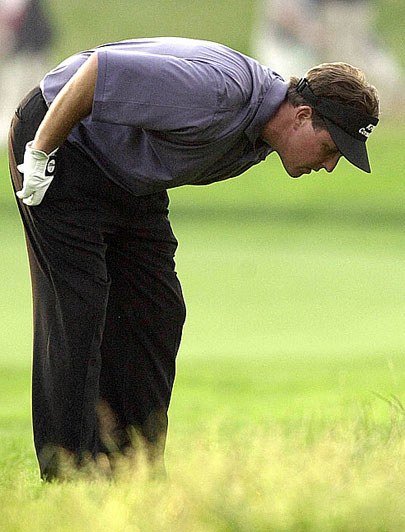
Phil making some rough calculations

First of all, ignore the yardage and take a club that will actually get the ball out of the rough. Obviously you don't want to hit the ball into a hazard because it didn't travel far enough, but neither do you want to leave it in the rough because it didn't travel at all!

Bill Schmedes III (the instructor featured in this article) also says you need to move the ball back in your stance at address. He specifically says "an inch and a half." It's nice when a teacher gives you a specific number. I suppose he means an inch and a half back of your normal ball position for the club you choose, not just an inch and a half back of center.

Coupled with the ball position change, he says to aim more to the right (for a rightie; more to the left for a leftie) because the rough will likely grab your club and cause a hook.

Finally he says to make sure you hit down on the ball. If you try to help it up, you'll come in too shallow and get too much grass between the ball and clubface. He has a short list of things that might help you do this more easily; you'll want to read the article and see which one will help you the most.

While few of us have to deal with fescue, thick rough is just a fact of life. This article should give you some tools -- and some hope -- for the next time you end up there.

Thursday, May 11, 2017

To 3-Wood or Not to 3-Wood? That's the Question...

And it's an interesting question: Just how useful is your 3-wood, really? Teachers Butch Harmon and Mackenzie Mack appear to have a difference of opinion, and Golf Digest has two articles that contrast their thoughts.

Butch Harmon hitting a 3-wood from the fairway

The older article, from Butch Harmon, is called Bench Your 3-Wood. Butch says the only time you should use your 3-wood from the fairway is when you can reach the green. Otherwise, he says you probably won't hit it well and should probably use your 5-wood instead. (I don't carry a 5-wood. My 7-wood has always been my magic wand when I'm in need, and that's my go-to club.)

Butch does say that, if you're going to use your 3-wood, position the ball a few inches inside your lead heel -- that is, closer to the center of your stance -- and make sure you get off your trailing foot during your downswing. (But if you're swinging that hard, so you're reverse-pivoting, maybe you should just lay up to a good wedge yardage instead. That's what I think.)

The newer article, from Mackenzie Mack, is called Three Shots You've Never Used Your 3-Wood For, But Should. Ironically, Mack seems to feel that your inability to hit a 3-wood well can be an advantage! At least, his three shots never get the ball very high off the ground.

He says you can use the 3-wood off hardpan because you just want to keep the ball low and get it rolling. He even wants you to set up to the ball as if it were a putt, so that sounds a bit like Butch's setup. (Personally, I'd be using my 7-wood here. I'd be more confident with it off hardpan.)

He also recommends you use the 3-wood to get out of the trees. Even if the grass is pretty thick. That's what he says, and it's because -- again -- you don't really want the ball to get up in the air in the first place. (You might want to practice that before you try it. I understand the logic, but from thick grass? That sounds iffy to me.)

And finally, he wants you to use the 3-wood to putt from the fringe. For this shot, he wants you to set up with the ball in the back of your stance, as if you were going to chip the ball. (So why not use a shorter club like a hybrid? Still, a 3-wood chip shot is a nice one to have in your arsenal, especially for long chips.)

As you can tell, I believe you should think twice before using your 3-wood anytime it isn't teed up, unless you have practiced with it and are confident using it. Especially if a poor shot might cost you more strokes than a decent shot will gain.

And if you're having trouble breaking 80 -- or even 85 -- that poor shot probably will. Play smart!

Wednesday, March 16, 2016

Pitching with a Restricted Backswing

Golf Magazine has a really neat tip in the April issue but I have been unable to find it on the website. Therefore I have no link for you. You'll just have to settle for my version of it.

Here's a picture of hockey legend Wayne Gretzky from his page at Wikipedia. See that split grip he uses on his hockey stick? (You righthanders just reverse the hands.) This is the key to this tip.

Wayne Gretzky

Let's say you've hit your ball into some trouble and you have a restricted backswing. Maybe a tree branch is in the way, or some other form of vegetation, or an immovable obstruction like an OB fence. The best you can do with your regular stroke is knock the ball a few feet... and that's not enough.

Try this hockey-style split grip. Obviously you won't split your hands as wide as Wayne holds his hockey stick, but you can split them to the ends of the grip. You open your stance and move the ball back to the middle of your stance, and your shoulders will be tilted much more than normal because your trailing hand is lower on the club. Then you just cock your wrists quickly and make a "slap shot" with your club.

This will take a bit of practice, but you just focus on really using your trailing hand while your lead hand keeps the club steady or even moves slightly backward. You can create a lot of speed this way, which will help you get more distance from that restricted backswing.

One caveat: Golf Magazine says you don't want to use this tip on a full swing.

Saturday, March 5, 2016

Butch Harmon on Hitting from a Sanded Divot

Butch Harmon is doing some new videos for Golf Digest. In this video Butch demonstrates how to hit from a divot full of sand.


It sounds simple enough, doesn't it? Three steps:
  1. Place the ball in the middle of your stance.
  2. Keep your hands a bit forward of the ball (lean the shaft forward).
  3. Make a steep downswing so you can hit down on the ball.
Bear in mind that this is one of the few times you really want to hit down on the ball. Hitting down on the ball makes it squirt out of the divot. (Under normal circumstances you want to come into the ball fairly shallow and catch the ball near the bottom of your swing arc. That gives you the most distance and height.)

Note also that Butch says the clubface will be a bit open. You don't have to change your grip to get that. It happens because you move the ball back in your stance and lean the shaft forward, which means you hit the ball before your club has time to square up completely. You might want to allow a little for that when you address the ball, but don't open your stance much. That's something you'll learn with experience.

And remember, this creates a lower squirting shot, so you probably don't want to try carrying hazards -- at least, not until you've hit this shot a few times and know what to expect.

Friday, June 12, 2015

Blair O'Neal on Hitting from the Wet Stuff

If you're having a lot of rain -- as much of the US is -- you're probably finding your ball in a lot of wet lies and you have no convenient place to take relief. Or even if you get relief, the ground is still soaked. Enter Blair O'Neal with another Sexiest Shots in golf, this one on hitting from a wet lie.


I suppose there's nothing really new here; there rarely is when it comes to fundamentals. Still, it's nice to hear things laid out as simply as Blair does here:
  • Take one extra club and grip down on it. You don't want to strain for distance.
  • Put 60% of your weight on your lead leg and keep it there throughout the swing. You need as accurate a strike as you can get, and you won't get it if you're moving off the ball.
  • Don't scoop the ball -- that is, don't flip your hands in an effort to get the ball up in the air. Your hands should be slightly ahead of the ball at impact... and they will be if you keep 60% of your weight on your lead side during the whole stroke.
  • Finish with your hands low. This shortens your swing a bit and makes it easier to keep your hands slightly ahead of the ball at impact.
Yeah, I know. It's simple stuff and you probably already knew it. But it's never bad to hear it again because we're human and we tend to forget things really easily.

Wednesday, January 14, 2015

Playing Out of a Divot

If you listen to the TV analysts enough, you're probably convinced that playing from a divot is soooooo hard. Well, it really isn't... and here's Aussie teaching pro Lorien Scott to tell you just how simple it really is.


Got that? You just move the ball back in your stance a bit and swing down more steeply. You'll take a bigger divot as a result.

Rough translation: You have to dig for it.

I think the most important thing to remember is WHY you have to do it this way. Because the ball is basically down in a hole, the bottom of the ball is lower than it is on a normal shot. That's the reason you have to go down more steeply -- you're digging it out.

And if you remember that, you'll realize that the same technique applies on almost any shot where the ball is nestled down in a hole. (If the ball is on top of the ground but sitting down in thick grass, that's more of a sand shot. Again, remember the difference and you'll make the right choice.)

One additional thought: When hitting out of a divot, you probably won't get quite as much distance. You'll probably need to take one more club to make your yardage. But use common sense -- if the divot is really deep, you may just need to take a wedge and be sure you get it out. Remember, dig it out.

See? It's not that difficult at all.