ATTENTION, READERS in the 28 EUROPEAN VAT COUNTRIES: Because of the new VAT law, you probably can't order books direct from my site now. But that's okay -- just go to my Smashwords author page.
You can order PDFs (as well as all the other ebook formats) from there.
Showing posts with label sand play basics. Show all posts

Friday, August 10, 2018

David Frost on Getting Out of Bunkers (Video)

This GC video, with David Frost's quick lesson on getting out of bunkers, was shot at St. Andrews in the Road Hole Bunker. But there's something you might misunderstand here, so let me point it out to you.


First David gives you some general strategy tips. You can get those yourself; they're pretty simple.

The steps to getting out of the bunker are equally clear.
  1. Turn the club in your hands, then take your grip. That way you'll be less likely to flip the club at impact.
  2. On your backswing, make sure the heel of the club gets up higher than the toe of the club.
  3. On your downswing, hit just behind the ball and don't flip the club.
That second part is what I think you might misunderstand. I bet you'll try to twist your forearms on the way back, to make sure you twist the heel over the toe. BUT YOU DON'T HAVE TO! If you grip the club with the face open, the heel will AUTOMATICALLY move above the toe when you swing back. You don't need to rotate your forearms at all to get the face in the correct position all the way through to the finish.

If you try to twist your forearms, you'll add inconsistency to your swing and make it harder to hit the sand properly with the sole of the club. As long as you keep turning your shoulders all the way through the shot, you don't need to twist your forearms at all.

David says this tip will help you get out of the bunker first time, every time. You may not always get the ball real close but, with just a little practice, your next shot will be a putt. For most of us, that's a major accomplishment!

Saturday, March 17, 2018

Stacy Lewis on Beating the High Lip Bunker

I've done a number of posts on bunker play but I think this is the first to focus on DEEP bunkers! Stacy Lewis did this great post for golfdigest.com that -- pardon the pun -- hits the high points.

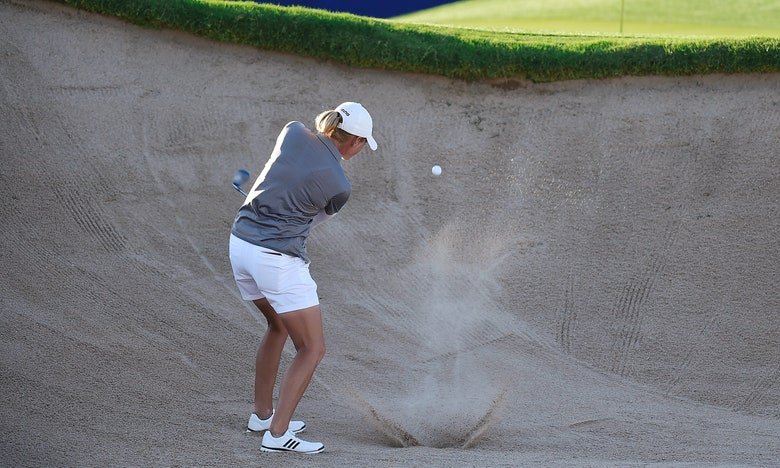
Stacy Lewis in a deep bunker

If you take nothing else from this post, remember this: The deeper the bunker is, the more sand you have to dig out. In a bunker you don't hit the ball, you hit the sand; and to make the ball go higher, you have to move a lot more sand with your wedge. Stacy gives a great drill to teach you how to get that extra sand moving!

Draw a four-inch diameter circle in the sand with your ball in the middle. Set up with the ball opposite your lead foot, then remove the ball. Dig your feet into the sand so you have a solid footing, then grip the club with an open clubface. (Remember that the open clubface won't send the ball out sideways because the clubface never touches the ball.)

Then she says to swing as if you're trying to stick your hands in your left pants pocket. (If you're a righty, that is. Lefties, stick it in your right pants pocket!) That's because you want to cut across the ball -- an out-to-in swing. This image will help you do that.

Finally, when you make that swing, try to take all of the sand out of that four-inch circle. And once you get the hang of doing that, put the ball back in the circle and watch that ball fly high and soft!

This is a beautifully simple drill for learning a shot that gives most players fits.

Friday, October 27, 2017

How Visualization Helps on the Beach

Instructor Will Robins has a new Golf Digest article on how to get out of the sand without practice. Sound interesting? Let's check it out.
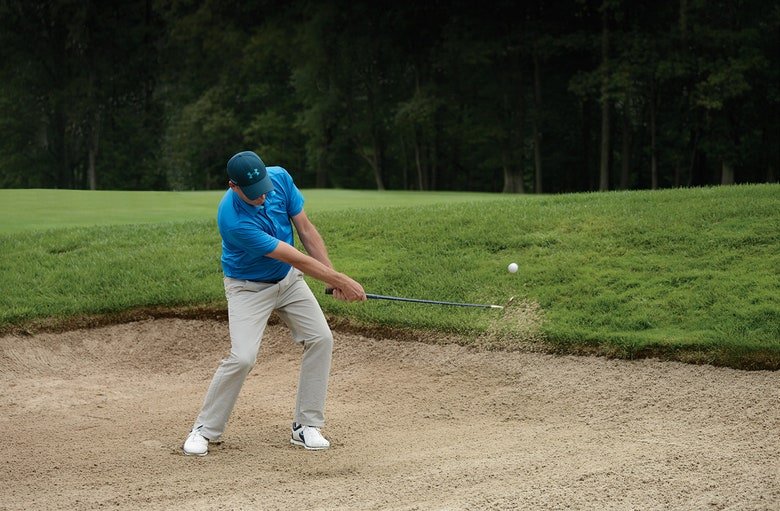
Will Robins hitting sand from a bunker

How can Robins make such a claim? Because he says your problem with bunkers isn't your technique. Rather, it's your fear of bunkers.

Alright, I'll bite on that. He says that when you're afraid you tense up, and that screws up your technique. If you just relax, your muscles will do what you know to do without a problem. After all, you can hit several inches behind the ball and still get it out of the bunker.

I'd like him to clarify that a bit. You can hit behind the ball and get it out of the bunker as long as there's a lot of sand in the bunker. If you're in a bunker with a thin lie or just hard sand, hitting too much behind the ball results in a skulled shot. Most of the time, that's not going to get you out.

So I think his advice here is good as long as you've got a standard lie in the sand. If there's some sand under the ball, his advice is probably going to help you... and he's right that you won't need much practice to make it work.

Since you can hit as much as three or four inches behind the ball when you've got a standard lie in the bunker, Robins suggests that you forget about the ball. Or to put it another way, since you don't have to hit the ball at all during a normal sand shot, why worry about what the ball does?

Robins wants you to use a visualization image: Throw a handful of sand onto the green with your club. That's it. You can practice your swing in the rough beside the bunker, making a nice swish that doesn't dig into the grass. Then just do that in the bunker, swinging hard enough to throw some sand onto the green.

The ball will just happen to fly out of the bunker as well.

I really like this advice. Rather than directly trying to attack the fear of leaving the ball in the bunker, Robins wants you to do something you KNOW you can do -- swing hard enough to throw some sand onto the green. From a standard lie, you don't even have to be particularly accurate with your entry point behind the ball to get both sand and ball out of the trap and onto the green.

Once you get over your fear of leaving the ball in the bunker -- however long that takes -- then you can worry about those thin lies. (To be honest, you might just try chipping from a thin lie. The ball's going to come out low anyway.)

In the meantime, just sling some sand onto the green. I bet you can do that just fine.

Thursday, September 28, 2017

David Leadbetter on Buried Lies from a Bunker's Upslope

Golf Digest (and David Leadbetter) did an article on how to dig your ball from a plugged lie on an upslope. The article is short but I'll summarize anyway.

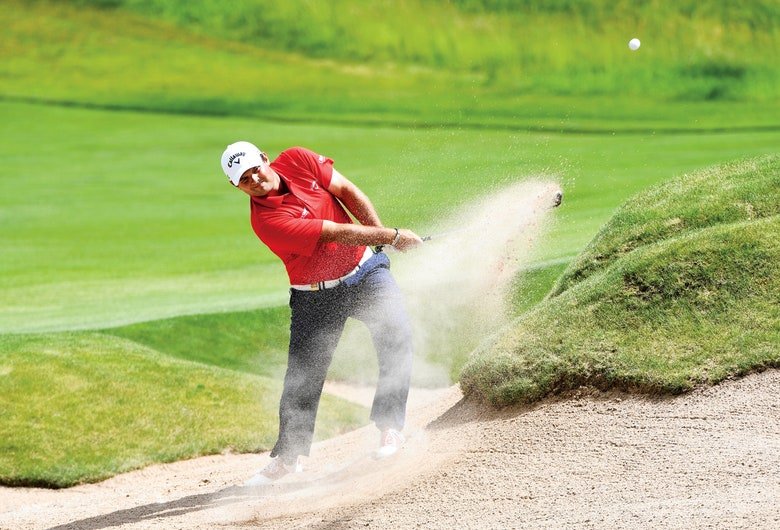
Patrick Reed from the bunker

When you're plugged in a bunker's upslope:
  • Square up the clubface. You don't need to open the face because you'll be swinging up anyway. Plus you want the front edge to dig in since the ball's buried.
  • Set your weight on your lead foot and lean forward a bit. You want to get steady footing on that upslope.
  • Swing aggressively down into the sand. You won't have much of a finish because you're digging into the sand with the front edge.
  • Step down the slope with your lead foot as the club hits the sand. The timing on this one can be a bit tricky, but it helps create more power to get the ball out of the sand. Besides, on some slopes you'll just naturally fall backwards...
You'll need a little practice to get the hang of this, but there aren't any special techniques you have to learn. Unless you count falling backwards without hurting yourself as a technique. ;-)

Saturday, July 15, 2017

An Old Sand Tip from David Leadbetter

I found this Leadbetter sand play tip in an old Golf Digest magazine from January 2013. (At least, that sure seems old!) There's no tricky setup or swing moves to learn.

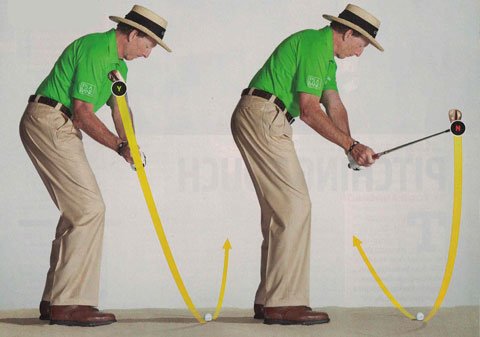
DAvid Leadbetter demonstrating sand techniques

The right side of the photo shows the way we're typically taught to play a sand shot -- open your clubface, open your stance, swing the club up sharply along your foot line (that's an out-to-in swing) and then try to "splash" the ball out of the bunker. Leadbetter says this leads to a steep downswing that digs in too deeply and makes sand play harder than it needs to be.

His alternative approach is shown on the left side of the photo. The setup is the same -- you still open the clubface and your stance -- but you play the ball farther forward in your stance (he doesn't say how much, but it shouldn't take much time to find a spot that works) and swing the club straight down your target line, not your foot line. This creates a slightly flatter attack angle when you hit the sand, which makes you less likely to dig too deep, and moving the ball a bit farther forward serves the same purpose.

You might wonder why you still open the clubface. Since the ball is farther forward in your stance, the clubface is going to close a bit more. If you were to set up with the clubface square to the target, you'd probably pull the shot.

This won't necessarily work for everybody. All of us have natural tendencies in our swings, and for some players this might result in a skulled shot. But if you've been having trouble getting out of the sand, this might be a technique you'll want to try.

Friday, November 18, 2016

Rob Strano on "Dancing" Out of the Sand (Video)

I HAD to post this. Rob Strano's GC video on how to use the "Carlton Dance" to play better bunker shots is just too good to miss!


Soft arms. Very soft arms. Soft enough that you let your elbows bend as you take the club back and then again as you swing through. Why is this good advice?

Because you want a steep swing that flattens out quickly at the bottom so the bounce on your sand wedge can glide through the sand. That's exactly what the super-soft arm action of the "Carlton Dance" allows you to do, almost without any conscious thought.

Some tips are just too cool to ignore. This is one of them.

Thursday, November 3, 2016

Martin Hall (and Gary Player) with a Sand Play Tip (Video)

First off, congratulations to the Illinois men and the Duke women on their victories at the East Lake Cup (And also congrats to the Chicago Cubs for breaking their 108-year win drought at the World Series!)

And now for a quick refresher on how to "strike the match" when you hit a sand shot. This Golf Digest video from Martin Hall is a couple of years old, but I like the way he teaches the "strike" in this one. I don't think I've ever actually HEARD the strike as clearly as I do in this one.


I would suggest you try this at home, using a plastic-covered cushion. That's what Hall is using; if you can find one of those old sleeping mats like the ones kids used for nap time in elementary school, that would be perfect. But any kind of cushion with a slick surface should work.

Once you can get that little "zipping" sound Hall gets, you've got this technique down.

Friday, September 2, 2016

Jeff Ritter on Practice Swings (Video)

This is another of Jeff Ritter's Instagram videos, this one about why you keep hitting shots fat. Although he focuses on chips and pitches here, it's just as true with your sand shots and your full swings.


Did you catch that? You may be practicing hitting the ball fat with your practice swings!

Jeff's right, of course. Most players make practice swings just to loosen up, without even thinking about what they're doing, and as a result their practice swings look nothing like their real swings. But that means you're practicing a swing you never intend to use! If you want to improve your contact, you have to start thinking about what you're doing.

So what does Jeff suggest? Simply that you make sure your practice swings duplicate the shot you want to make.
  • Set up beside the ball -- not close enough to accidentally hit it, of course -- and be sure your club is brushing the ground just past the ball.
  • Make sure the bounce of your club is grazing the grass and you're not digging into the ground. Again, decide what you want to do when you actually hit the ball. Digging a bit is okay if that's what you're after, but for most short shots it's not.
And let me add this about practicing your full shots. Make sure that you're following the same procedure. Make sure your practice swing makes contact with the ground so you'll take a small divot in front of the ball. And make sure it's a small divot -- a strip of bacon, not a strip steak, to borrow a popular image.

Jeff uses the phrase a more mindful rehearsal swing. That's what you want to make. Think before you make that practice swing -- make sure you're actually rehearsing the shot you want to make -- and your actual swings will get better.

Sunday, August 28, 2016

Charlie Rymer on Short Game Strategy (Video)

Saturday on Morning Drive, Charlie Rymer gave some very useful tips on scoring well on unfamiliar courses.

And trust me, this really is useful info that you rarely find all together in one place.

Charlie listed several things you need to find out when you play a new golf course and want to play it well quickly. These are things the pros find out very early when they're learning a new course.

First, there are different grasses that you'll see on greens. Each has certain characteristics you need to learn. As Charlie said, these are general rules. You may find exceptions but these are generally correct.
  • Bentgrass: Read the slope. Bentgrass greens don't have as much grain as other grasses, so although you need to check the slope on every type of green, slope is the most important influence on bentgrass greens.
  • Bermuda: Read the grain. Bermuda greens have a lot of grain to them, so much that it can counteract the slope somewhat. Grain generally grows toward the setting sun.
  • Poa annua: Grain goes downhill. The grain in poa tends to follow the flow of water running off the green. Uphill putts are slower than you think, downhill putts are faster than you think.
Then he talked about how the ball generally behaves in the rough.
  • Cool weather grasses: The ball will jump. The ball comes out of it a little faster.
  • Warm weather grasses: The ball will fluff. (This includes Bermuda.) That means it's hard to catch the ball solid, so it isn't likely to fly as far.
And finally, the type of sand in the bunkers.
  • Soft fluffy sand: Make a shallow attack. You need to use the bounce more or you'll take too much sand. And fried egg lies are more likely.
  • Firm sand: Make a steeper attack. You'll be using the front edge of the wedge a bit more, otherwise you'll bounce off the sand and catch the ball thin.
Very simple information that you rarely see in one place. Thanks, Charlie!

Thursday, June 30, 2016

Rickie Fowler Bunkered to His Knees (Video)

This video from Golf Digest featuring Rickie Fowler and Butch Harmon covers a shot you hope you never have to hit -- a plugged bunker shot from your knees. I've never seen a presentation on how to play this specific shot before, so I wanted to pass it on.


Note that Rickie can't go toward the hole if he takes a normal stance. Don't rule that possibility out too soon! If you have a better angle to the fairway than the hole, that might be your best play. But obviously Rickie is showing you how to play this bizarre shot, so let's get on with it.

I want to focus on the stance because that's the real key here. Here's a frame snagged from the video so you can follow what I'm saying.

Butch with Rickie on knees beside bunker

First, Rickie isn't down on both knees. I know there are numerous videos showing how to hit shots from your knees, but in this case -- a plugged ball -- you may lose your balance when the clubhead hits the sand. You have to move A LOT of sand to dig this plugged ball out. By going down on only one knee, you create a wider base so you stay steadier over the shot.

Note also that Rickie's TRAILING knee is the one on the ground. This helps you avoid any movement backward during your downswing, which might result in a fat shot that is more likely to leave the ball buried in the bunker. If you do move a little, you want to move toward the target, not away from it.

The extra 'twist' you can get from using your lower body this way also helps you get the ball out.

From there it's basically just chopping down on the ball with the club, like an ax chop. You want to hit just behind the ball, not way behind it -- remember, this shot is plugged. You may end up sticking the head of the club in the ground. That's okay, as long as the ball pops out.

Remember, there's some luck involved here. A plugged ball may not come out, no matter how perfectly you hit it. But Rickie's technique gives you the best chance of making your next shot a putt.

Sunday, June 12, 2016

Shortsided in a Greenside Bunker

Swing coach Jeff Ritter -- you may have seen him on GC, he's been on several times -- did this tip for getting out of a greenside bunker when you shortside yourself. Here's the link that Golf Digest posted with a verbal summary of the bunker shot, and I've embedded the Instagram video below.


Here's a quick summary of my own:
  • take the most lofted club in your bag
  • open the face
  • grip down so one finger is on the shaft
  • set up with the ball forward in your stance
  • make a short aggressive swing (choking down on the club keeps the ball from traveling too far)
The key here is to avoid decelerating during your downswing. Make an aggressive swing so the ball will get out of the bunker.

I would also point out that, in the video, Ritter is NOT opening his stance. This is something that teachers often disagree about. But the video is pretty clear: As long as you keep your swing speed up and hit an inch or two behind the ball, the sand should throw the ball out whether you open your stance or not. That should simplify your setup a bit!

Thursday, February 25, 2016

DRILL: Hitting Flop Shots with Your 7-Iron

There was a slightly longer version of this Golf Channel Academy lesson on Morning Drive either Tuesday or Wednesday, and it was such a neat drill that I wanted to post it. In order to help you get better at using the bounce on your wedges, GCA Lead Coach Justin Bruton has a drill where you hit flop shots with a 7-iron.

I know, it sounds preposterous. But watch the video and then I'll give you a few things to watch for when you set up and swing that should help you get the hang of this more easily.


First, in your setup:
  • Your stance is slightly open. Take a good look at the video -- SLIGHTLY open. The idea is to swing just a bit out-to-in; you're not setting up for a big sand shot.
  • The ball is positioned forward in your stance. It appears to be opposite your lead heel. I tested that setup and was able to consistently strike the ground from that position, so it should work fine for most of you.
  • Note that when you split your grip, your trailing hand touches the shaft. Again, don't get crazy -- just one finger on the shaft is fine.
  • Grip the club so the clubface is slightly open. That helps you use the bounce better.
Now, when you actually make the swing, the butt end of the club should point at or just ahead of your belly button when the clubhead hits the ground. That will guarantee that you're using the bounce but not flipping your hands at impact. Not enough hand action makes the leading edge dig into the ground; too much hand action gets the leading edge too high off the ground and makes you more likely to hit the ball thin.

And remember his caution: You probably WILL hit the ball thin the first few times you try this drill. You have to learn the rhythm of the swing. But once you get it, your pitching should improve dramatically.

Best of all, since it uses a regular club and not a training aid, you can use this drill to make a few practice strokes before you actually hit a pitch during your round if you feel a bit uncomfortable. It's hard to beat a drill that can help you right at your moment of need!

Saturday, January 2, 2016

Playing from Hard Sand

Alright, let's start the New Year with a tip for playing from packed or thin sand. This video is from Michael Breed and it makes playing from hard sand simple.


As you can tell, some of Breed's keys for this shot are similar to playing a pitch from a tight lie... but there ARE some differences. Let's summarize the process.
  • Pick a club with low bounce. Michael gives 7° as an example, but just pick a club with a smaller sole. If the bunker lip isn't too high and you've got a little green to work with, you might even want to try a pitching wedge or 9-iron.
  • As usual with a sand shot, you want the ball a bit forward in your stance -- say, a little inside your lead heel. But you don't want to open your stance as much. Michael says it's more closed but you might find it easier to think of setting up with a square stance, and just open up a bit if you need to.
  • You want to dig a bit with the lead edge -- that's why we take less bounce -- so you don't open the face as much. Michael has a good visual here. Out of soft sand you might open the face enough that a line drawn along the leading edge would point at your lead big toe. For this shot off hard sand, you want that line to point toward your lead HEEL. That's almost square to your target -- ALMOST BUT NOT QUITE.
  • You want to swing a little slower. Now, this should seem logical to you but I'll say it anyway: If your swing is slower, it has to be longer. Take a look at Michael's swing in the video and you'll see that it's almost a 3/4 swing.
  • Finally, all of this will result in a lower trajectory shot so you'll have to allow for a bit more roll after the ball hits the green.
I know that sounds like a lot to remember but most of it's just common sense once you understand how this shot differs from a 'soft sand' shot.

Sunday, December 6, 2015

Hitting High Soft Shots from the Rough

Today I have a short video from Golf Digest and Golf Magazine teacher James Sieckmann (he has his own golf academy as well). This video is on how to hit a high soft SPINNING shot from the rough... and Sieckmann says it works from the sand as well.


Sieckmann says the two keys are:
  • lower body stability
  • getting the speed from your arms and hands
Note that he's creating that lower body stability by bowing his legs a bit. That's not essential but it's a good way to learn how to turn your shoulders without excess leg movement. In swings this short, you don't need much lower body movement to create speed at impact. Also note that his knees DO move, but that's it -- they move, they don't drive. That's a key difference between proper use and overuse of the legs.

That second key is a classic swing technique -- most good short game players use classic technique in the short game because it makes it easier to get feel and control. Note that Sieckmann emphasizes that you have to start your downswing SLOWLY; speed happens late in the swing and is greatest JUST AFTER you've hit the ball. Also, as long as your shoulders continue to turn into your finish, you won't flip the clubhead with your forearms.

Creating clubhead speed in a short game swing should NOT take a lot of effort. If you're grunting when you hit a pitch shot, you're just trying way too hard!

Sunday, October 11, 2015

Fairway Bunker VS Greenside Bunker

I guess everybody saw Phil Mickelson hole out for eagle from the fairway bunker on the 12th during Friday's fourball matches. That shot got played over and over and over, especially because it came just a few holes after the notorious "lost two holes at once" ruling.

In case you missed it, here it is again:


Golf Digest did a short write-up about the shot, including some interesting instruction from instructor Kevin Weeks about the difference between a fairway bunker shot and a greenside bunker shot.

Why do most weekend players struggle so much with fairway bunker shots, even when they've heard so much instruction? Weeks says it's because they don't realize that you have to play fairway bunkers differently than greenside bunkers.

Phil Mickelson hits from fairway bunker at Presidents Cup

From a greenside bunker, you want to hit the sand first and let it throw the ball out onto the green. This is typically the shot that most instructors are teaching, simply because that's where most weekend players need to save strokes.

From a fairway bunker you need to hit the ball first and then the sand. If you hit the sand first, as in a greenside bunker, the ball will pop out high but fly short. That's okay if you have to get over a lip and have no other choice, but that's a lay-up shot. And if you hit the ball only, chances are good you'll skull it and maybe even leave it in the bunker.

For the fairway shot, Weeks suggests moving the ball slightly back of the center of your stance. (Of course, the ball would be forward of center for a greenside bunker.) Set your weight a bit on your lead foot and make a three-quarter swing so you don't move off the shot -- if your weight moves to your trailing foot, you're more likely to hit the sand first. He suggests this practice drill as well:
"To practice it, draw a line [in the sand of a fairway bunker] perpendicular to the target and make three or four practice swings where your divot is past the line. Then put a ball on the line and replicate the same feel."
Remember: For a fairway bunker shot, ball first then sand. For a greenside bunker shot, hit sand only. Even if you don't hit it like Phil, that should improve your chances of hitting the shot you intended.

Saturday, October 3, 2015

Using a Cup from the Sand to Help You Get in the Cup

The October issue of Golf Magazine has an unusual short game drill. Joe Hallett -- you may know him because he teaches Stacy Lewis on the LPGA -- mentions this drill as a way to help you hit better sand shots from greenside bunkers. It's on page 41 of the issue (and, if you have the Digimarc Discover app on your phone or iPad -- it's a freebie app, btw -- you can scan the photo there and see a demo video).

All you need is one large plastic drink cup. (Based on the photos in the mag, I'd guess it's a 9-ounce cup.)

Here's how you do the drill:
  • Drop your ball in the sand.
  • Set the cup over the ball, upside down. You don't put anything (like more sand) in the cup, you just want to cover the ball with the empty cup.
Hallett says the rim of the cup is about the right size for the amount of sand you want to 'take out' with your swing. And since the cup hides the ball, you'll tend to concentrate on the sand you want to hit.
  • Address the cup just as you would normally address the ball.
  • Then make your swing. Try to enter the sand just behind the back edge of the cup and exit the sand just past the front edge.
If you do it correctly, Hallett says that both the cup and the ball should land on the green.

Oh, and one other thing. He says you might want to find a part of the practice area where you'll get a little privacy. After all, it might look a bit strange to some folks...

Monday, September 7, 2015

Blair O'Neal on Escaping from a Fried Egg Lie

Now that Blair O'Neal is co-hosting GC's School of Golf while Sara Brown is out on maternity leave, I guess we have to take her golf tips even more seriously, don't we?

Well, let's get started right now. Here's another of her Sexiest Shots in Golf videos, this one demonstrating how to get out of a plugged (also called a fried egg) lie in a bunker.


Your primary thought is to use the bounce of your sand wedge, not the leading edge. Sounds easy when she does it, doesn't it? Here are her keys:
  • Stand a bit further away from the ball
  • Lower your hands by squatting a bit more
  • On your backswing, hinge your wrists aggressively
  • On your downswing, make a descending blow through the ball
  • Finish aggressively (keep your swing speed up)
You're using the bounce by making a flatter swing, making sure the shaft is nearly vertical -- not leaning forward -- when you hit the sand, and swinging fast enough to move the sand as well as the ball.

Like I said, sounds easy when she does it. You probably just need a little practice.

Friday, July 24, 2015

ATTENTION: Freebie Lessons Alert!

Okay, this is one of the more unusual freebie lesson plans I've seen done by any magazine, so I HAVE to share it with you.

Golf Magazine has put up a 30-day, 50-lesson plan they say can help you improve all areas of your game. They brought together 5 of their Top100 teachers -- Scott Munroe, Mike Adams, Kellie Stenzel, Mark Hackett and Jon Tattersall -- and they have put together this huge guide that covers everything from driving to iron play to putting to flexibility.

And they've made it available online FOR FREE. This link will put you on the first page of the lesson guide.

The 5 teachers who wrote the golf.com guide

Part of what I try to do on this blog is help you understand enough of the mechanics of various golf swings that you can recognize the difference between what will and what won't help you. It's why I always recommend that you have a filter, a single teacher or player whose techniques work for you -- and you KNOW they work for you -- so you have a framework to help sort things out.

Here is a sterling opportunity for you to put that information to work.

Sure, you may not need all of these drills. And many of them may not work for you. But this is an excellent chance for you to check out some other teachers' ideas and drills, all without spending a penny.

As Bubba would say, you're welcome. ;-)

Friday, May 8, 2015

Butch Harmon's Generic Sand Shot

Golf Digest printed a new article by Butch Harmon on how to hit a simple sand shot that will get you out of a greenside bunker most of the time. This explanation is so simple that I had to pass it on.


Butch says:
  • Turn the face of your sand wedge so it's about 20 degrees open, then take your grip.
  • Set up so the ball is opposite the heel of your lead foot. That means it's waaaay forward in your stance.
  • Put a little more weight on your lead side.
  • Hold the shaft of the club straight up and down, not leaning toward the target.
  • Then just make a half-backswing and hit the sand about two or three inches behind the ball. You're trying to throw the sand and the ball out of the bunker at the same time.
Butch also says you don't want to cut across the ball when you swing. Rather, swing toward the target and let the open club face take care of getting under the ball.

A very simple approach to a shot that makes many of us weekend players nervous. By all means, take a look at the article.

Friday, December 26, 2014

How to Match Your Sand Wedge to the Sand

I have an old book (2002) called Turn Three Shots into Two by PGA Master Instructor Bill Moretti. It's a book on various facets of the short game, and I found some info in the section on sand play that may be news to many of you.

While most of us focus on how to play from various types of sand, we don't always realize that we're having trouble playing from different types of sand because we have the wrong sand wedge for the job. I can tell you this from experience. For a long time I thought I couldn't play from the sand until I found out I had the wrong amount of bounce for the sand at my favorite course. Once I got the right wedge, I had no more trouble.

According to Moretti, when you choose a sand wedge you need to consider the type of sand on the courses you'll be playing, the weight of the club, and the way the wedge fits in with the rest of your set. The three main design variables that you need to consider are:
  • the loft (Moretti's specs are from 55 to 58 degrees, but now they can easily range from 52 to 64)
  • the bounce (typically from 8 degrees or low bounce, to 13 degrees or high bounce), and
  • the swingweight (D1 to D8 -- that's light to heavy -- although women's clubs can go down to C8 and I've seen men's clubs up to E2)
Swingweight is just a measure of how heavy the club head feels relative to the club's grip. A higher swingweight makes the club feel heavier at the top of the swing and slows down your change of direction.

Moretti makes the following recommendations:
  • If you play a variety of courses -- that is, many different types of sand -- you should stay in the middle of those ranges for loft and swingweight.
  • If you play mostly hard sand and elevated greens, pick a wedge with more loft (higher number), less bounce, and a lighter swingweight.
  • If you play mostly soft sand and heavy rough, pick a wedge with less loft (lower number), more bounce, and a heavier swingweight.
And those choices reflect the way you'll want to use your sand wedge:
  • In the softer sand you'll want to use the bounce more so you make a shallower swing to let the club head slide under the ball.
  • In the hard sand you use the bounce less so you make a steeper swing that's more like a chipping stroke.
Those are the basics. And of course there's no law that says you can carry one of each -- a high loft / low bounce wedge for short game shots off tighter lies, and a low loft / high bounce wedge for fluffier lies.

Just for the record, I originally had a 56-degree wedge with around 10 degrees of bounce. The problem was that my course had very soft sand. I went to a 52-degree wedge with 13 degrees of bounce and immediately started hitting good bunker shots.

Believe me, the right sand wedge is a truly miraculous piece of equipment.

Of course, it's possible you play something else, like a course with soft sand and deep bunkers. That would indicate a high loft / high bounce wedge, wouldn't it? But such a club is very specialized and might not get used enough to carry its weight in your set. Your local pro can get you fitted for what you need.

But at least now you know the basics of matching sand wedge to sand.