With Georgia Hall having won the Ricoh Women's British Open this past weekend, I thought it might be good to take a quick look at her swing. She did this video on driving for the LET.
I'm not going to focus on any specific tip from this video. Rather, I want you to notice what she calls this video -- "The Stable Drive." As she says, too many players move too much over the ball, and that makes it hard to get consistent and predictable hits.
Georgia's not talking about being immovable over the ball; she specifically says that she works on rhythm, which requires you to stay relaxed. We all tend to get so tight! We freeze over the ball during address, then we jerk around when we finally try to move and we wonder why we can't stay steady over the ball.
If we want to get better, we have to learn to relax and move freely during our swings. And as she says, trying to hit the ball too hard works against that. It's better to accept what feels like a little less clubhead speed at first while we learn how to "swing casual," to borrow an old Han Solo line, then just move a little quicker as we get more relaxed.
Hey, it worked for Georgia Hall. It couldn't hurt to try it, could it?

Showing posts with label balance in general. Show all posts
Showing posts with label balance in general. Show all posts
Tuesday, August 7, 2018

Wednesday, June 20, 2018
Jeff Flagg on Launching One 400 Yards (Video)
Almost three years ago I did a post about how 2014 long driving champ Jeff Flagg hits the long ball. Check that post out, by all means, but here's a video where Jeff demonstrates how to do it.
Jeff's three keys are:
Come on, give Jeff's advice a try. What have you got to lose... besides that short little dinky drive you hate?
Jeff's three keys are:
- Let your arms dictate club speed. He demonstrates this by throwing a rock sidearm.
- Open up your trail shoulder and remove all tension from your lead arm. You do this by letting your trailing elbow 'fly' -- that is, move away from your side during your backswing. This increases your swing arc, btw.
- Use the Flamingo Drill. Put all your weight on your lead foot, stand on the toe of your trail foot, and use your upper body to do most of the swing work -- just like throwing a rock sidearm. Please note that, although he's not trying to, he can't help but straighten his lead knee to "use the ground." This happens without conscious effort -- that's what Jeff wants you to understand.
Come on, give Jeff's advice a try. What have you got to lose... besides that short little dinky drive you hate?
Wednesday, December 20, 2017
Tommy Armour on the Purpose of Footwork
Today's quotes come from Tommy Armour, the three-time major winner who gained great fame as an instructor. I say "quotes" because I'm picking several bits from a chapter he wrote on footwork.
These thoughts come from How to Play Your Best Golf All the Time, from a chapter called Footwork, the Foundation of Best Golf:
First, he talks about the backswing. Note the boldface print -- I put that in to emphasize his main point.
These thoughts come from How to Play Your Best Golf All the Time, from a chapter called Footwork, the Foundation of Best Golf:
What prevents many ever learning correct footwork is the fact that they don't understand its purpose.Let me break here for a minute. Armour spends quite a bit of this chapter explaining the mistakes made by a player who "endeavors to make his body work his feet." I won't repeat all that. But bear in mind what you've read so far -- simply put, footwork is so simple that we tend to try too hard. Take the thoughts that follow as simply as you can!
The function of correct footwork is to get the body in the right place for the arms and hands to act with maximum precision and power, and with smoothness.
A great deal of confusion in teaching and learning footwork arises from the fact that the subject really is so simple that people just can't readily believe that there isn't a mysterious and complicated trick to it.
So, what generally happens is a complete reversal of logic; the player endeavors to make his body work his feet, instead of having his feet impel and direct the proper body action.
First, he talks about the backswing. Note the boldface print -- I put that in to emphasize his main point.
Your knees are a reliable index to correct footwork. On the backswing, the left knee moves until it is pointing to a point not too far behind the ball. The left knee is moved into this position by raising the left heel and getting a bit of a push from the inside of the sole of the left foot, but although those foot actions are the motivating elements, they are details I seldom mention when I'm teaching as I want to avoid all possible details. I have the pupils consider knee position as the indicator of proper footwork. When the left knee is in the position it should be at the top of the backswing, the footwork has been performed correctly.Now he talks about the downswing. He thinks instructions like opening your hips to face the target are counter-productive.
There's only one way to have the left foot function in getting the knee into the desired position, so if the pupil thinks of the result he must get, he doesn't need to worry about the details of cause.
When the right knee comes in toward the direction you're hitting, your right heel comes off the ground, and you're pushing the body around into perfect position for hitting. Your left side is bound to straighten up as your left knee straightens.That's a long quote, but the basic idea is clear, don't you think? Let me boil it down to one paragraph.
But, if you keep your right heel on the ground, it is physically impossible to get your right knee to play its proper part in the swing. Therefore, your entire right side -- the right shoulder and the right hip -- can't get into position for hitting.
The knee action in a good golf swing is practically identical with knee action in throwing a baseball.
The side that delivers the power -- the right side -- is put into position to deliver by correct footwork, and only by correct footwork can this position be attained.
There's a lot of confusion about how and when to get the left heel on the ground at the start of the downswing, but there needn't be. As the right side springs into action from the right foot up, the left heel will simultaneously go to the ground.
All you have to do is let the right side come into the shot by moving the right knee around toward the ball.
Point your lead knee behind the ball on your backswing, then point your trailing knee toward the ball on the downswing. Don't try to keep both feet flat on the ground; all you'll do is make it impossible to move your feet correctly. If you just think about where you want your knees to point, you'll move your feet properly.It doesn't get any simpler than that.
Friday, December 1, 2017
So Yeon Ryu's Favorite Drill
This is from a Golf Digest article called The Drill You Need When Your Swing Falls Apart. So Yeon calls it the Stomping Drill, which she says fixes a multitude of problems in your swing.

Do this drill with an iron and address the ball with your feet close together. Essentially you just step away from the target with your trail foot to start your backswing, then step toward the target with your lead foot to start your downswing. That's it.
So Yeon says it takes some practice so you have to start out slow. But she also says it will cure a lot of ills in your swing.
What do I like about it? If you do this properly, you won't slide your hips and tilt your spine during the drill. That causes problems in more swings than most players realize. Give the drill a try and see what you think.
Do this drill with an iron and address the ball with your feet close together. Essentially you just step away from the target with your trail foot to start your backswing, then step toward the target with your lead foot to start your downswing. That's it.
So Yeon says it takes some practice so you have to start out slow. But she also says it will cure a lot of ills in your swing.
What do I like about it? If you do this properly, you won't slide your hips and tilt your spine during the drill. That causes problems in more swings than most players realize. Give the drill a try and see what you think.
Wednesday, November 15, 2017
Learning from an Old Golf Swing (Video)
The swing belongs to none other than Walter Hagen. Hagen won two US Opens, four Open Championships and five PGA Championships (it was match play back then). Hagen is third on the list of all-time major winners, topped only by Nicklaus and Woods.
Why am I posting this? Because this video shows Hagen in Europe in 1928, which means he was using hickory shafts. Although the USGA okayed steel shafts in 1924, the R&A refused to allow them until 1929. That means the swing you see in this video was made with hickory shafts.
You may have seen a lot of weird-looking hickory swings, but you won't see that with Hagen. There's a lot you can learn from this sweet move!
A few notable things you might find consider:
Why am I posting this? Because this video shows Hagen in Europe in 1928, which means he was using hickory shafts. Although the USGA okayed steel shafts in 1924, the R&A refused to allow them until 1929. That means the swing you see in this video was made with hickory shafts.
You may have seen a lot of weird-looking hickory swings, but you won't see that with Hagen. There's a lot you can learn from this sweet move!
A few notable things you might find consider:
- Hagen starts his backswing with a slight forward turn of his hips. That makes the start of his backswing a reaction; he isn't starting from a "frozen" position over the ball.
- Note the full shoulder coil, almost Daly-esque in its length. There's no tension there!
- The footwork is very simple -- the lead heel comes up off the ground and is then replanted, his hips move back freely and he turns freely toward the target. There's no sway during his backswing, no exaggerated slide forward, no leaning backward at impact. He just "steps" to turn away from the target, then "steps" to turn toward the target. Very simple and natural-looking.
- Finally, just look at how relaxed he appears to be all the way through the swing. He's not straining for distance, although he was considered one of the longer hitters of his day. He just makes a long, rhythmic swing that moves pretty fast!
Tuesday, November 7, 2017
A Quick Look at Shanshan Feng's Swing (Videos)
Shanshan Feng (aka Jenny Money) has moved up to #3 in the Rolex World Rankings this week, less than a quarter point behind long-hitting Sung Hyun Park.. I thought it might be instructive to take yet another look at one of the simplest yet most effective swings in women's golf.
This first video shows her swing from straight on, and it includes a slo-mo view of her hands at impact.
And this second video shows her swing from a variety of angles.
Let me point out a few simple things you can learn from Shanshan -- simple things that you can put into action immediately.
And bear in mind that Shanshan is notorious for NOT PRACTICING. If you want a dependable swing that doesn't need a lot of attention, you could do a lot worse than copying Jenny Money!
This first video shows her swing from straight on, and it includes a slo-mo view of her hands at impact.
And this second video shows her swing from a variety of angles.
Let me point out a few simple things you can learn from Shanshan -- simple things that you can put into action immediately.
- Simple setup. Note that her lead wrist is bent a bit more than most teachers would recommend, but that's because she has the butt end of the shaft pointing at her belly button. In other words, she has the end of the shaft pointing at the center of her body, so it's pointing at her spine.
- She cocks the club a bit earlier than some players, but there's nothing contrived here. She just takes it back in a way that feels comfortable to her, so it's consistent.
- Her backswing isn't extremely long, even with a driver -- it looks more like a three-quarter swing -- but she gets a good shoulder turn and she doesn't slide away from the ball.
- Yes, she starts down by moving her hips forward... but no, she doesn't make some powerful forward thrust with her hips. Physics demand that your lower body has to move first in order to start your downswing, but Shanshan doesn't exaggerate the move. She just moves in a natural way, stepping from her trail foot to her lead foot as she turns toward the target.
- She really uses her hands, arms and shoulders, so her wrists uncock as she hits the ball. The shaft is pointing at her belly button at impact, just the way she set up to the ball. She isn't worried about getting her wrists in some special position; she just points the shaft straight at the ball.
- Her footwork is very simple during her downswing. Again, all she does is just step from her trail foot to her lead foot as her shoulders turn completely into her finish. Since she doesn't stop her shoulders from turning, the club doesn't flip over as she hits the ball. As a result, the ball flies pretty straight.
And bear in mind that Shanshan is notorious for NOT PRACTICING. If you want a dependable swing that doesn't need a lot of attention, you could do a lot worse than copying Jenny Money!
Thursday, March 16, 2017
Bobby Jones on Proper Weight Shift
I was rereading some of Sidney Matthew's collection of Bobby Jones's newspaper columns called Bobby Jones Golf Tips: Secrets of the Master and found this interesting tidbit about weight shift during the downswing. It's such a simple image that I thought I'd pass it on.
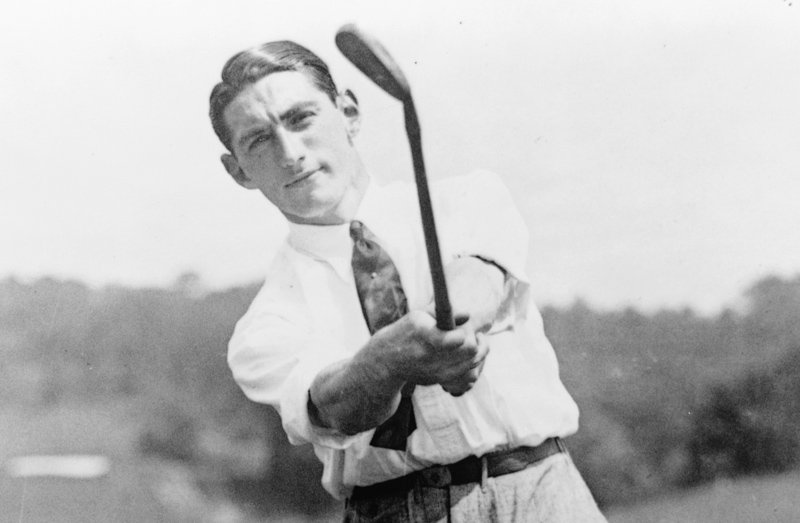
 The photo at right comes from the Royal Liverpool at Hoylake's history page. It shows Bobby Jones during his Open win there in 1930, and it shows exactly what Jones said in the article I read called On the Proper Method of Shifting Weight. Note that when Jones talks about the left leg, he means your lead leg. (So you lefties can mentally insert 'right leg.')
To drive upward on the downswing -- that is, straighten your lead knee --it follows that your lead knee has to bend on the backswing. What these two moves do is allow your hips and lower body to move freely during your swing without your upper body lurching around.
Now, how do you make sure you drive upward and don't lean forward? Jones says you "hold the shoulder back while the left hip goes forward." He means that your lead shoulder turns toward your lead heel, and that makes your weight shift properly. You aren't leaning backwards, folks -- you're just turning your upper body so your chest faces the target. (Take a good look at that photo!) This is a strong balanced move into the ball.
If you can't make this move without lurching forward, then you're trying to drive your legs too hard during your downswing. But once you get the hang of this balanced swing, you'll make better contact more often. Good swing mechanics never change...
We just forget how to keep our balance when we try too hard. ;-)
The photo at right comes from the Royal Liverpool at Hoylake's history page. It shows Bobby Jones during his Open win there in 1930, and it shows exactly what Jones said in the article I read called On the Proper Method of Shifting Weight. Note that when Jones talks about the left leg, he means your lead leg. (So you lefties can mentally insert 'right leg.')If we but examine the styles of different golfers, even with the naked eye, it is easy enough to tell whether the weight transference has been a sway or a shift. One characteristic of the proper body action, that is to say, the shift, is that the left leg is straight at and after impact. If you want to know why this is, you have only to look at the time, which marks the left side of the body. It has been lengthened, without lifting the head, by holding the shoulder back while the left hip goes forward. The characteristic of the sway, located again in the left leg, is a decided bend of the left knee in this same area. The entire weight of the body has been thrown forward. The shoulders coming forward also prevent the straightening of the left leg, and either the knee bends more or the player fall flat upon his face. [p94]I find this very interesting simply because Jones is writing around 1930 or so, yet he is saying the most obvious way to get a proper weight shift is to drive upward with your lead leg at impact so your lead hip and upper body don't move too far forward. Push up to move forward in your downswing properly. Sounds rather modern, doesn't it?
To drive upward on the downswing -- that is, straighten your lead knee --it follows that your lead knee has to bend on the backswing. What these two moves do is allow your hips and lower body to move freely during your swing without your upper body lurching around.
Now, how do you make sure you drive upward and don't lean forward? Jones says you "hold the shoulder back while the left hip goes forward." He means that your lead shoulder turns toward your lead heel, and that makes your weight shift properly. You aren't leaning backwards, folks -- you're just turning your upper body so your chest faces the target. (Take a good look at that photo!) This is a strong balanced move into the ball.
If you can't make this move without lurching forward, then you're trying to drive your legs too hard during your downswing. But once you get the hang of this balanced swing, you'll make better contact more often. Good swing mechanics never change...
We just forget how to keep our balance when we try too hard. ;-)
Sunday, March 12, 2017
I Bet You've Never Heard This "Secret" Before!
Everybody's always looking for a secret, a silver bullet that will give them THE KEY to a great golf swing. Today I've got one that I doubt you have ever heard before.
It comes from a 2004 book by John W. Barrett called Such a Little Secret. It centers around an old BBC broadcast of the Open Championship, with commentary by Peter Alliss and Henry Longhurst, where they discussed "The Secret" as it was being demonstrated by some player who Barrett couldn't remember.
Anyway, according to the Dynamic Duo, "The Secret" is illustrated by this diagram from the book:

To restate "The Secret" so both lefties and righties can use it, "Swing around a still trailing ear." To quote Barrett:
Still, some of you might find some use in this idea of swinging around your trailing ear. You won't reverse pivot or sway during your backswing if you use it, but your head will still have some freedom of movement. You won't drive too hard toward the target on your downswing because, if you do, your head will get pushed away from the target and you're going to fall over backward. And you'll finish in a balanced position -- you need only to look at the drawings above to see that.
So while I don't believe this is "The Secret" to good golf, I do think it's an image that might help some of you who are struggling to stay steady over the ball during your swing. Take it for what it's worth.
It comes from a 2004 book by John W. Barrett called Such a Little Secret. It centers around an old BBC broadcast of the Open Championship, with commentary by Peter Alliss and Henry Longhurst, where they discussed "The Secret" as it was being demonstrated by some player who Barrett couldn't remember.
Anyway, according to the Dynamic Duo, "The Secret" is illustrated by this diagram from the book:
To restate "The Secret" so both lefties and righties can use it, "Swing around a still trailing ear." To quote Barrett:
In any focus of concentration, the smaller the focal point the greater is one's sensitivity to it. To continue to use the word ear would do, and in a television broadcast it was probably a more genteel choice than use of the vernacular. Distilling the focal point down to the quarter inch diameter of the aural canal, however, will give a golfer a far sharper image in the mind than the more vague outline of the whole of the right ear. [p57]Look, am I saying that this is "The Secret" to fixing your golf swing? Absolutely not. I don't believe there's one technique that will make you the next Jason Day or Rory McIlroy. If there's a secret, it lies in relaxation, balance and rhythm.
Still, some of you might find some use in this idea of swinging around your trailing ear. You won't reverse pivot or sway during your backswing if you use it, but your head will still have some freedom of movement. You won't drive too hard toward the target on your downswing because, if you do, your head will get pushed away from the target and you're going to fall over backward. And you'll finish in a balanced position -- you need only to look at the drawings above to see that.
So while I don't believe this is "The Secret" to good golf, I do think it's an image that might help some of you who are struggling to stay steady over the ball during your swing. Take it for what it's worth.
Friday, February 24, 2017
"Feel" Fred Couples's Swing for 38 Seconds (Video)
The Champions Tour posted this video of EVERY full swing Fred hit on the back 9 at the Chubb Classic on Sunday. If you want to get a good sense of how smooth his swing is, this will definitely help.
Bear in mind that Fred hits the ball a long way WITHOUT shoving his hips way out ahead of his upper body. His spine doesn't bend backwards at impact. And he never looks to be straining.
Want to hit the ball better? Copying the rhythm and tempo of Fred's swing is a good place to start.
Every full swing from Fred Couples' Sunday back nine at the @ChubbClassic. pic.twitter.com/4WrmQeLxMq— PGA TOUR Champions (@ChampionsTour) February 23, 2017
Bear in mind that Fred hits the ball a long way WITHOUT shoving his hips way out ahead of his upper body. His spine doesn't bend backwards at impact. And he never looks to be straining.
Want to hit the ball better? Copying the rhythm and tempo of Fred's swing is a good place to start.
Friday, February 10, 2017
Want to Understand What a Swing Is? Here's One Way...
 I have a copy of the Ernest Jones book Swing the Clubhead, which was originally called Swinging into Golf when it came out in 1937. The book was an attempt to teach players how to swing like the classic players did, albeit while using steel-shafted clubs.
There's an interesting sequence of pictures in the book that shows Leo Diegel hitting balls while standing on only one foot. The pictures are very small and dark in the book, and I haven't been able to find copies of them on the web, but the concept is an interesting way to learn how to swing.
No doubt you've heard of the famous Jones teaching aid -- a pocket knife attached to a handkerchief. You can read a good explanation of how that works at this GolfWorx page. But the Diegel exercise might help you understand that handkerchief drill better than the drill alone will, so let me explain what Diegel did.
Diegel was right-handed, so Diegel swung while standing on his right foot (his trail foot). So you righties would stand on your right foot, while you lefties would stand on your left foot. The idea is to make a full swing, hit the ball solidly, and finish in a balanced position without your lead foot ever touching the ground. If you overuse your body, you won't be able to keep your balance and will have to put your lead foot down.
Start by hitting pitches and half-shots, then lengthen your swing as you get more confident. This will help you get your hands, arms and body in sync throughout your swing. And when you go back to your normal stance, you should be able to hit the ball longer and perhaps more accurately.
Jones says that Diegel was able to shoot in the low-70s playing this way. I assume he shot some practice rounds this way, in order to work on his rhythm and balance. It sure sounds like a lot more fun than some of the practice techniques I've seen.
Thursday, December 29, 2016
Paula Creamer's Anti-Sway Drill
Paula Creamer posted this on her Instagram account a couple weeks back. I actually found it through this Golf Digest article, where they (with help from instructor Jason Guss) tried to figure out exactly what she was trying to learn with it.
The whole idea of standing on an unstable surface to improve your footwork and balance is nothing new, of course; you can find any number of such drills from various instructors. But you don't often hear players say that they're doing these drills to improve their shoulder coil. (Note Paula's hashtags #thatshoulderturn and #thathipturn.)
The nice thing about this version of the drill is that it's a really cheap version. Many folks have (or know someone who has) extra bits of 2x4 laying out in the garage. And if not, a 2x4 is extremely cheap at a building supply store.
So here's yet another version of the balance drill you can add to your practice arsenal.
The whole idea of standing on an unstable surface to improve your footwork and balance is nothing new, of course; you can find any number of such drills from various instructors. But you don't often hear players say that they're doing these drills to improve their shoulder coil. (Note Paula's hashtags #thatshoulderturn and #thathipturn.)
The nice thing about this version of the drill is that it's a really cheap version. Many folks have (or know someone who has) extra bits of 2x4 laying out in the garage. And if not, a 2x4 is extremely cheap at a building supply store.
So here's yet another version of the balance drill you can add to your practice arsenal.
Wednesday, December 21, 2016
Jim Flick on the TWO Pendulums in Your Swing (Videos)
The late Jim Flick was well respected in the golf community. He was one of those teachers who seemed able to help almost anybody because he used such simple images to teach the basics.
In his book Jim Flick on Golf he gave a very simple explanation of how to use your hands and arms in a golf swing to create speed. I bet you've heard this explanation before but I'd also bet you didn't really understand it. Let's see if we can change that today. Here's how Jim put it in his book:
No doubt you've heard of an 'L-to-L' swing. It's a common way to learn pitching technique. You swing your hands back to waist high (an L with the club shaft pointing straight up), then they straighten out as the clubhead hits the ball, and finally they form another L in the followthrough (again, with the shaft pointing straight up). Here's Mike Malaska, who worked closely with Jim, demonstrating how this works.
Please note that Mike isn't trying to drive his lower body when he does this. The club's motion pulls his upper body around, and then his upper body pulls his lower body around. As you gradually get out to a full swing you'll start to use your legs more, but it'll be a very natural leg drive -- you won't be thrashing at the ball. (Mike refers to this added drive late in the video when he mentions "using the ground.")
Let me anticipate a question here: When you do this drill at waist high, your wrists will cock as your hands slow down at waist high. When you make this move in a full swing, your wrists will cock as your hands slow down near the end of your swing. It's the change of direction that creates the wrist cock. Got it?
Okay, here's a bonus video with Malaska teaching you how to use the L-to-L drill to learn shot shaping. I bet A LOT of you will be working with this one!
Using the L-to-L drill will help your swing in so many ways, including improved balance, better footwork and weight shift, and eventually longer distance for less effort. This is a post you'll want to bookmark in your browser and come back to again and again.
In his book Jim Flick on Golf he gave a very simple explanation of how to use your hands and arms in a golf swing to create speed. I bet you've heard this explanation before but I'd also bet you didn't really understand it. Let's see if we can change that today. Here's how Jim put it in his book:
There are actually two pendulums at work. The first is formed by the hands and wrists cocking, uncocking, and recocking. The second is created by the forearms and upper arms swinging from the shoulder sockets.Alright, the two pendulums are the one stretching from the clubhead to your hands, and the one from your wrists to your shoulder joints. Your wrist joins the two of them together, and act as the pivot point. When your wrists are fully cocked, the clubhead-to-hands-to-shoulder-joints stretch looks like an L shape.
My former colleague from Golf Digest school days Peter Kostis called them the first swing and the second swing. I think of them as two pendulums.
What permits the two pendulums to work together is the combination of the weight in club head, centrifugal force, the good old law of gravity -- and the golfer. These pendulums supply about 80 percent of the distance in your golf shot -- provided the swinging elements of your body drive the turning elements and not vice versa.
If your grip pressure is too tight, the weight at the end of the club is restricted from doing its job.
If you try consciously to turn your shoulders and shift your weight, you destroy the natural harmony of those two pendulums.
If you try to accelerate at impact and follow through, well, you know what happens there. [NOTE: This is a reference to an earlier section in the book. If you TRY to accelerate, you interfere with the natural motion and actually lose clubhead speed.]
But if your posture is good, and your grip pressure -- fingers secure, arms relaxed -- is correct, you give those two pendulums a chance to work in harmony. (p58-59)
No doubt you've heard of an 'L-to-L' swing. It's a common way to learn pitching technique. You swing your hands back to waist high (an L with the club shaft pointing straight up), then they straighten out as the clubhead hits the ball, and finally they form another L in the followthrough (again, with the shaft pointing straight up). Here's Mike Malaska, who worked closely with Jim, demonstrating how this works.
Please note that Mike isn't trying to drive his lower body when he does this. The club's motion pulls his upper body around, and then his upper body pulls his lower body around. As you gradually get out to a full swing you'll start to use your legs more, but it'll be a very natural leg drive -- you won't be thrashing at the ball. (Mike refers to this added drive late in the video when he mentions "using the ground.")
Let me anticipate a question here: When you do this drill at waist high, your wrists will cock as your hands slow down at waist high. When you make this move in a full swing, your wrists will cock as your hands slow down near the end of your swing. It's the change of direction that creates the wrist cock. Got it?
Okay, here's a bonus video with Malaska teaching you how to use the L-to-L drill to learn shot shaping. I bet A LOT of you will be working with this one!
Using the L-to-L drill will help your swing in so many ways, including improved balance, better footwork and weight shift, and eventually longer distance for less effort. This is a post you'll want to bookmark in your browser and come back to again and again.
Tuesday, June 30, 2015
A Quick Look at Na Yeon Choi's Swing
Na Yeon Choi is 5'5" tall and averages just over 252 yards off the tee. That's 56th on the LPGA, which is considerably better than average.
She also hits over 73% of her fairways, which puts her 75th. That would be incredible on the PGA Tour but it's just average on the LPGA.
Since she won in Arkansas on Sunday, I thought I'd do a quick post about her swing -- in particular, something that I think is a real strength of hers. This is a short video, only 35 seconds long, but it shows her swing several times and gradually slows it down. It's just a face-on view but it's recent and it shows what I want you to see.
NYC's swing, like that of most of the Korean players, is very simple and mechanically sound. But I want you to notice how balanced, how rhythmic, how smooth it is. Although she's hitting it pretty hard -- and developing quite a bit of swing speed in order to hit the ball as far as she does -- she doesn't appear to be going at it that hard at all.
The reason is that she avoids exaggeration. By that I mean that she doesn't make big dramatic moves when she doesn't need them. She's not moving off the ball on her backswing, she's not lurching forward at impact, and she doesn't squat down dramatically and then jump up off the ground in an effort to create more swing speed.
What she's doing is using her club as a tool. She swings it and lets it do the work of launching the ball. It's entirely proper to say that she NAILS the shot because she uses her club like a hammer. She can do this because, although she's swinging as fast as she can, she's trying to keep her muscles relaxed throughout the swing. Relaxed muscles can move faster than tight muscles, and she doesn't have to lurch back and forth because almost all of the energy is going into the club.
If you've ever swung a tennis racket or thrown a Frisbee™, you know this feeling. There's a sense of... let me call it "gathering yourself" as the top of your backswing. It's not really a pause because you don't stop moving. It's just a moment in your swing when you change direction.
If you exaggerate your lower body movement when you start down, you'll destroy this feeling. I often recommend that you try to feel as if you were falling from the top of your backswing, literally just relaxing your legs so both feet are planted solidly on the ground and your hips automatically move forward a bit. If you don't interfere with the start of your downswing, your lower body WILL start your move into the ball; it's physically impossible to change direction any other way.
Watch Na Yeon Choi's swing a few times, try to imagine what it feels like, and then try to duplicate it. Imitation is one of the easiest ways to learn tempo and speed.
She also hits over 73% of her fairways, which puts her 75th. That would be incredible on the PGA Tour but it's just average on the LPGA.
Since she won in Arkansas on Sunday, I thought I'd do a quick post about her swing -- in particular, something that I think is a real strength of hers. This is a short video, only 35 seconds long, but it shows her swing several times and gradually slows it down. It's just a face-on view but it's recent and it shows what I want you to see.
NYC's swing, like that of most of the Korean players, is very simple and mechanically sound. But I want you to notice how balanced, how rhythmic, how smooth it is. Although she's hitting it pretty hard -- and developing quite a bit of swing speed in order to hit the ball as far as she does -- she doesn't appear to be going at it that hard at all.
The reason is that she avoids exaggeration. By that I mean that she doesn't make big dramatic moves when she doesn't need them. She's not moving off the ball on her backswing, she's not lurching forward at impact, and she doesn't squat down dramatically and then jump up off the ground in an effort to create more swing speed.
What she's doing is using her club as a tool. She swings it and lets it do the work of launching the ball. It's entirely proper to say that she NAILS the shot because she uses her club like a hammer. She can do this because, although she's swinging as fast as she can, she's trying to keep her muscles relaxed throughout the swing. Relaxed muscles can move faster than tight muscles, and she doesn't have to lurch back and forth because almost all of the energy is going into the club.
If you've ever swung a tennis racket or thrown a Frisbee™, you know this feeling. There's a sense of... let me call it "gathering yourself" as the top of your backswing. It's not really a pause because you don't stop moving. It's just a moment in your swing when you change direction.
If you exaggerate your lower body movement when you start down, you'll destroy this feeling. I often recommend that you try to feel as if you were falling from the top of your backswing, literally just relaxing your legs so both feet are planted solidly on the ground and your hips automatically move forward a bit. If you don't interfere with the start of your downswing, your lower body WILL start your move into the ball; it's physically impossible to change direction any other way.
Watch Na Yeon Choi's swing a few times, try to imagine what it feels like, and then try to duplicate it. Imitation is one of the easiest ways to learn tempo and speed.
Sunday, June 7, 2015
Bobby Jones on Proper Weight Shift
Sometimes you read something a dozen times before it suddenly jumps out at you. That was the case for me today. I was rereading a piece from Bobby Jones Golf Tips: Secrets of the Master by Sidney Matthew, a piece called On the Proper Method of Shifting Weight, and suddenly realized how simply it explained something that many of you are struggling with.
I can't quote the whole thing here; it's three pages long. But I'll give you the key thought that struck me so hard.
Jones notes that most amateur golfers can't really distinguish between a "shift" (which they've been told to do) and a "sway" (which they've been told they must avoid). Then he makes a most interesting statement:
How can this be?
Well, what you feel during the backswing is a change in the muscles of the trailing leg. It's an increase in tension rather than a shift of weight. But that doesn't explain how you make a shift forward during the downswing. Wouldn't that destroy your balance?
Not according to Jones. First of all he says that most good players stand more erect at address so they can turn more easily. (You may recognize this advice. Tiger has a tendency to squat a bit at setup and it doesn't allow him to turn easily, according to the analysts.) Jones further says that the weight should be pretty evenly divided between the player's feet.
The key is his description of the downswing:
Now how do you make that small move? Jones says:
This tip should work for almost all of you, no matter what type of swing you have. I have to say "almost" because if I don't, somebody will write and tell me it didn't work for them. We're human so it's rare that anything works exactly the same for everybody. But I bet it'll work if you try it.
Here's the key to remember: If you can't keep your head and shoulders steady, you're either trying to do too much with your legs or you're too bent over at address... or both. When I do it properly, I actually feel as if I'm focused on turning my shoulders toward the ball to start my downswing -- it's almost impossible NOT to turn my hips when I do that. (Think of making a tennis stroke. You don't think about turning your hips; you think about getting the racket to the ball.) It's actually a move that we make naturally in most sports because we don't worry about it so much.
Give Bobby's advice a try. I bet it will help you make a better smoother swing.
I can't quote the whole thing here; it's three pages long. But I'll give you the key thought that struck me so hard.
Jones notes that most amateur golfers can't really distinguish between a "shift" (which they've been told to do) and a "sway" (which they've been told they must avoid). Then he makes a most interesting statement:
Let me begin by saying that although I have in the past inclined toward a different view, it is now my definite opinion that there need be no shifting of weight from left foot to right during the backstroke. I have examined numbers of photographs of the very best players and I have been able to find no case in which such a shift was perceptible. But there should occur during the hitting stroke a quite pronounced shift from the right to the left, a shift which does not follow the club or pass smoothly along coincident with its progress, but which is executed quickly and leads the arms and club all the way through. (p92)This is really quite an amazing statement. When he says the weight does NOT shift from the lead foot to the trailing foot during the backswing, he means there is no attempt to move the position of your body backward away from the target. However -- and this is important -- there IS a noticeable shift from the trailing foot to the lead foot during the downswing.
How can this be?
Well, what you feel during the backswing is a change in the muscles of the trailing leg. It's an increase in tension rather than a shift of weight. But that doesn't explain how you make a shift forward during the downswing. Wouldn't that destroy your balance?
Not according to Jones. First of all he says that most good players stand more erect at address so they can turn more easily. (You may recognize this advice. Tiger has a tendency to squat a bit at setup and it doesn't allow him to turn easily, according to the analysts.) Jones further says that the weight should be pretty evenly divided between the player's feet.
The key is his description of the downswing:
The downswing or hitting stroke presents another picture. There is a shift here, but there is no sway, and the difference is what the average golfer wants to understand. It is this: The weight shift which is proper is a shift of the hips -- a lateral movement of the middle part of the body which does not alter the position of the head and shoulders. The sway, which is entirely improper, is a forward motion of the entire body, which sends the head and shoulders forward too, and tends to upset the player's balance. (p93, emphasis mine)Now this sounds like a typical description of a forward weight shift until you take his description of the backswing into account. If you don't move your body backward during the backswing, there is no need to move it forward during the downswing... and, more importantly, it means that the "lateral movement of the middle part of the body" is a relatively small movement compared to the one we normally try to make.
Now how do you make that small move? Jones says:
If we but examine the styles of different golfers, even with the naked eye, it is easy enough to tell whether the weight transference has been a sway or a shift. One characteristic of the proper body action, that is to say, the shift, is that the left leg is straight at and after impact. (p94)When he says the lead leg is straight, he means perpendicular to the ground. (Some players may have a slight bend in the lead knee; that's okay.) And he says this is the result of the lead side "lengthening" during impact by the hip moving forward without the head and shoulders having to move. That's the "pushing up at impact" move so many teachers tell you will create power. It creates the "extension" that Martin Hall says you should get after impact -- you know, when he says your chest should be pointed slightly skyward at the finish. It's how you "use the ground" during your swing.
This tip should work for almost all of you, no matter what type of swing you have. I have to say "almost" because if I don't, somebody will write and tell me it didn't work for them. We're human so it's rare that anything works exactly the same for everybody. But I bet it'll work if you try it.
Here's the key to remember: If you can't keep your head and shoulders steady, you're either trying to do too much with your legs or you're too bent over at address... or both. When I do it properly, I actually feel as if I'm focused on turning my shoulders toward the ball to start my downswing -- it's almost impossible NOT to turn my hips when I do that. (Think of making a tennis stroke. You don't think about turning your hips; you think about getting the racket to the ball.) It's actually a move that we make naturally in most sports because we don't worry about it so much.
Give Bobby's advice a try. I bet it will help you make a better smoother swing.
Friday, February 13, 2015
John Daly's Balance
Nothing complex today. I just thought that, since John Daly shot his best score on the PGA Tour in around 10 years Thursday, you all might like to be reminded why he's still so good at 48 years old. Just take a look at his balance in this slo-mo swing from the 2014 Turkish Airlines Open Pro-Am, roughly 3 months ago.
Despite that long swing -- it doesn't look like it's shortened any at all over the years, does it? -- he still manages to stay balanced and swing smoothly. A smooth balanced swing makes it easier to make solid contact consistently. Just watch and absorb!
Despite that long swing -- it doesn't look like it's shortened any at all over the years, does it? -- he still manages to stay balanced and swing smoothly. A smooth balanced swing makes it easier to make solid contact consistently. Just watch and absorb!
Friday, November 14, 2014
Adding a Little Seve to Your Game
Originally I planned to use some actual video of Seve from YouTube for this post but I wasn't happy with the quality of what I found. At least, not for what I wanted to cover today.
Rather than specific swing techniques, I wanted to give you an idea of how Seve approached all of his shots. For Seve, shotmaking was as much a mindset as it was a set of techniques. So I've pulled a couple of videos -- one by Johnny Miller that focuses on full swings and a second one by Martin Hall that focuses on short game swings. First, heeeeeere's Johnny!
And then here's Martin Hall with an "extra credit" video from School of Golf.
The first thing you should notice is that Seve wasn't rigid in his setup, regardless of whether he was making a full swing or a short swing. (He did stand fairly still when he putted, but most putter strokes are so short that you won't move much anyway.) Seve was very relaxed and allowed his knees to move more than most players. That's part of how he got short shots to land softly and managed to curve his full shots more easily. His whole body moves, not just certain parts of it.
Second, Johnny notes that Seve's backswing was always the same -- it was the followthrough that he changed to create shots. Seve was a little wild at times because he was maneuvering the ball by changing the club face during his downswing, not because his backswing was inconsistent. If his backswing was constantly changing, he wouldn't have been able to keep the ball on the course!
Finally, both Johnny and Martin note how much Seve was using his hands and arms to create shots; his lower body moved in response to how he moved his hands and arms, not the other way around. This is how Bubba does it as well; he decides what he wants the club face to do and how his hands and arms should move to get that result. Then he focuses on swinging that way and he lets his subconscious mind take care of sequencing the rest of his body.
This is more of a "reactive" way to swing, the same way we play tennis or baseball or anything else -- we focus on the ball and what we want our hands to do with it, not on what our feet and legs are doing. This is the "natural" way to swing a golf club, and consequently it's the way we can best "feel" when we make a good swing.
All of this is more of a classic swing mindset than a modern swing mindset. It's based on motion and target, not on positions and angles. Although it sounds a bit strange at first, it's really easier once you stop thinking of a golf swing as being different from any other sort of swing. And if you'd like to become a bit more Seve-like in your game, this is the starting point.
Rather than specific swing techniques, I wanted to give you an idea of how Seve approached all of his shots. For Seve, shotmaking was as much a mindset as it was a set of techniques. So I've pulled a couple of videos -- one by Johnny Miller that focuses on full swings and a second one by Martin Hall that focuses on short game swings. First, heeeeeere's Johnny!
And then here's Martin Hall with an "extra credit" video from School of Golf.
The first thing you should notice is that Seve wasn't rigid in his setup, regardless of whether he was making a full swing or a short swing. (He did stand fairly still when he putted, but most putter strokes are so short that you won't move much anyway.) Seve was very relaxed and allowed his knees to move more than most players. That's part of how he got short shots to land softly and managed to curve his full shots more easily. His whole body moves, not just certain parts of it.
Second, Johnny notes that Seve's backswing was always the same -- it was the followthrough that he changed to create shots. Seve was a little wild at times because he was maneuvering the ball by changing the club face during his downswing, not because his backswing was inconsistent. If his backswing was constantly changing, he wouldn't have been able to keep the ball on the course!
Finally, both Johnny and Martin note how much Seve was using his hands and arms to create shots; his lower body moved in response to how he moved his hands and arms, not the other way around. This is how Bubba does it as well; he decides what he wants the club face to do and how his hands and arms should move to get that result. Then he focuses on swinging that way and he lets his subconscious mind take care of sequencing the rest of his body.
This is more of a "reactive" way to swing, the same way we play tennis or baseball or anything else -- we focus on the ball and what we want our hands to do with it, not on what our feet and legs are doing. This is the "natural" way to swing a golf club, and consequently it's the way we can best "feel" when we make a good swing.
All of this is more of a classic swing mindset than a modern swing mindset. It's based on motion and target, not on positions and angles. Although it sounds a bit strange at first, it's really easier once you stop thinking of a golf swing as being different from any other sort of swing. And if you'd like to become a bit more Seve-like in your game, this is the starting point.
Wednesday, June 11, 2014
Martin Hall's "X Marks the Spot" Knee Drill
Today I've got one of those extra videos that Martin Hall and Holly Sonders do for School of Golf. This one is a drill to help understand what correct knee movement looks like. See the X in the screen grab below? That's just two clubs laid on the floor.

The shafts of the clubs show you how your knees should move during your golf swing. Here's the video:
If you're having trouble with your forward weight shift or a reverse pivot, this drill can help you identify where the problem is and give you a visual aid to correcting the move. Not bad for such a simple drill.
If for some reason the video didn't embed properly in this post, you can find the original here.
The shafts of the clubs show you how your knees should move during your golf swing. Here's the video:
If you're having trouble with your forward weight shift or a reverse pivot, this drill can help you identify where the problem is and give you a visual aid to correcting the move. Not bad for such a simple drill.
If for some reason the video didn't embed properly in this post, you can find the original here.
Friday, November 22, 2013
Getting Your Spine Tilt at Impact Correct
I found this video by Brian Manzella over at the GOLF Magazine site and was absolutely fascinated by the concept it teaches. (Manzella is one of their Top100 teachers.) Here, take a look at it and then I'll discuss it. (And if the video didn't embed properly, just click on the link at the beginning of this paragraph. That will take you to the original video at golf.com.)
One of my pet peeves on this blog and in my books is the way weekend golfers tilt their spines away from the ball too much during their downswing. As a result, they tend to hit push-slices. Manzella talks about that, and then suggests the drill in this video to help prevent it.
The whole idea of using the position of your lead hand and lead knee to prevent this problem is a creative one. It forces you to push your lead hip back, away from the ball, as you make your downswing rather than sliding it toward the target and leaning away from the target. Instead, as your lead knee moves toward the target, you're forced to keep your head and shoulders more over the ball.
But it does more. If you keep your lead hand on or close to your lead knee, you won't stand up during your downswing. That means you keep your knee flex and therefore keep your distance from the ball more consistent throughout your swing. No more thin shots!
Try doing the drill a few times without hitting balls; you're just trying to get a feel for your body position as you near impact. Next, take your normal grip and make some easy practice swings while feeling you're swinging with the same posture. Finally, try to hit a few balls this way. Again, please start off swinging easy; you may have some balance problems at first if you've been standing up during your downswing.
This may feel really awkward at first, but it should help you learn to keep your spine angle more consistent throughout your swing... and that should translate into more solid shots.
One of my pet peeves on this blog and in my books is the way weekend golfers tilt their spines away from the ball too much during their downswing. As a result, they tend to hit push-slices. Manzella talks about that, and then suggests the drill in this video to help prevent it.
The whole idea of using the position of your lead hand and lead knee to prevent this problem is a creative one. It forces you to push your lead hip back, away from the ball, as you make your downswing rather than sliding it toward the target and leaning away from the target. Instead, as your lead knee moves toward the target, you're forced to keep your head and shoulders more over the ball.
But it does more. If you keep your lead hand on or close to your lead knee, you won't stand up during your downswing. That means you keep your knee flex and therefore keep your distance from the ball more consistent throughout your swing. No more thin shots!
Try doing the drill a few times without hitting balls; you're just trying to get a feel for your body position as you near impact. Next, take your normal grip and make some easy practice swings while feeling you're swinging with the same posture. Finally, try to hit a few balls this way. Again, please start off swinging easy; you may have some balance problems at first if you've been standing up during your downswing.
This may feel really awkward at first, but it should help you learn to keep your spine angle more consistent throughout your swing... and that should translate into more solid shots.
Sunday, October 20, 2013
How Your "Love Handles" Affect Your Shots
Okay, technically your obliques aren't the same as your love handles. Your oblique muscles are underneath the fatty rolls we call love handles. But if you've got love handles, there's a good chance your obliques are a little weak... and that can affect your swing.
I've got a couple of articles that can help you identify the problem and strengthen the muscles.
The first article is a post from Golf Digest's Instruction Blog called Activate Your Obliques for a Better Swing. GD's Fitness Editor Ron Kaspriske talked to Dave Phillips and Greg Rose -- the guys you see every week on GC's Titleist Performance Institute show -- about how weak obliques and weak glutes combine to affect your swing. One of those affects is the notorious reverse pivot, and the TPI guys show you how to test for weak obliques and give you a simple exercise to help strengthen them. The photo to the right is from that post.
But I know some of you will want more, perhaps even a full plan to help really build your core strength. For that I found an article over at military.com called Lose the Love Handles. The author, Stew Smith, was a Navy SEAL and is a fitness author certified as a Strength and Conditioning Specialist (CSCS) with the National Strength and Conditioning Association. (That means he's a trustworthy source of info, folks!) Smith, like Phillips and Rose, works the obliques and legs together.
The article is fairly long but the part you'll be interested in (a little over halfway down the page) is the Tuesday and Friday workout for the legs and love handles. You may not want to follow his workout precisely but it will give you an idea about what exercises are most effective for working these two areas.
And just a bit below that is a list of exercises for building the core, especially the stomach and lower back, if you're interested.
With winter just around the corner, now might be a good time to begin some simple core work to get ready for next year. These articles can get you started.
I've got a couple of articles that can help you identify the problem and strengthen the muscles.
The first article is a post from Golf Digest's Instruction Blog called Activate Your Obliques for a Better Swing. GD's Fitness Editor Ron Kaspriske talked to Dave Phillips and Greg Rose -- the guys you see every week on GC's Titleist Performance Institute show -- about how weak obliques and weak glutes combine to affect your swing. One of those affects is the notorious reverse pivot, and the TPI guys show you how to test for weak obliques and give you a simple exercise to help strengthen them. The photo to the right is from that post.
But I know some of you will want more, perhaps even a full plan to help really build your core strength. For that I found an article over at military.com called Lose the Love Handles. The author, Stew Smith, was a Navy SEAL and is a fitness author certified as a Strength and Conditioning Specialist (CSCS) with the National Strength and Conditioning Association. (That means he's a trustworthy source of info, folks!) Smith, like Phillips and Rose, works the obliques and legs together.
The article is fairly long but the part you'll be interested in (a little over halfway down the page) is the Tuesday and Friday workout for the legs and love handles. You may not want to follow his workout precisely but it will give you an idea about what exercises are most effective for working these two areas.
And just a bit below that is a list of exercises for building the core, especially the stomach and lower back, if you're interested.
With winter just around the corner, now might be a good time to begin some simple core work to get ready for next year. These articles can get you started.
Tuesday, October 8, 2013
Warming Up for the Big Drive
I found this little video by LPGA/PGA instructor Lee Huntley over at golftipsmag.com, and I think it's pretty cool. It's a quick warm-up you can use before you hit a drive. It both improves your flexibility and helps you make a more balanced swing.
I like this drill not only because it doesn't take long but because it looks like it could help prevent injury. As Lee says, we tend to develop one-sided flexibility because we swing only one way... and this looks like a simple way to help combat that.
Give it a try next time you play -- I know I plan to. Anytime you can get extra benefits from a drill without extra time or effort, why not go for it?
I like this drill not only because it doesn't take long but because it looks like it could help prevent injury. As Lee says, we tend to develop one-sided flexibility because we swing only one way... and this looks like a simple way to help combat that.
Give it a try next time you play -- I know I plan to. Anytime you can get extra benefits from a drill without extra time or effort, why not go for it?
Subscribe to:
Posts (Atom)