ATTENTION, READERS in the 28 EUROPEAN VAT COUNTRIES: Because of the new VAT law, you probably can't order books direct from my site now. But that's okay -- just go to my Smashwords author page.
You can order PDFs (as well as all the other ebook formats) from there.
Showing posts with label rules of golf. Show all posts

Tuesday, March 13, 2018

Rules Bifurcation Arrives... in a Small Way

It appears that the USGA and the R&A finally decided that some form of bifurcation in The Rules of Golf was inevitable. And it was the pace of play issue that finally forced their hand.

The Rules of Golf book

There are four main rule changes that have been emphasized in the announcements over the last day or two. You can get the lowdown from this article at golfchannel.com, this one at golfweek.com and this one at golfdigest.com. The Golf Digest article also has a graphic showing how the new bifurcated rule will work. Here's what that graphic looks like, although the original is much easier to read:

Graphic showing the new two-stroke rule

Yes, it's the stroke-and-distance rule. Most of us hate the extra trip back to the tee when we lose a ball or simply hit it out-of-bounds. Here's how the Golfweek article summed up the change:
Balls lost or out of bounds: Alternative to stroke-and-distance penalties: A new local rule will be available in January 2019, permitting committees to allow golfers the option to drop the ball in the vicinity of where the ball is lost or out of bounds (including the nearest fairway area), under a two-stroke penalty. It addresses concerns raised at the club level about the negative impact on pace of play when a player is required to go back under stroke and distance. The local rule is not intended for higher levels of play, such as professional or elite competitions. (Key change: This is a new addition to support pace of play.)
There are two very interesting aspects of this change:
  • It's an optional local rule that courses can use. It's not required, but it's now available as a sanctioned part of the Rules.
  • Most importantly, this optional rule is NOT available to competitions involving professions or "elite amateurs."
That, my friends, is bifurcation. The Rules of Golf will now recognize a rule that affects top-level competitions but not regular amateurs. And it's a rule that will be instituted in order to speed up play.

I'm perfectly fine with this change. Let's face it, most amateurs don't obey the stroke-and-distance rule anyway! This will, as most would argue, simply bring the rule into line with the way most players already play.

But -- and this is just an observation -- I expect this change to have some unexpected side effects. After all, most handicaps are determined by casual rounds, not by official rounds in a tournament. The two-stroke penalty assumes that a player would go back to the tee and hit his or her tee ball somewhere near the spot where they take a drop... but we all know that doesn't always happen.

The handicaps determined through those casual rounds could end up being used by some amateurs when they play in various levels of tournament play. Will it be a large number? Probably not, although this local rule does open the door for some "creative handicapping" if players so choose, and they could argue that they did it legally. (Those handicaps would be better than the player actually deserves, so they might get into a tournament they would not otherwise qualify for.) I don't expect that to be a big problem, as most players tampering with their handicaps would prefer to make them worse so they could sandbag it a bit.

Again, that's just an observation and, from a practical standpoint, it probably won't amount to much. But it's the sort of problem that bifurcation brings to the table...

And I suspect the USGA and the R&A might have chosen this rule to be a test case for bifurcation. Misusing this rule would hurt a player more than help, so it seems a safe way to see how bifurcation might affect the intergrity of the game.

But make no mistake about it: The ruling bodies have given us what we wanted. For better or worse, bifurcation will now officially enter the game of golf, effective 01 January 2019.

Now we'll just have to see where it leads.

Tuesday, March 6, 2018

Some Thoughts on the Distance Debate

As I was watching Golf Central yesterday, I couldn't help but be surprised at some of the things that Geoff Shackelford, Jaime Diaz and Matt Adams said about the various statements that have come out from the USGA, the R&A, the PGA Tour and the PGA regarding the distance study. So I thought I'd note a few things that I believe have been forgotten in this discussion.


In case you haven't heard, the USGA and the R&A released a report Monday which they say shows an unusual jump in the distances golf balls carry on six of the seven tours that were studied. Most thought this report indicated consideration of new rules to "roll back" the golf ball. Here's a link to Golf Channel's post about that report, with a link to the report itself in it.

The first thing that surprised me was the panel's general belief that the statements from the PGA Tour and the PGA probably meant that any meaningful discussions would be stymied. Why? Because the statements made it pretty clear that the ruling bodies and the "playing bodies" had opposing views.

That makes no sense at all to me. We all know that each of the interested parties in this discussion has their own agenda. That's nothing new in any situation like this because the movers and shakers in any discussion have something at stake, and we know that they're always going to take stances to defend those stakes.

In my opinion, knowing what those stances are in advance make it easier to discuss things, not harder. If they made statements that indicated they didn't care one way or the other about the outcome, they would only be saying what they thought others wanted to hear and not what they meant. Knowing where everyone stands up front should make it easier for them to uncover the issues — the real issues — and perhaps make progress toward a solution.

Of course, it's unlikely that any real progress will be made toward a solution anytime soon. The reason? Because the only logical solution involves bifurcation of the rules, and to do that eliminates one of the things that really differentiates our sport from other sports. As it stands, amateurs and pros can compete against each other using handicaps, because handicaps take into account the things that differentiate an amateur's game from a pro's game.

You know, things like differences in driving distance.

But once you bifurcate the equipment, you eliminate even the possibility of a handicap. In fact, you eliminate the very thing which allows amateurs and pros to compete together. Because if they use different equipment, their games don't have enough in common to allow a usable comparison of their games. So the argument that bifurcation of the equipment is necessary to maintain the integrity of the game is actually a faulty one, because the ability of pros and amateurs to compete together is an integral part of our sport.

But that's only the beginning of the problems. Because the basic assumption — that rolling back the ball's distance will mitigate some of the challenges our game faces — is shortsighted.

One of the concerns is that classic courses are becoming obsolete because of the golf ball's distance. However, distance is the least of the problems. Most classic golf courses, having a smaller footprint as they do, don't have the space to handle a modern golf tournament. They weren't built to handle modern crowds, nor the parking that crowd will require, nor the rest of the infrastructure a modern event requires.

Things like grandstands, executive boxes, merchandising tents, and even sufficient trash cans and recycling receptacles to handle the waste a modern crowd creates take up far more ground space than the designers of those golf courses ever expected to need.

Rolling back the distance a modern golf ball travels will have absolutely no impact on those problems.

But can we even be so certain that rolling back the golf ball will have a major impact on the other issues that depend directly on the golf ball? By that I refer to the actual factors involved in the launching and landing of a golf ball. For the sake of this post, I'll ignore the agronomy issue, because hard and fast fairways certainly influence how far the ball travels once it lands.

Let's go back in time to 1997, Tiger's first year as a pro. That's the year the distance became something of an issue as Tiger rewrote the entire concept of the power game. This is before the introduction of the Titleist Pro V1, which debuted in October 2000. I pulled the driving distance of a few big-name pros that year from the PGA Tour's website.
  • Tiger Woods, 294.8 yards (2nd)
  • Phil Mickelson, 284.1 yards (5th)
  • Mark Calcavecchia, 279.1 yards (14th)
  • Ernie Els, 271.6 yards (52nd)
  • Mark O'Meara, 261.7 yards (153rd)
The reason for choosing Tiger and Phil is obvious, but perhaps the others are not so clear. Calc was in one of his better stretches of golf, winning three times from 1995 to 1998; Els was in a dominant stretch which spanned several years, and had won his second U.S. Open that year; and O'Meara won twice that year, with his two majors to follow in 1998. (In case you're curious, the longest driver on tour that year was John Daly at 302.0 yards.)

What's interesting here is that both Mickelson and Els were noticeably taller than Tiger, while Calc and O'Meara will roughly the same height. (Daly was the only one of this crew under 6 feet in height.) The changeover from persimmon drivers was nearly complete, with Davis Love being one of the last holdouts; 1997 was the last year any significant number of players used one.

Note that Woods was significantly longer than Mickelson — and Daly significantly longer than Woods, for that matter — although the major new ball technology had not been introduced yet. All three of these players used swings which were distinctively different from most other players — Woods used a very powerful, muscular swing while Daly and Mickelson both used swings which were much longer and more flowing than the standard tour swing. While it's possible to lay some of the credit for this distance on driver technology, it's clear that strength and flexibility were a much bigger influence on their results.

Look, I'm not saying that the distance golf balls travel these days is an unimportant consideration, nor that we can ignore the challenges it poses to the future of our game. The costs involved in maintaining longer golf courses are a real cause for worry. (As an aside, I suspect that indoor golf courses using simulators may become the next great source of growth for the golf industry. They have far less overhead, it doesn't take any more time to play a long course than a short one, and they are more easily located in population centers where they might attract casual players.)

But I do think the golf ball is receiving far more than its share of blame for modern golf's problems. And I hope the industry proceeds slowly as it pursues possible solutions because, if this is mishandled, we could harm the future of our game far more than we'll help it.

Tuesday, December 12, 2017

The New Video Protocols

In case you missed it, on Monday the USGA and R&A finally released their new "video protocols" for dealing with -- let's be blunt here -- TV viewers calling in to report rule infractions. Here's your quick guide to what's involved.

First, here are the USGA video protocols page and the R&A video protocols page. And here is the link to the brief video clip (embedded below) from Morning Drive announcing those protocols:


Now, the short version is this:
  • One or more officials will watch the broadcast to monitor possible rules violations.
  • Nobody is going to take phone calls reporting said violations. (At least, that's what it sounds like.)
  • The only video that will be accepted is the broadcast video. No phone or camera videos.
  • And a local rule eliminating the two-stroke incorrect scorecard penalty will be enacted as a bridge to the 2019 official rule.
Sweet, simple and to the point. The language is a bit wordier than that, but that's the gist of it.

The page with the Morning Drive video also has a number of other videos related to the issue, since quite a lot of time was devoted to it. Even Thomas Pagel spent considerable time answering questions.

I see a couple of potential issues that might have to be dealt with as this protocol goes into effect in January:
  • First, I suspect the monitoring officials may end up being stationed in the broadcast trucks to better monitor all of the network cameras, in an effort to catch potential problems as soon as possible. If so, there will almost certainly always be more than one official on duty. Even if you only watch a single TV showing the broadcast, you don't want anybody getting distracted for a moment and missing the very thing they're looking for!
  • And second, I'm under the impression that any person physically at the event -- players, caddies or fans -- will be able to report things they see to the officials. If so, they may have to rethink the camera/phone video ban since that would provide instant feedback about the legitimacy of the report.
Having said that -- and knowing that every new protocol generally needs some tweaking -- this is a major step forward. Pagel said that their feedback from the pros had been mostly favorable and that the pros were in favor of infractions being reported and penalties enforced, even if those penalties had to be enforced in a later round. It's that extra two-stroke incorrect scorecard penalty that most of them found to be unacceptable.

For those of you who are afraid that some penalties will be missed, let me just say this... they will. Even in sports where the events happen on a relatively small playing field -- like a basketball court or a football field -- infractions are not only missed in real time but even in the replay reviews. Because we are human, there is NO WAY that all the infractions will be caught or even properly dealt with, and we'll just have to accept that. We'll just have to do our best and accept the results.

And once any little bugs have been worked out, I think everyone will be pleasantly surprised at how well it's going to work simply because our sport is unusual in that most of us want the correct ruling to be made, even if it goes against us. As Lexi Thompson tweeted regarding the new rule, "I am thankful that no one else will have to deal with an outcome such as mine in the future."

All I can say is "amen to that."

Thursday, December 7, 2017

Did You Know This Rule? (Video)

This short video is from GC's digital content and it highlights a Rule of Golf that I didn't know. Did you?


With all the limitations the Rules of Golf put on "helpful equipment" like rangefinders, I was surprised to learn that a compass is perfectly legal.

To be honest, I'm not sure when you would use that kind of info. Knowing where the wind is blowing relative to the pin seems more useful than knowing whether it's an east or a south wind. But it certainly seems to have helped Dylan Frittelli, so I may be wrong.

At any rate, it's always good to know the rules.

Sunday, October 1, 2017

Jordan's Unexpected Penalty

In case you wonder what happened to Jordan Spieth on the 12th hole Saturday, Golf Digest published a short piece explaining it. Ironically, the Internationals also pleaded Jordan's case, even though the ruling was in their favor.


Of course, a violation is a violation -- Jordan touched an opponent's moving ball. Still, it points out how many of the Rules of Golf have become a bit silly. I know the rule was created to prevent one team from interfering with another team's score, but perhaps this is another rule that needs to be interpreted by the spirit rather than the law.

Saturday, September 16, 2017

The Skinny on Ben Crane's 8-Stroke Penalty and DQ

Today I've just got a link for you. Here is Golf Digest's explanation of what happened to Ben Crane at the Albertson's Boise Open in the Web.com Playoffs. After reading the article I finally understand why Ben got DQ'ed. At least Ben had a sense of humor about it.

Ben Crane

But it still seems a bit senseless to me. The stickers had no more influence on the club's performance than the company engravings on the clubhead did. And given that he hadn't even used the clubs...

Let's just say I have mixed emotions about this ruling. There's the letter of the law, and there's the spirit of the law. Perhaps the rather important distinction between the two has been forgotten here.

Tuesday, July 11, 2017

The Rahm Ruling Reconsidered

The Rahm Ruling on Sunday demonstrates how complicated it is to simplify the rules, especially in regards to using video. I'd like to take another look at the bigger issues, the arguments for both sides, and propose one possible rule that might minimize the problems.

Jon Rahm

DEFINING THE ISSUES

Just to sum up the original situation: Jon Rahm needed to move his ball marker for his playing partner, but didn't replace the ball in exactly the same place. The ET rules official decided that Jon didn't do it on purpose and that his error wasn't large enough to affect the outcome, so Jon wasn't penalized.

In my view, the two sides in this issue each raised valid points for why the decision was correct or incorrect.
  • Those who agree say that there was no intent to cheat and that the error was minor. To use Jon's example, it wasn't as if he misplaced his ball by three feet on a six-foot putt. This viewpoint believes the rules should adjust the penalties to allow for some human error (that's the "intent" in this).
  • Those who disagree argue that a rule was broken nevertheless and that "intent" is an insufficient guideline for enforcing the Rules of Golf. The main problem -- in the Lexi Thompson ruling, which is often referenced in regard to this ruling -- was the extra two-stroke penalty for signing an incorrect scorecard. This viewpoint argues for the fairness of the penalties, rather than elimination of them.
I will also add a third viewpoint: Neither side mentioned, although I believe it's important, that the error was only discovered via video replay, which meant the ruling was delayed. While it was handled during the round, the delay still affected the choices available for dealing with the infraction AND the ruling itself could have influenced the outcome. (Although personally I think Jon had the tournament pretty well in hand!)

Let me deal with the original two sides first.

I agree that the rules should make some allowance for human error, especially when that error has little or no effect on the shot that is played. We aren't machines, after all, and this is a game. As long as the rules are interpreted consistently across the field, the fairness and integrity of the game can be maintained for all -- and that is the ultimate goal of rules.

However, "intent" is an unacceptably hazy standard for maintaining that integrity. It makes two faulty assumptions.

The first one is best summed up by a much older friend from my childhood. This adult once told me that "rules are for honest folk." What he meant is that people who obey rules are people who want to obey rules. If someone is dishonest, making a rule won't stop them. It will only define the punishment they'll face if they get caught.

But more important is this ruling's unspoken belief that "intent" can be judged by the size of the error. Let me give you an example:
Suppose a player notices that, on the line of his putt, there is some damage to the green that may affect how his putt behaves but which he is not allowed to repair. He marks his putt to the side, then replaces his ball on the other side of his marker. This might move his ball less than an inch to the side -- and no closer to the hole -- yet it now allows an undamaged path to the hole.
Video may not show this damage, and indeed the angle of the video may not accurately show how much the ball was actually moved. Jon alluded to this viewing angle problem when asked about the ruling, but he noted that it might show excess movement. In either case, the video evidence doesn't present a true image.

Although the error is small, in my example it would certainly affect the shot in ways that aren't clear merely from the size of the error. But more importantly, once we have the full story, there is clear intent by the player to improve his line here... but that intent can't be determined merely by the size of the "error." Rules should focus on aspects of the error that can be easily quantified, without argument, by all parties.

In order for a rule to be applied consistently to every player in the field, the mere fact that a noticeable error has been committed has to be the criteria for applying a rule... and for determining an appropriate penalty. Ultimately, it's all about the penalties.

THE PROBLEM OF TIMELINESS

But I am still bothered by the timeliness of the ruling. This is what determines how many options are available to us, especially if we want to eliminate unfair penalties.

If an error is recognized at the moment it happens, players often have the option to correct their errors and avoid penalties entirely. At the very least, the penalties can be minimized. There are two reasons video has come under such scrutiny:
  • Not all players in the field receive the same video exposure, therefore the potential for unequal treatment is greater for some players than others. I don't think this can be ignored, simply because the benefits of avoiding a penalty can be greater for a player struggling to make the cut than for a player leading a tournament. If you're playing well enough to be in contention, a penalty may cost you a win. But if you're playing poorly, a penalty might cost you a Tour card... and your livelihood.
  • A delayed ruling can multiply your penalties. Let's face it -- had this not bitten Lexi so dramatically, we might not be having these conversations now!
Ironically, the problem presented by video seems quite similar (to me, at least) to the old question: "If a tree falls in a forest and no one is around to hear it, does it make a sound?"

And if you don't believe that's a real problem, just go to the Wikipedia page devoted to that question. Merely reading the section on the metaphysics of the question will test your mind!

Let me put that question in more modern terms, and I think you'll better understand the problem.

Everyday we are surrounded by radio programs that are broadcast by vast numbers of radio stations around the planet. However, I bet you never think twice about them. Why? Because you can't hear them unless you have a radio tuned to one of the stations. Sound waves can't be heard unless there is a "receiver" capable of converting them to something our brains recognize as actual noise.

Falling trees do the same thing. They don't make a noise; rather, they create sound waves that our ears pick up and our brains convert into a noisy crash. Whether someone is there or not, the action happens -- whether it's the tree falling or, from my earlier example, the radio station broadcasting -- but there is nothing to tell us it happened. That's where the metaphysics come in.

Without someone to observe it, the action might as well have never happened.

Now think about our golf problem. Until someone observes the rules infraction, it might as well have never happened. Of course it happened... but there will be no penalty because no one saw anything that needs to be punished. If no one saw it happen at the time, but a video camera captured the action, you can make a legitimate argument that there was no infraction until the video was seen by someone.

Yeah, I know... it sounds weird. But from a practical standpoint, it's true. Unless someone SEES an infraction being committed, there is no infraction to be punished. And, as Jon pointed out, the viewpoint of the video may not be trustworthy or even understood. (As far as I know, I'm the only person to point out that the Lexi video shows that she couldn't even see her marker... and I had to try and reenact the video to discover that. Do you think they're doing that in the tour video trailers?)

So it seems to me that we need to take this "metaphysical" aspect of video evidence into account when we make our rules.

MY RULE SUGGESTION

How do I take the metaphysical questions into account?

That's simple enough. If a rules infraction is discovered using video, that infraction alone can be penalized because -- at least, I would argue -- the infraction didn't even exist until it was actually seen, so it can't have the same consequences it would have had if discovered earlier. In Lexi's case, that would have meant the two-stroke penalty for an incorrect scorecard wasn't included. After all, if the infraction "didn't happen" until after the next day, she couldn't have signed an incorrect scorecard!

I think that's a general principle that would apply to most (if not all) video-related rulings.
The infraction seen on the video is the ONLY one that can be penalized, not any other infractions that might have been a side effect of the video infraction.
Likewise, I think we have to remove any appeals to "intent" when we judge infractions. If a player is honest, they didn't intend to break the rule. And if they aren't honest, do you really expect them to say, "Yeah, I did it on purpose"? That's just ignoring reality. Forget that "intent" crap. If you broke the rule, you broke the rule and there's a penalty to be paid.

However -- and I'm applying this only to a mismarked ball infraction, because each situation should be judged on its own merits -- I think the penalty should be changed. And here's my logic:
  • If there's no infraction, there's no penalty.
  • If there's an infraction and the player corrects it before playing, there's no penalty.
  • If there's an infraction and the player doesn't correct it before playing, there's a two-stroke penalty.
So, if the mismarked ball infraction is found via video -- which means the player had no opportunity to correct it before playing and thus avoid the penalty altogether, I say we split the difference:
If a mismarked ball infraction is discovered via video evidence at any time after the player has finished the hole and begun the next hole, the player will be assessed a ONE-shot penalty.
To me, that seems the fairest answer. "Intent" is eliminated as a criterion for the penalty because "intent" can't be unquestionably determined by another person. The player has broken the rule, so they are penalized. But since the ruling was made too late for the player to have an opportunity to avoid the penalty, they are given a lesser penalty to reflect the "error" of a delayed ruling.

I don't know that the ruling bodies will consider my suggestion. But I think it's the best way to deal with the unpredictable and uneven nature of video rulings -- again, not everyone gets videoed -- and the need to uphold the Rules of Golf.

Because if it doesn't matter whether we follow the rules or not, who needs them?

Thursday, April 27, 2017

Here's How Lexi Accidently Mismarked Her Ball (Video & Pics)

After listening to Lexi's presser Wednesday -- and recreating the mismarking incident myself -- I think I can finally explain how Lexi could mismark her ball so badly by accident. And since Lexi seemed genuinely confused by the event when asked at the presser, perhaps it will help her as well.

First, here's the now-notorious video of the event, currently posted on this page at the Golf Channel website. (In the photos below, please forgive the ever-present "arrow" -- it appeared every time I paused the video for a screen capture.) The footage I'm using is in the first 32 seconds of the video:


There are actually two things you need to know in order to understand this video, and Lexi told us both of them at her presser. You can find the quotes I'm using in this Golfweek post.

The first is her mental focus at the time. She had just missed a short putt on the last hole and, as she walked up to tap this putt in, she said she could hear her dad's voice telling her to slow down:
Thompson began by explaining how upset she was about her birdie effort from 20 feet in the third round. Terrible stroke, she said.
She initially thought about tapping it in, but because her father, Scott, has fussed about the number of short putts she has missed over the years by moving too hastily - “I’ve stubbed a few” - Thompson decided to mark the ball.
She walked along the line of the original putt to tap in the putt, then decided at the last second to mark it. You can see the momentary indecision in the video. That indecision is why she marked it from the side.

The second is how she marks her ball:
“The way I mark my ball, I mark my ball with a dot, and that’s where I focus my eyes on where I want to make contact,” she said. “So when I went to mark it, I just rotated my ball to line up my dot to where my putter would make contact.”
She uses a dot on the back of the ball, not a line on top, so she's looking at a tiny dot when she marks.

Now we're ready to go through the incident as it happened in the video.

Lexi has just made that "terrible stroke" and walks toward the ball, intending to just tap it in. But she thinks better of it -- her father's voice, if you will -- and decides instead to mark it. Perhaps because she's still frustrated by the miss on the previous hole and the bad stroke she just made, perhaps because she just didn't think things through because it's a spur-of-the-moment decision, perhaps because it's such a short putt, she doesn't walk around and mark the ball as she might for a longer putt. Instead, she marks it from the side. This is the mistake that sets the whole debacle in motion.

You see, Lexi may have thought about her dad's words, but she's still "moving too hastily." Her mindset hasn't changed from "this is just a tap-in." She's more concerned about the dot than the putt.

As we all know, it's very easy to miss the obvious when your mind is on something else. (How often have we heard an announcer say, "He fell in love with the line and forgot to hit the ball?" Same thing.) But because we don't want to be disturbed when we're trying to putt, we're advised to choose a very small target -- like a single dimple on the ball, or a dot -- and focus on that. Lexi's focusing pretty hard on that dot at this point, and not much else.

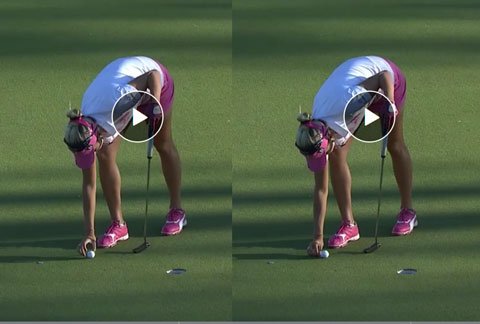
My first thought was that perhaps when Lexi tried to line up that dot, she tilted her head somehow and changed the way she saw the line. But as you can see from this comparison showing just after she put the coin down to reach for the ball and then just after she set the ball down to reach for the coin, her head is in the same position:

Comparison of Lexi before and after moving her ball

At this point I realized that I needed to try and recreate what she did. Often we watch things over and over without really seeing what's there, and we don't really "see" until we try it ourselves. And that's what happened to me.

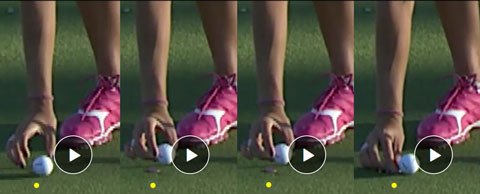
Because when I tried to mark the ball just like Lexi did, I suddenly discovered that I COULDN'T SEE THE BALL MARKER AT ALL AFTER I PUT IT DOWN. MY PALM WAS IN THE WAY.

Look, here are four stills from the close-up in the video. I've added a small yellow dot just below the position of the marker. The stills show:
  1. Lexi just after placing the marker
  2. Lexi rotating the ball
  3. Lexi placing the ball
  4. Lexi reaching to pick up the marker
The ball marker is under her palm -- hidden from view -- in all four stills. In fact, I found that rotating the ball as Lexi did actually made the marker even harder to see -- my fingers got in the way.

Sequence of Lexi marking her ball

Why didn't Lexi notice this? Because her attention was on the small dot she was trying to line up with the hole. And from her point of view, her hand never moved from its original position, so no alarms went off in her head.

Go back and watch the incident again at full speed. It's obvious, once you know what to look for.

Look, this doesn't mean that Lexi didn't break a rule, not even when you take the new "naked-eye" and "reasonable judgment" standards into account. The movement is clearly visible when viewed at full speed from the original broadcast footage. But this should put to rest any rumors that Lexi did it on purpose.

However, we should note the cause of this whole sad sequence of events. Once Lexi decided to mark the ball, if she had been thinking about making a normal putt instead of a tap-in, and had lined up the ball as if it were a longer putt, her hand would have been to the side of the marker, not covering it while she marked the ball. She would have had a clearer view and would likely have noticed if she positioned the ball incorrectly.

As much as I hate to say this -- given the current fuss about slow play -- Lexi simply didn't take enough time to gather herself. She probably should have put down her coin, picked up her ball and walked away. She should have taken a few deep breaths, a few practice strokes, and taken time to clear her mind of the bad putt she had just hit. And then she should have taken the time to line up her putt like normal.

In short, Lexi didn't treat this like an important putt. But it was.

There's no such thing as a tap-in at a major. I.K. Kim can tell you that. And now, so can Lexi. Hopefully she'll move past this sooner rather than later.

Of course, we'll get to watch her first tournament back starting today at noon ET when GC broadcasts the Volunteers of America Texas Shootout. You can get a quick overview of the event over at Tony Jesselli's blog.

Wednesday, April 26, 2017

Introducing... the Nordqvist Rule!

Yes, everybody was expecting a Lexi Rule. But what we got wasn't bad at all, in my opinion.


Decision 34-3/10 institutes two new criteria for judging rule breaches. They are the "naked eye" standard and the "reasonable judgment" standard.

In addition, a new "working group" has been created to examine the best way to deal with video and viewer-submitted evidence when enforcing the rules. That working group includes folks from the USGA, R&A and the major tours.

Personally, I was thrilled to see the "naked eye" test included. If you follow my blog, you know I've been arguing this for a while, as I did in my Why Armchair Officials Are Unneeded post right after the Lexi debacle, where I wrote:
I think that any "infraction of the rules" that can't be seen with the naked eye from a few feet away ISN'T an infraction. That's how the rules were enforced when The Rules of Golf were originally written.
And that's why I call this new rule the Nordqvist Rule -- because it specifically mentions the Nordqvist ruling at the US Women's Open last year:
...there are two situations in which the use of video evidence is limited: When a player unknowingly touches a few grains of sand in a backswing with a club in making a stroke from a bunker... In such situations, if the Committee concludes that such facts could not reasonably have been seen with the naked eye and the player was not otherwise aware of a potential breach of the Rules, the player will be deemed not to have breached the Rules, even when video technology shows otherwise.
The second example they quote happened several years ago. (I forget the name of the player, although GC mentioned him during their broadcast.) The point is that the USGA and the R&A agree that the rules need to evolve along with technology. That's a HUGE step forward, and the fact that they've decided to put it into effect immediately is also very promising. (Kendra Graham told GC that evolving the rules along with the technology is a guiding principle of the new rule revisions and, since it's so basic to the revision, they saw no reason not to put it into effect right now.)

Ironically, neither of the new standards would have actually helped Lexi. According to the video evidence that was used originally, you can see that the ball was moved perhaps two inches from its original position -- no closer to the hole, just sideways. But based on the standards, that's an amount that's observable by the naked eye of a competitor.

The "help" will be left up to the working group. They will work to decide what evidence will be allowed in the enforcement of the rules. And I suspect this will be somewhat messy for a while, as different methods are tried at different events in different circumstances.  Ironically, Kendra said she was all for eliminating video evidence entirely -- but noted that doing so would also eliminate using video to help players, as when it's used to determine where a ball entered a hazard.

MAKE NO MISTAKE -- THERE WILL BE SOME MISTAKES MADE DURING THIS PROCESS. As Kendra noted, there are going to be unforeseen consequences with any decision the group makes, and we'll just have to put up with them during the process.

But I think that's okay. The rules will be worked out in the crucible of the game itself, not in some remote office where only the carpets are green. The actual effects of proposed changes -- the often unexpected repercussions -- will be seen in the real world, not just in some theoretical debate.

In the end, there is no substitute for experience. As critical as I have been of the ruling bodies for some of their decisions, I think this is a necessary step if they really want to make the Rules of Golf work under actual circumstances. I'm applauding them for what they did Tuesday.

Saturday, April 15, 2017

To Call or Not to Call (Video)

Today I'd just like to make sure you all know both sides of the continuing argument about the Lexi Thompson ruling at the ANA a couple weeks back. I've got an article and a video for you.

The article is from Golf Digest and is called Viewer Discretion Advised. In it Jaime Diaz covers the discussions between the USGA, R&A, PGA Tour, LPGA and European Tour since the whole thing took place. It also discusses the rule that might change it -- the proposed Rule 1.3a(2).

The video is from Morning Drive's interview with Michael Bamberger about why viewer phone-ins should be allowed. Needless to say, his is going to be a controversial opinion!


The one thing I gathered from these two pieces is that a rule change may be a much bigger issue than many people expect. To me, this is an issue grounded in the history of the rules -- namely, that video was never considered when the rules were made because video wasn't even a possibility at the time. For that reason, I don't think "video police" who aren't on the premises of the event should be allowed to act as referees. Having tournament officials use video to confirm infractions -- including questionable behavior witnessed by fans attending the event -- would be allowed.

To me, that seems to fit the spirit of the rules.

But it's becoming more and more clear that this will be an issue about the "squeaky clean" image that the major golf organizations wish to maintain. Whether it's intended or not, that image is being called into question more and more as the debate goes on, especially with Jack Nicklaus having used the term cheating during a TV interview to describe a situation at the 2015 Presidents Cup. (That incident is mentioned in the article as well.)

As a result, I'm afraid this might get ugly before it's over. I guess we'll find out soon enough.

Tuesday, April 4, 2017

Why Armchair Officials Are Unneeded

I'll do my "5 to Watch" at the Masters post tomorrow. Today it's time for my promised rant about letting TV viewers affect tournament rulings. I think there are a number of things which are being ignored in the debate, even after the Thompson ruling at the ANA Sunday. I'd like to look at three of them in this post.

Point #1: Allowing armchair officials actually works against the ideal of creating a level playing field for all competitors.

The Rules of Golf, like the rules of most sports, were never designed to deal with a digital world. That's part of the reason we're having these struggles now, as are many other sports organizations like the NFL. Of course, golf is having a worse time than most, simply because the other organizations don't allow viewer input at all. For example, former Vice President of Officiating for the NFL Mike Pereira tweeted:


In fact, here's an interesting note on how the NFL will now treat video reviews, as expressed in a decision made at the NFL Owners' Meeting just this past March 28:
Most notable Tuesday was the change in handling officiating of video replays. Referees will now watch replays on the field using tablets, eliminating “going under the hood” to the watch on television monitors.

League officiating chief Dean Blandino and his staff in New York will make the final decisions on those calls, with input from the referee, who in the past was the ultimate arbiter after consulting with league headquarters.

“And I think that’s important to remember, we’re not taking the referee out of the equation,” Blandino has said. “The referee will still be involved, the referee will still give input, but will no longer have the final say.”
For those of you who don't understand why the NFL would want to minimize the part played by the actual refs on the field during a video review, you have to realize that NFL games are taking place all over the nation and each game has a different set of refs. What the NFL wants to do is have only one voice in EVERY game making the final decision during video reviews, in order to get one consistent set of rulings for the entire league.

In other words, the NFL decided that you make the game fairer for every player by MINIMIZING the number of people involved in officiating. And when the golf tours allow viewers -- who aren't even part of the appointed officiating crew -- to influence decisions, they actually increase the likelihood that players will be treated unfairly.

Lexi's ruling was a case in point. Millions of fans watched the same broadcast but saw no violation. However, one person who discovered a problem 24 hours later probably cost her a major. In no other sport -- where only the officials on the field are allowed to make such rulings -- would a travesty like that have been allowed. Which brings us to...

Point #2: Officials are unbiased. Fans are not.

I realize that this point is going to offend some people, but we have to deal with it. And while I don't mean to insinuate that every fan is motivated in the following ways, the nature of the violations that get reported are problematic. For when fans call tour officials to "report a violation" -- something that none of the officials, nor millions of other fans saw, and especially when finding said violation requires examination of extreme video close-ups to verify what happened (and those close-ups weren't shown as part of the broadcast) -- we have to ask what kind of fan goes to that much trouble.

And the answers aren't very pretty.

We may be dealing with people who feel powerless, and they boost their feelings of self-esteem by trying to effect the actions of "famous people." I think we'd all agree that these people have a psychological problem that requires therapy, not the validation of ruining things for the "famous person." Granted, this is less dangerous than stalking or attempting to murder a celebrity, but it's still not something we want to re-enforce.

We may be dealing with fans who will do anything to help "their" player win. In this case, the player has been specifically targeted, rather than the randomness of the previous example. And since a particular player has been targeted, the integrity of the field has clearly been compromised if we allow these "violations" to be heard.

But perhaps the darkest possibility is that the entire event is being manipulated. Whether the tours want to talk about it or not, we all know that a great deal of sports betting goes on around the world. I wonder how much money -- betted legally or not -- changed hands when Lexi was assessed a 4-stroke penalty and the odds on who might win the ANA changed dramatically?

Worse yet, imagine how much money could be made if the bettor KNEW that the odds were going to change because he or she orchestrated that change? This possibility simply can't be ignored.

One of the sides of the debate I've heard over the last day or so is that "golf is different from other sports, and this is part of what makes our game different." But I would argue that every decision we make has consequences, and we can't simply ignore some of them because we don't want to admit they exist. There is a reason why other sports don't allow the fans to influence the referees in this manner.

Tell me: Is the fear that someone may occasionally make a cut because of a missed penalty really worth risking such wholesale manipulation of the sport itself? I can't agree with that. The risk is too great.

When ANYONE can affect the officiating of a game, we open the door to all sorts of manipulation that can destroy the integrity of that game. The only way to prevent that is to stop it at the source. We simply MUST limit the number of people whose voices matter. If we don't, we're being irresponsible toward the players in the field and the vast majority of fans who are content to let the appointed officials do their jobs.

Point #3: Eliminating the outside voices will not allow more violators to "get away with it." Rather, the fix is rather simple to implement.

In listening to the debates over the last day or so, I've been amazed at how easily we are overwhelmed by technology. How many officials are needed in the TV truck, for example? Who will keep watch on the 30 or more video streams coming from the on-course cameras? Perhaps we need all the viewers to help us keep watch on the field, to make sure no one cheats!

There are so many flaws in this line of thinking that I almost don't know where to start. But I'll try.

First of all, we don't need to worry about all the cameras on the course. In case no one has yet realized it, all of those millions of fans are watching the exact same cameras -- namely, the network broadcast stream. I'm pretty sure the tours can find one or two officials who are willing to take a beer and some pretzels, head off into an air-conditioned room, and settle into comfy chairs in front of a large-screen TV to watch the broadcast! Since this is such a strenuous job, we can rotate the officials every hour or so. That way we'll always have fresh eyes watching.

We can even give them a direct intercom to the TV truck. That way, if our "official viewers" should see something, they can buzz the official in the truck: "Hey, can you take a look at Lexi's ballmark on 17? She might have marked it wrong. Thanks."

Is that really so hard?

As I said earlier, The Rules of Golf were never designed to deal with a digital world. But that really shouldn't be a problem when it comes to enforcing them. We talk constantly about the integrity of our players, and we build entire youth programs around the values our game teaches. But we seem compelled to contradict that by our actions...

After all, if our golfers are so honest, then why do we need super-magnification on our cameras to detect when the ball has been misplaced by a single inch? It's obvious, isn't it? It's because WE MUST PUNISH ANY IMPERFECTION WITH THE MAXIMUM ALLOWABLE PENALTY! WE MUST NOT TOLERATE LAWBREAKERS, EVEN IF THEY CLEARLY DO SO BY ACCIDENT AND THEIR TRANSGRESSION HAS NO MEASURABLE EFFECT ON THE GAME!

Our game has reached a point where it is no longer about having fun. It's about the paranoia of being perfect in every possible way:
  • We MUST have perfect mechanics, or our swings are subject to criticism.
  • We MUST hit every wedge shot within a statistically acceptable range, or our players look as if they just ate a live slug and they slam the ground with their clubs.
  • And we MUST call every penalty possible on ourselves, lest our integrity be called into question. You say that you caused that ball to shift position by ONE WHOLE DIMPLE? My God, man! Call that one-shot penalty on yourself or forever be a pariah among your peers!
Other sports -- all of which accept the fact that there will be occasional errors in the officiating -- continue to grow in popularity, much faster than golf. Apparently the fans are less concerned with perfection than with fair competition. Perhaps golf should adopt the same attitude, especially since we are so proud of our players' integrity. Why not trust them for a change?

But there is no longer any room for human frailty in our game, is there? We can't just present a good product; it has to be a perfect product. It doesn't matter whether the so-called violation has any effect on the outcome of the game or not. And in the process, we teach the youngsters coming up that nothing we do is ever good enough. We teach them that legalism and punishment are more important than logic and common sense. We teach them, in effect, to be "holier than thou."

I think that makes "growing the game" a good deal harder than it needs to be.

There has been a great deal of debate so far over the proposed rule changes being considered by the USGA and the R&A. Everyone is debating whether individual changes are integral changes to the game or just overdue logic. We're even beginning to ask if intent should matter when enforcing the rules. These debates are necessary. They're how we discover what is important in our rules.

But perhaps common sense should play a bigger part in our rules. Lexi was penalized 4 shots for placing her ball one inch to the left of her original line... on a flat putt measuring twelve inches in length. While we don't want our players to get sloppy about marking their ball, there has to be some point at which we simply say, "Oh well, it didn't make any difference to the outcome. But you need to be more careful from now on."

It happened 24 hours earlier, folks. It didn't affect how difficult Lexi's putt was, and the integrity of the field wasn't harmed. But that 4-shot penalty, assessed in the midst of the final round, DID affect the integrity of the field and tainted the whole event. Even So Yeon Ryu, who benefited from the ruling, stood there crying at the end and told Lisa Cornwell that it just didn't feel right.

When the Rules create the very problems they were meant to prevent, it's time for the Rules to change.

I think that any "infraction of the rules" that can't be seen with the naked eye from a few feet away ISN'T an infraction. That's how the rules were enforced when The Rules of Golf were originally written. If the infraction couldn't be seen, the players were expected to call it on themselves. And no one worried that someone would "get away" with breaking a rule. If we modern types believe they will, unless we use the most high-powered enforcement tools available...

Well, maybe we don't believe in personal integrity as much as we claim.

At the very least, we don't need millions of viewers all calling in about it. Video wasn't part of the Rules when they were originally set down. It DEFINITELY shouldn't be part of them now.

End of rant. For today, anyway. ;-)

Thursday, March 2, 2017

A Primer on the New Proposed Rules of Golf (Video and Links)

The full extent of the changes that are being proposed to the Rules of Golf caught everybody a bit offguard, I suppose. Rather than try to sum them up -- after all, the restructuring changed things from 34 to only 24 Rules, and Thomas Pagel says it may actually be more dramatic than the numbers say -- I've just decided to give you some online references you can check to get a handle on what we may see going forward.

First, here's a video from Morning Drive, featuring Mike Davis and Thomas Pagel, with some of the discussion:


That page also has links to some other videos, plus the link to this page, which seems to be the clearest explanation of the proposed changes that I've found. The changes are presented in a table that's very easy to read. IF YOU'RE JUST GETTING YOUR FEET WET, THIS IS WHERE I WOULD START.

Here's a brief article from PGATOUR.com that contains some of the immediate responses from Rory McIlroy, as well as the Tour's stance on the changes.

This USA Today post by Christine Brennan is a bit tongue-in-cheek, but I can't say that I disagree with her. Her point is that golf has other problems that are more pressing in terms of increasing its popularity, although it's clear that she's in favor of the proposed changes.

Golf Digest has put together this 31-slide presentation of the proposed changes.

Likewise, Golf.com has posted this article with their take on the project. This article is one of the longer ones I found on the topic.

Here is the USGA's official hub page on the whole modernization project. And here's the R&A's page, in case you're "across the pond" and would prefer their site.

One last link: Jeremy Schilling sent me the official iTunes link to his podcast interview with Thomas Pagel from a few weeks back. You can also pull up the original link at Jeremy's blog, which is listed in my bloglist over in the sidebar.

That should be enough to satisfy all your desires to discover the ins and outs of the projected changes. Remember, we've got roughly six months to give the USGA and R&A our feedback.

Sunday, February 5, 2017

The Latest on the Rules of Golf Update

Lately, many of my posts seem to be links to other websites. But there has been so much happening lately that I feel referring you to these other posts are the most helpful thing I can do.

And I finally have a link about the update to the Rules of Golf that we've all been waiting for.

USGA President Diana Murphy and Executive Director Mike Davis

Golf Digest's post on the update doesn't give us a lot of specifics, but what we do get is tantalizing:
What’s expected to be revealed is nothing short of the biggest restructuring of the Rules in decades. “It doesn’t fundamentally change how you think golf is played,” Davis said. “What it does do is fundamentally change the understanding of the rules, why they are the way they are, and how they’ll be communicated.”
That includes a re-organization of the Rules that is expected to blow up the current 34-rule structure.
That post refers to the rumored changes that were reported last month, and this Golfweek post can fill you in on those if you only heard about the changes secondhand.

The most stunning news from this new post is the dramatic re-organization that is predicted. Given that there will be a more visual presentation, I'll be very interested to see how the new Rules are going to be organized... and if the book will be any thinner! If a more visually-accessible book is in the works, the book itself could end up being much larger, even if the number of rules is actually reduced.

Finally, we now have a date for the big reveal. The new and improved Rules of Golf -- at least, the proposed changes -- will be made public sometime in March.

The post is very informative, so check it out. That way you'll be better prepared for what's coming next month.

Monday, December 19, 2016

Thomas Pagel on the Teeing It Up Podcast

I'm skipping the Limerick Summary today. After all, there's been no new golf this past week (nor will there be any for the next two weeks), so three generic Limerick Summaries in a row just seems a bit ridiculous to me.

USGA's Thomas Pagel

Instead, I'm passing out information. You may remember I did a couple of posts on the new DJ Rule a couple weeks back, and in this one I mentioned Jeremy Shilling. Jeremy hosts the Teeing It Up podcast on iTunes, and he messaged me to let me know that he's going to have Thomas Pagel from the USGA on today's podcast. (That's Thomas in the photo above.) They're going to talk about the DJ Rule, among other things.

The podcast happens this morning and, as soon as Jeremy sends me the links, I'll update this post so those of you who are interested can find it quickly. I should get them sometime today.

LINK UPDATE:

Okay, here are the links.
If Jeremy gets me a link directly to iTunes download -- apparently there's a technical issue with it right now -- I'll add that to this list.

The podcast is about 16 minutes long.

Saturday, December 10, 2016

The DJ Rule, Part 2

Usually when I do a post like yesterday's about the new "DJ Rule" I don't expect much feedback. I often get a comment or two but not much else.

So imagine my surprise when I found myself in a friendly Twitter conversation (it's nice to know those really do exist!) with Jeremy Shilling and Missy Jones. Among other things, Jeremy hosts the Teeing It Up podcast on iTunes and Missy is on several rule committees, including the USGA, NCAA, LPGA and AGA.

Personally I find Twitter very frustrating because it's hard to convey nuances of meaning in 140 characters. So I've decided to do a second post on this topic, just to talk about the "whys" behind my thoughts. (Actually, I guess this is my third post since I did one called I Can Fix the "Ball Moved on the Green" Rule back in August.)

Before I start, I should emphasize something Missy said, which is (and I quote) "Give it some time to be ironed out. The process and interpretations take time." This is only a local rule at this point, a part of what Thomas Pagel calls an example of the "rule modernization changes" which the USGA hopes to implement going forward.

Having said that, let me put in my own two cents' worth, in hopes of making a positive contribution to this process. I'm afraid the post turned out longer than I intended, because it always takes longer to explain WHY than HOW.

THE PROBLEM


First, remember that this rule only affects balls laying on the putting green, not in the fairway or rough or hazards. My August post also suggested possible ways to simplify those rules, but they're not important to this post.

As far as it goes, I like the USGA's new "prototype rule," especially removing the penalty for accidentally moving the ball. I think that's smart. Nobody intends to cause trouble for themselves by moving the ball. If they were really trying to gain an advantage, they wouldn't call the rule on themselves!

But my contention is that the rule doesn't go far enough, because it doesn't deal with the problem that really caused the USGA and R&A to create this local rule, which goes into effect 1 January 2017. As I wrote in yesterday's post about this new rule:
Correct me if I'm wrong, but the problem has been that players said they didn't cause the ball to move. Doesn't the rule -- as worded -- mean that the player has to say that he or she DID CAUSE the ball to move in order to replace the ball without penalty?
This isn't just a matter of a rule being difficult to enforce. It's about the PERCEPTIONS of the game that the rule causes, as well as the PRACTICALITIES of the rule's assumptions. Those are what I want to talk about today, because I think they are being ignored when they're actually at the root of the problem.

PERCEPTIONS

Jeremy quoted Mike Davis as saying that the USGA had been put in the awkward position of judging DJ's intent, which it didn't want to do. I agree with him.

But the new rule wouldn't have changed what happened. Here's a short version of what would have happened with the new rule in place:
  • OFFICIAL: Did you cause the ball to move?
  • DJ: No, I didn't.
  • OFFICIAL: Then we have to determine if something else could have caused it to move...
Wait, isn't that basically what happened anyway? If the player insists they didn't cause the ball to move, the new rule has no effect on the procedure!

BUT WHAT ABOUT THE PERCEPTION OF WHAT HAPPENED?

Presumably this new 'rules simplification initiative' is, in part, about making the game more attractive to new golfers. But what did TV viewers considering the game see?

The player (in a sport that prides itself on self-policing) called attention to a ball movement that no one could see without severe enhancement of HD footage. If DJ had said nothing, it's unlikely anyone would have noticed, but he followed protocol and told his playing partner. The official came up. The player said he didn't move the ball. The official at the hole agreed.

Then a four-person rules committee halfway across the grounds, that wasn't personally at the spot of the supposed infraction, started studying the video footage and they said, as reported by golf.com,
"As we looked at the video we had concerns," Jeff Hall, the USGA's managing director of Rules and Open Championships, said on-air during the Fox Sports broadcast.
They then overruled DJ AND THE ON-SITE OFFICIAL and levied a one-stroke penalty.

What did TV viewers learn from this?
  • The rules are so complicated that the player can't even know if he breaks them without outside help. Viewers unfamiliar with the game won't know that the player needs a ruling to know whether he plays the ball as it lies or moves it back... and that making the wrong choice is a penalty.
  • The rules are so complicated that even the on-site official can't be sure he's making a correct ruling... so officials don't enforce rules, they merely offer opinions that may or may not be correct.
  • The rules are so complicated that a rules committee, the members of which aren't even at the scene of the ruling, is required in order to make decisions... and their decisions overrule the people with actual firsthand involvement.
  • Perhaps most damning of all, golfers claim that they are self-policing... but the ruling body doesn't accept their explanation of what happened. "We had concerns" in the quote above basically means "we didn't believe that what he said was what actually happened." You can argue that saying "we believe he lied" is NOT what the ruling body meant (and I'd agree that it doesn't have to mean that), but it IS how the majority of the viewing public probably understood it.
Tell me.. if you're considering taking up a game and found that you were expected to call penalties on yourself BUT that your version of events (or even those of an on-site official) weren't sufficient for the rules committee, would you want to take up the game? I don't think so.

But it's even worse when you consider the practicalities involved.

PRACTICALITIES

The Rules of Golf exist to provide a level playing field for all competitors. Players call penalties on themselves for the same reason -- they don't want to gain an unfair advantage over the field.

BUT WHAT CONSTITUTES AN UNFAIR ADVANTAGE? To me, this is where the proposed rule falls far short of its goal. Let's go back to DJ's ruling.

The fifth hole at Oakmont Country Club is a par-4 that played roughly 382 yards, according to this golfchannel.com page. DJ's ruling concerned a ball that moved  -- as do the vast majority of rulings this rule is intended to address -- AT MOST one-quarter of an inch. The original putt was, what, maybe two feet?

Take a yardstick and lay it down on the floor. Along one edge place one golf ball 24 inches from the end, on the other side place another golf ball 23.75 inches from the end. Can you tell me that you truly believe that quarter-inch had ANY effect on the makeability of that putt?

Let me rephrase that. Can you tell me it mattered AND KEEP A STRAIGHT FACE WHILE YOU DO?

For the vast majority of players this proposed rule would affect, a moving ball has moved "a dimple" or "an eighth of an inch." A MOVEMENT THAT SMALL HAS NO MEASURABLE EFFECT ON THE GAME. And yet we'll waste 10-20 minutes determining what caused the ball to move and whether it should be replaced or not.

Perhaps such things somehow make very traditionally-minded golfers and rules officials feel that "the integrity of the game is being preserved" in some way, but what do you think potential golfers watching this unfold on TV think?

I suspect the word insanity is probably involved.

The problem is that we haven't distinguished between meaningful rules and meaningless rules. We want to argue "it's the principle of the thing" when, in fact, the problem is an obsession with perfection where perfection can't possibly exist. As Bob Rotella said, "Golf is NOT a game of perfect," so we should accept that and make our rules accordingly. That's the only way we're going to successfully simplify them.

MY TWO SUGGESTIONS

To make a useful rule that can be easily and consistently applied in a fair manner, we need to examine our assumptions about that rule. I actually have two suggestions and, while I believe the second one is the better one, I doubt that any of the rulemakers will seriously consider it.

Missy noted in one of her tweets that proximity, time and action have been the factors by which Rule 18-2 has always been interpreted. But perhaps, given the new local rule -- which eliminates the penalty -- we should reassess which of those factors still matter. Without the penalty, these factors now only determine whether the ball is replaced or not.

I question how important any of them are now, now that there's no penalty.

My first suggestion, from the post I did back in August, is simply to set a threshold for proximity. I suggested that, if you moved your putter within one ball width of your ball before it moved, you are deemed to have moved it. If you didn't, then you are deemed NOT to have moved it.

This is a simple solution that could be easily verified on video, if need be. And players would know beforehand -- "If I sole my putter behind the ball and then it moves, I moved it. Just replace the ball." After all, since the new rule removes the penalty, the only question now becomes whether players replace their ball after movement or not.

That's simple. It's easy to determine, easy to enforce. Forget time and action and anything else -- if you placed or moved your putter within one ball width of it, you moved the ball. Players know immediately whether to replace the ball or leave it where it came to rest. And since every player knows the distance between putter and ball that determines it, it's fair to everybody. We spend ten seconds instead of ten minutes on this, and we get on with the game.

But back then I was trying to make the penalty easy to assess. Now, since the USGA and the R&A have removed the penalty, I believe there's an even simpler solution.

My second -- and preferred -- solution is even simpler: If your ball moves on the green after you've marked it, for whatever reason, simply replace the ball and get on with the game. Look, there's no penalty either way, right? And if you were able to mark the ball in the first place, then there's a solid place for the ball to sit, right? Then replace the ball and replay it from that spot, the way you originally planned. That's fair to everybody.

And if conditions have changed and the ball will no longer stay put, we have other rules that regulate that, correct? Rules like "place the ball on the nearest spot where it WILL stay" and "suspend play until the course is playable again." If those circumstances come up, we're already prepared.

But in my opinion, since the penalty has been removed, there is simply no longer any need for complicated rules regulating unintended ball movement on the green. One or two unambiguous sentences can do the job from now on.

And that's my two cents.

Friday, December 9, 2016

Does the DJ Rule Get It Right?

A lot of interesting things happened Thursday, like Lydia Ko splitting with David Leadbetter, Lexi playing at the Shootout, and Bryson DeChambeau's new "sidesaddle" putting technique. But I guess we should stick with the big news of the day:
THE DJ RULE
Yeah, they may call it "a local rule modifying Rules 18-2, 18-3 and 20-1" but we all know what it is. It's an attempt to avoid any more debacles like the one at Oakmont. But will this rule actually do that?

I'm not so sure. Let me explain.

For those of you who missed it, here's the short version of the new USGA and R&A rule:
“Rules 18-2, 18-3 and 20-1 are modified as follows:

When a player’s ball lies on the putting green, there is no penalty if the ball or ball-marker is accidentally moved by the player, his partner, his opponent, or any of their caddies or equipment.

The moved ball or ball-marker must be replaced as provided in Rules 18-2, 18-3 and 20-1.

This Local Rule applies only when the player’s ball or ball-marker lies on the putting green and any movement is accidental.

Note: If it is determined that a player’s ball on the putting green was moved as a result of wind, water or some other natural cause such as the effects of gravity, the ball must be played as it lies from its new location. A ball-marker moved in such circumstances is replaced.”
You can read the full text here. The reason it's only a local rule is because they're making this change outside of the official rule update cycle, so they can't make it a "full" rule yet. GC posted the following infographic about the rule on their website.

DJ Rule infographic

It sounds great, doesn't it? If a ball on the putting green gets moved accidentally, it's replaced with no penalty.

So why am I still concerned?

No one has really paid attention to the wording of this rule yet, have they? Reread the short version of the rule that I posted above, and pay special attention to my emphasis:
When a player’s ball lies on the putting green, there is no penalty if the ball or ball-marker is accidentally moved BY the player, his partner, his opponent, or any of their caddies or equipment.
Correct me if I'm wrong, but the problem has been that players said they didn't cause the ball to move. Doesn't the rule -- as worded -- mean that the player has to say that he or she DID CAUSE the ball to move in order to replace the ball without penalty?

Because if "wind, water or some other natural cause such as the effects of gravity" caused the ball to move, it must be played from its new position. If the ball is replaced under those conditions, Rule 20-7 levies a 2-stroke penalty on the player.

So the rule -- as worded -- requires either:
  • the player must say THEY CAUSED the ball to move in order to replace it without penalty OR
  • we STILL have to determine whether the player moved the ball or not in order to avoid the penalty for moving a ball that's in play.
This rule -- as worded -- only helps the player who says, "Yes, I caused the ball to move." So unless players suddenly want to start taking responsibility for ball movement, it doesn't sound to me as if this will solve the problem.

That is, unless the USGA and the R&A felt the real problem was that the players weren't being honest about causing the ball to move in the first place. And that's a whole different kettle of worms, isn't it?

Saturday, July 30, 2016

How Many Drops Did Jordan Get? (Video)

This is a short post but it's about something I learned Friday. This is the video of Jordan's media questions after his round, concerning the complex drop he got. The video came from this page at golfchannel.com, where you can also see footage of the actual ruling again. (Use that link if the video doesn't show up below for some reason.)

Anyway, here's the video:


What I learned is that you can get multiple drops for casual water relief, or you can take only one, but after you get the ruling you can change your stance so you're standing in the casual water anyway. That was a new one on me!

Jordan took a stance to get relief from the water so his ball was on dry gravel. However, after that ruling was made to the satisfaction of the official, Jordan was allowed to change his stance. The new stance wouldn't have given him complete relief from the original position; but once the original ruling was made, the new stance would have meant getting a new ruling... which he chose not to get.

To make things even more confusing, Brandel Chamblee believes Jordan could have taken that new "relief from casual water" ruling with the new stance, then asked for another ruling to get a drop from the gravel. Brandel believes that would have let him get a drop in the grass on the right side of the cartpath (the right of the video at golfchannel.com that shows the actual ruling, that is), which would have given him a clearer shot at the green.

In any case, knowing that little quirk of the "casual water" rule could help some of you in a tournament sometime... or at least, it might save you a call to the TV station wondering if it's a rules infraction!

Tuesday, June 21, 2016

Of Golf Balls and Footballs

The controversy over DJ's one-stroke penalty continues. Today I'd like to clarify what I believe are the three major questions that the golf community -- and the USGA in particular -- have to answer if they want to prevent these kinds of problems in the future.

DJ over the controversial putt

1) Why put a rules official with each group if that official's ruling isn't binding?
This is the most obvious question that needs to be asked. DJ's official ruled that there was no infraction, to play on. The ball was NOT replaced, which an infraction demanded. Therefore DJ couldn't possibly avoid a penalty if the decision of the official APPOINTED BY THE USGA wasn't binding.

I'm reminded of the LifeLock commercials. For those of you, especially overseas, who may not have heard of LifeLock, they're a company that claims they monitor and prevent credit problems. Here's a typical commercial:


At least this guy is upfront about it -- unlike the USGA, he doesn't claim that his presence means anything. The USGA will have to address this problem if they don't want potential golfers to see golf as a game with impossible rules.

2) How can you demand the ball remain still when you want greens where the ball 'trickles' 30, 40, even 50 feet after it should have stopped?
This goes back to a post I did where I mentioned Phil Mickelson's misgivings about the speeds of classic green complexes. (The specifics about greens are near the end of that post. Geoff Shackelford has voiced similar concerns on many occasions.) Classic courses designed with more slope on the greens assumed much slower green speeds, perhaps 8-10 on the stimpmeter. But the USGA insists on speeding these greens up to 12-13, speeds where the ball can't be expected to stay still.

And even though the USGA said that Oakmont has faster greenspeeds "in its DNA", the fact remains that they estimated that the greens were only about 70% of the firmness and speed they desired. What would have happened if they had gotten the green speeds they wanted? Such disregard for simple physics is simply begging for rules violations like this.

3) Are we expecting too much from video replay in our rulings?
This is where football enters the picture. In case you don't watch NFL football, one of the most contentious areas of the rules there has become a real embarrassment for the game. And what is that problem?

Ironically, no one can say for sure what constitutes a 'catch' anymore. Before video replay, it was pretty easy to say when someone had caught a pass and when they hadn't. But now, with the ability to make extreme digital close-ups in ultra-slow motion, referees are forced to try and determine whether a diving catch was actually touching the ground a thousandth of a second before it was 'caught'.

In other words, the question used to be "Did they hold on to the ball when they hit the ground?" Now they can't even determine when the ball was actually caught, or even how much a ball might move in a player's hands when a catch is made and still be considered a 'catch'. And this confusion has already changed the outcome of games.

Take a look at this catch by the Dallas Cowboys' Dez Bryant in a 2015 Divisional Playoff game. Ten years ago this would have been ruled a catch; it's pretty clear that Dez is holding the ball in one hand when he hits the ground, and the ball stays firmly in his hand when he lays out on the ground. (He hit the ground hard enough for the ball to bounce loose at impact if his grip wasn't good.) But extreme slo-mo shows tiny wiggles that happen too fast for the naked eye to see -- and therefore wouldn't affect the ruling at regular speed. (And it's not that I'm a Cowboys fan -- I'm a Panthers fan. But this kind of thing is happening too often, and this is one play that I remember well enough to find easily.)

The answer to football's catch riddle -- and to golf's moving ball question -- is to create some simple criteria that are easily seen and verified in real time. In Dez's catch, the fact that he had the ball in one hand and it remained in that hand after he hit the ground should have been enough to say that was a catch. Instead, the Cowboys' run to the Super Bowl was ended.

The USGA should make a simple test for moving balls. Did the player ground his or her club behind the ball? That should be sufficient in most cases. If they need more, tell players not to make practice strokes within one putterhead length of the ball to either side. These are objective criteria, not "more likely than not" subjective criteria.

Here's MY rule for rules questions: If the test can't be a simple one, then the problem in question shouldn't be a rules infraction. If you can't KNOW FOR SURE that a rule was broken, then you don't need a rule in the first place.

These are the issues that the USGA needs to face concerning the Rules of Golf. If they don't, things are only going to get trickier going forward.

Sunday, April 24, 2016

The Shifting Sands of the Rules

I wanted to mention this because it's the kind of question that players often face when they get an awkward lie in the sand. Haru Nomura is leading the Swinging Skirts LPGA Classic, but she had to get a ruling after she finished. Did she build a stance in the sand at 6?


This is the original report Whit and Karen filed. The one they filed after the ruling was made wasn't up yet on golfchannel.com when I did this post, but Haru was ruled NOT to have built a stance after about 45 minutes of questioning and repeated viewings of the video by LPGA officials.

Why was this ruling so difficult? It's because The Rules of Golf allow a player to 'fairly take a stance' when playing a shot. And it appears that a couple of factors were in play here:
  • Haru was unable to keep from slipping in the sand after a typical 'digging in' move, even after repeated attempts. Every time she made a practice swing, her right foot would slip. In fact, if you look at her initial attempt to take a stance -- right around the :58 second mark -- you can see tracks in the sand where her right foot slipped quite a way just by trying to step into the trap.
  • Apparently the officials looked to see if the angle of her foot was noticeably changed by her attempts to take her stance. You hear Karen mention that there didn't seem to be much difference but if her foot looked to be on 'flatter ground' after digging in, they would have likely ruled that she altered the ground and thus built a stance.
That last one seems to be the most obvious way to tell if someone is building a stance, at least on a slope like Haru was on. As long as her foot still followed the slope so that her spikes were holding her in place -- as opposed to a flattened area of sand -- she was allowed to dig in enough to find that solid ground.

I don't think she would have gotten a favorable ruling had the slope been less severe or the sliding of her foot less obvious. Even with those two things in her favor, it still took 45 minutes for officials to make the ruling!

The result is that Haru Nomura has a 3 shot lead instead of a 1 shot lead going into the final round. It was a major ruling that could have changed the way things play out today. Bear in mind that the leader was at -9 after the first round but the current leader is only at -10 after a favorable ruling. And conditions aren't likely to be much easier today.

Remember: You have to be careful when digging into the sand. It's a fine line between a fair stance and a built stance.

Wednesday, October 28, 2015

Yet Another Guide to the Anchoring Ban

Golf Digest has done its own guide to anchored VS unanchored putting strokes, with diagrams and explanations. It's not very long but the explanations seem very clear.

For example, this diagram comparing a legal short putter stroke with both elbows tight against the sides to an illegal anchored stroke with a broomstick putter includes this as part of the explanation:
"If the forearms are resting against the body, this method is acceptable only if the hands are not separated. They can still work independently when making a stroke this way."
That phrase I highlighted, "...only if the hands are not separated," is a great reminder of the diagram and provides an easy-to-understand reason for why one method is legal while the other isn't.

Broomstick putter, unanchored and anchored

Between this guide and yesterday's video from Golf Central, you should get a pretty clear picture of which putting strokes will be legal and which won't be when 2016 officially arrives.