I just had to post this. Both the Abu Dhabi and Singapore tournaments are letting amateurs try to hit shots closer to the pin than the pros on some holes... and DJ got beat by a 13-year-old. Take a look:
Young Oscar Murphy hit a 3-wood around 177 yards and got within 25 feet, which beat both DJ and Tommy Fleetwood. Apparently he didn't beat his hero, Rory McIlroy -- who was also in the group -- but he did get to hang out with Rory for a bit.
The coolest part of it for me? Take a listen to that solid crack when Oscar hit the ball. There's a lot of pros who would pay to hit it that solid.

Showing posts with label amateur swings. Show all posts
Showing posts with label amateur swings. Show all posts
Friday, January 19, 2018

Friday, January 9, 2015
What Bobby Jones Said About Slow-Motion Video
Yes, believe it or not, Bobby Jones actually wrote some things about slow-motion video!
Sidney Matthew, who has written several books about Bobby Jones, did a small collection of Jones newspaper columns called Bobby Jones Golf Tips: Secrets of the Master. And one of those columns, called On Making the Warner Brothers Films, references some earlier slo-mo film shot in 1930 by the Jenkins Laboratories in Washington for the PGA and its teaching professionals.
In case you're interested, here is a YouTube video of that footage. Note that it includes not only Jones but Miss Joyce Weathered (another top amateur at the time, who played a lot with Jones) and the great Harry Vardon. I know this is the footage because Jones mentions Weathered and Vardon in the article.
Jones made some interesting observations about viewing and learning from "slow-motion pictures" that every golfer should hear, given how easy it is to tape your own swing these days -- one observation in particular:
For example, that's part of the reason why analysts are so confused by Bubba Watson's swing. They can analyze it and figure out what he's doing, but they can't figure out how to duplicate it. That's because they want to control things that Bubba isn't controlling. For example, they want to figure out how Bubba times that little jumping move of his... but that's the wrong question.
Bubba isn't thinking about the jump; he's just thinking about how he wants the club face to contact the ball. When he swings the club, his mind subconsciously sequences his body moves -- including that jump -- so that his hands can get the club into that position.
In other words, they want to consciously control what is actually an instinctive move. And that's just not going to happen!
That's part of the reason my posts -- and my books, I admit it -- sometimes seem to approach things from a strange perspective. I want you to learn how to control the things you need to control but just let the other things happen instinctively, the way they're meant to happen.
Next time you start struggling with your golf swing, it might be a good idea to spend some time on the range just trying to swing the club without so many "I need to..." thoughts in your head. Instead, think about hitting the ball to the target. Focus your attention on the target. You might be surprised just how much of your golf swing is supposed to be instinctive.
At least, that's what Bobby Jones believed... and he didn't do too badly at the game. ;-)
Sidney Matthew, who has written several books about Bobby Jones, did a small collection of Jones newspaper columns called Bobby Jones Golf Tips: Secrets of the Master. And one of those columns, called On Making the Warner Brothers Films, references some earlier slo-mo film shot in 1930 by the Jenkins Laboratories in Washington for the PGA and its teaching professionals.
In case you're interested, here is a YouTube video of that footage. Note that it includes not only Jones but Miss Joyce Weathered (another top amateur at the time, who played a lot with Jones) and the great Harry Vardon. I know this is the footage because Jones mentions Weathered and Vardon in the article.
Jones made some interesting observations about viewing and learning from "slow-motion pictures" that every golfer should hear, given how easy it is to tape your own swing these days -- one observation in particular:
I think, now that we have had years of slow-motion study, almost every first-class golfer knows well enough how he hits the ball. The guess has been removed. But even slow-motion pictures need interpretation. The one great difficulty from the standpoint of the average golfer has been in separating the consciously controlled movements from those that are purely instinctive. (p117, my emphasis)That's a remarkably wise observation that even TV analysts don't recognize. There are a great many things in your golf swing that you do without even thinking about them, the same as in other area of your life. And if you don't know the difference, you can actually screw up your golf swing because you end up interfering with things you shouldn't try to control.
For example, that's part of the reason why analysts are so confused by Bubba Watson's swing. They can analyze it and figure out what he's doing, but they can't figure out how to duplicate it. That's because they want to control things that Bubba isn't controlling. For example, they want to figure out how Bubba times that little jumping move of his... but that's the wrong question.
Bubba isn't thinking about the jump; he's just thinking about how he wants the club face to contact the ball. When he swings the club, his mind subconsciously sequences his body moves -- including that jump -- so that his hands can get the club into that position.
In other words, they want to consciously control what is actually an instinctive move. And that's just not going to happen!
That's part of the reason my posts -- and my books, I admit it -- sometimes seem to approach things from a strange perspective. I want you to learn how to control the things you need to control but just let the other things happen instinctively, the way they're meant to happen.
Next time you start struggling with your golf swing, it might be a good idea to spend some time on the range just trying to swing the club without so many "I need to..." thoughts in your head. Instead, think about hitting the ball to the target. Focus your attention on the target. You might be surprised just how much of your golf swing is supposed to be instinctive.
At least, that's what Bobby Jones believed... and he didn't do too badly at the game. ;-)
Tuesday, February 12, 2013
The Strike of the Kobra
Lydia Ko has a US Women's Amateur and three pro tournaments under her belt... and she's not even 16 yet. She's not a big hitter; she just thinks her way around the course. But she's got a nice solid swing that all weekend golfers can learn from.
I've been looking for video footage and photos of her swing but not having much luck. Her website is supposed to have a swing sequence, but it's being rebuilt. However, I found the following photos at the jeffygolf.com forums (they're blown up much larger there). Let's take a look at her move through impact:
Lydia stays connected a la Ben Hogan during the bottom of her swing. That just means that her upper arms stay pretty close to her chest as she turns through. I'll come back to that in a moment.
Notice that she doesn't push her hips forward the way most weekend golfers do. See how her lead hip never moves outside of her lead foot in any of these photos? Her hips are turning because her trailing knee stays flexed all the way through -- her lower body doesn't "lock up" and stop turning. The flex in her trailing knee allows her trailing hip to keep moving. Because of this lower body movement, Lydia stays balanced and has good footwork. It's just a function of staying loose and keeping out of her own way.
Now, back to her arms. Look at the very first photo and focus on her trailing elbow. See how it's still bent? That's why her wrists are still cocked in the lower part of her swing! A lot of you are straightening your elbow at the start of your downswing; that's called casting. That's when you lose your wrist cock.
At the top of your downswing your lead elbow is fairly straight and your trailing elbow is bent; you can see that if you look in a mirror. As you start your downswing, none of that should change. Just let your hands and arms drop from the top of your swing until your trailing elbow is near your side. That's when you straighten your elbow! (And, btw, once your elbow is near your side, you can straighten that elbow as hard as you want and you'll still hit the ball solid. The connection with your body that I mentioned earlier will help keep your arm and club on line.) Just look in the photos and see what Lydia's doing.
Learning to drop your arms like that is hard for some people. It feels as if all the movement is happening at your shoulder joints. But if you let them drop to start your downswing, you're going to make a lot of your swing happen automatically -- your weight shift, your footwork, your balance, the whole thing.
You can learn to strike like the Kobra. It's not about trying to hit the ball hard; it's just about letting gravity take its course.
I've been looking for video footage and photos of her swing but not having much luck. Her website is supposed to have a swing sequence, but it's being rebuilt. However, I found the following photos at the jeffygolf.com forums (they're blown up much larger there). Let's take a look at her move through impact:
Lydia stays connected a la Ben Hogan during the bottom of her swing. That just means that her upper arms stay pretty close to her chest as she turns through. I'll come back to that in a moment.
Notice that she doesn't push her hips forward the way most weekend golfers do. See how her lead hip never moves outside of her lead foot in any of these photos? Her hips are turning because her trailing knee stays flexed all the way through -- her lower body doesn't "lock up" and stop turning. The flex in her trailing knee allows her trailing hip to keep moving. Because of this lower body movement, Lydia stays balanced and has good footwork. It's just a function of staying loose and keeping out of her own way.
Now, back to her arms. Look at the very first photo and focus on her trailing elbow. See how it's still bent? That's why her wrists are still cocked in the lower part of her swing! A lot of you are straightening your elbow at the start of your downswing; that's called casting. That's when you lose your wrist cock.
At the top of your downswing your lead elbow is fairly straight and your trailing elbow is bent; you can see that if you look in a mirror. As you start your downswing, none of that should change. Just let your hands and arms drop from the top of your swing until your trailing elbow is near your side. That's when you straighten your elbow! (And, btw, once your elbow is near your side, you can straighten that elbow as hard as you want and you'll still hit the ball solid. The connection with your body that I mentioned earlier will help keep your arm and club on line.) Just look in the photos and see what Lydia's doing.
Learning to drop your arms like that is hard for some people. It feels as if all the movement is happening at your shoulder joints. But if you let them drop to start your downswing, you're going to make a lot of your swing happen automatically -- your weight shift, your footwork, your balance, the whole thing.
You can learn to strike like the Kobra. It's not about trying to hit the ball hard; it's just about letting gravity take its course.
Tuesday, March 13, 2012
How Pros and Amateurs Differ
This post was born while I was watching Golf Central Monday night. They were talking about what Justin Rose has been working on and I realized it might confuse some of you.
See, Justin has been working on turning his shoulders less, which is the exact opposite of what I harp on in this blog. Although I have called it a shoulder turn or coil on occasion, I generally call it a one-piece takeaway since it's the early turn of your shoulders that keeps your arms straight but relaxed.
So what's the deal here? Should you turn more or less?
The problem here is that the typical pro has the exact opposite tendencies of the typical amateur: Amateurs tend to fight slices while pros tend to fight hooks. Obviously that means the two are trying to do opposite things:
But there is one thing the pros are trying to do that amateurs want to do as well: Each is trying to create a balanced controllable swing. This means that, ultimately, both players have the same goals but they're approaching them from different sides. It might help to think of the ideal swing as being halfway up a hill -- or down a hill, depending on your perspective. You may be at the bottom looking up and someone else is on the top looking down. These different starting points require different means to get to that midpoint.
What I want to help you do is to understand is how that balanced swing -- the halfway point -- works. Once you understand that -- and know where you are in relation to that standard -- you won't get confused as to how you should get there. Just bear in mind that I assume the vast majority of you are on the typical amateur's side of the swing, and that's how I decide what tips to pass on to you.
And in this case -- unless you're Justin Rose, that is -- you should probably be working on more shoulder turn, not less.
See, Justin has been working on turning his shoulders less, which is the exact opposite of what I harp on in this blog. Although I have called it a shoulder turn or coil on occasion, I generally call it a one-piece takeaway since it's the early turn of your shoulders that keeps your arms straight but relaxed.
So what's the deal here? Should you turn more or less?
The problem here is that the typical pro has the exact opposite tendencies of the typical amateur: Amateurs tend to fight slices while pros tend to fight hooks. Obviously that means the two are trying to do opposite things:
- The amateur struggles to get a 90-degree shoulder turn; the pro (at least the younger ones) frequently get 110-120 degrees.
- The amateur struggles with an out-to-in swing, the pro often fights an in-to-out swing.
- The amateur swings over-the-top; the pro may have an exaggerated under-the-plane loop.
- The amateur typically can't get his hips turned fully in his downswing; the pro may be getting stuck because his hips turn so much faster than his shoulders.
- The amateur leaves the clubface wide open at impact; the pro flips his wrists and closes the clubface too much.
But there is one thing the pros are trying to do that amateurs want to do as well: Each is trying to create a balanced controllable swing. This means that, ultimately, both players have the same goals but they're approaching them from different sides. It might help to think of the ideal swing as being halfway up a hill -- or down a hill, depending on your perspective. You may be at the bottom looking up and someone else is on the top looking down. These different starting points require different means to get to that midpoint.
What I want to help you do is to understand is how that balanced swing -- the halfway point -- works. Once you understand that -- and know where you are in relation to that standard -- you won't get confused as to how you should get there. Just bear in mind that I assume the vast majority of you are on the typical amateur's side of the swing, and that's how I decide what tips to pass on to you.
And in this case -- unless you're Justin Rose, that is -- you should probably be working on more shoulder turn, not less.
Wednesday, May 25, 2011
Dexter's Back!
As most of you probably remember, I've been trying to help Dexter over at Golf Tips & Quips improve his swing. After our initial round where we used a one-piece takeaway to eliminate his over-the-top move, I needed to see how he's doing so we could figure out the next step.
Here's the post where Dex posted the videos of his new swing. It has nine videos. He posted the original video of his old swing, followed by four videos of his new swing -- two different angles of both his driver and an 8-iron -- and four videos of his friend "the Doctor" (no relation to the BBC character) with the same clubs.
You really should go and look at the first two videos. I have to tell you, I'm incredibly proud of what Dex has done. For all the credit he gives me, all I did was help him identify the main cause of his problem and give him a drill; he's done all the work on his own. Some players struggle for years with an over-the-top swing; Dex has all but eliminated his in just a few months.
But Dex is still having some problems with consistency. And his friend (who I'll just call Doc) asked me if I had any advice for him. So today I want to take a look at some stills from the videos to identify what Dex needs to work on next. In each of these stills, Dex is on the left and Doc is on the right.
Ironically, he and Doc are having the same problem but for different reasons. That's why it can sometimes be difficult to find the true cause of a problem. Since this is a common one, I'm going to explain both.
In this first still I've drawn a line from the ball through their hands at about halfway back. This isn't intended to be a "desired plane"; rather, I just want to emphasize the problem: Both players are twisting their forearms on the way back. Their arms have started the club back along the line I've drawn but they've twisted their arms so the shaft points somewhere below that line. That means the club wants to go in one direction and they're trying to swing it in a different one. Because of this, they're fighting the club during their backswings, and this causes a lot of inconsistency in their swings.

The way they do this is different for each. Dex keeps his left elbow closer to his side (way to do that takeaway, Dex!) and is rotating his forearms. He feels like this puts the club on plane, but he actually turns it too far under the plane. We've talked about this before and he's worked on it some; if you compare this pic with that first video of his, you'll see he's turning less... but he's still turning too much.
Technically, Doc doesn't twist his forearms. Instead, he rotates his entire arm! See how his left elbow is pointed away from his side? If you look closely, you can even see the background sky between his arm and chest. This not only twists the club off-plane, but it puts him in a bad position to come down, as we can see in the following two stills -- the top one with the driver, the 2nd with the 8-iron:


As you can see clearly in the 2nd still, Doc has a "chicken wing" followthrough. That's because his lifted elbow at the top of his backswing causes him to make what feels like a powerful move to him -- he pulls the club through impact with his left tricep and lat. By comparison, Dex's left elbow is still near his side and he's standing more erect. (That's what some teachers call "staying connected." And that's a good move, Dex -- a really good move!)
That pulling action is also causing Doc to pull his swing across the ball. See the arrows pointing to the ball in the top still? Dex thought he had a poor launch angle with his driver, but it's actually pretty good. You can't get an exact launch angle measurement from these pics, but Dex's measures about 10° and Doc's about 30°. The ideal launch angle is around 12°, so Dex is very close. Doc's pull is a glancing blow that shoots the ball upward.
That's even more clear in this last still. See how Dex's clubhead is nearly in a straight line with his hands halfway to his finish? That's because he's kept his hands in front of him. (Really good job, Dex!) Doc's hands are in nearly the same position, but look at how far ahead of the clubhead they are. That's a sure sign that he's pulling across the ball. Note that the ball has started off pretty straight -- that's because he squared the clubface pretty well, and the clubface position has the most effect on initial ball flight. (If you've forgotten how that works, the first of 5 posts on the new ball flight laws is here. They're dated from Dec 15-18, and there are two on the 16th.)

So what both Dex and Doc need to do is correct that over-rotation of their arms during the backswing. In the next post I'll give them a drill to teach them both the proper movement of their arms though the entire swing -- or rather, teach them what they should feel in order to get the proper movement. That's what is really tripping them up.
Here's the post where Dex posted the videos of his new swing. It has nine videos. He posted the original video of his old swing, followed by four videos of his new swing -- two different angles of both his driver and an 8-iron -- and four videos of his friend "the Doctor" (no relation to the BBC character) with the same clubs.
You really should go and look at the first two videos. I have to tell you, I'm incredibly proud of what Dex has done. For all the credit he gives me, all I did was help him identify the main cause of his problem and give him a drill; he's done all the work on his own. Some players struggle for years with an over-the-top swing; Dex has all but eliminated his in just a few months.
But Dex is still having some problems with consistency. And his friend (who I'll just call Doc) asked me if I had any advice for him. So today I want to take a look at some stills from the videos to identify what Dex needs to work on next. In each of these stills, Dex is on the left and Doc is on the right.
Ironically, he and Doc are having the same problem but for different reasons. That's why it can sometimes be difficult to find the true cause of a problem. Since this is a common one, I'm going to explain both.
In this first still I've drawn a line from the ball through their hands at about halfway back. This isn't intended to be a "desired plane"; rather, I just want to emphasize the problem: Both players are twisting their forearms on the way back. Their arms have started the club back along the line I've drawn but they've twisted their arms so the shaft points somewhere below that line. That means the club wants to go in one direction and they're trying to swing it in a different one. Because of this, they're fighting the club during their backswings, and this causes a lot of inconsistency in their swings.
The way they do this is different for each. Dex keeps his left elbow closer to his side (way to do that takeaway, Dex!) and is rotating his forearms. He feels like this puts the club on plane, but he actually turns it too far under the plane. We've talked about this before and he's worked on it some; if you compare this pic with that first video of his, you'll see he's turning less... but he's still turning too much.
Technically, Doc doesn't twist his forearms. Instead, he rotates his entire arm! See how his left elbow is pointed away from his side? If you look closely, you can even see the background sky between his arm and chest. This not only twists the club off-plane, but it puts him in a bad position to come down, as we can see in the following two stills -- the top one with the driver, the 2nd with the 8-iron:
As you can see clearly in the 2nd still, Doc has a "chicken wing" followthrough. That's because his lifted elbow at the top of his backswing causes him to make what feels like a powerful move to him -- he pulls the club through impact with his left tricep and lat. By comparison, Dex's left elbow is still near his side and he's standing more erect. (That's what some teachers call "staying connected." And that's a good move, Dex -- a really good move!)
That pulling action is also causing Doc to pull his swing across the ball. See the arrows pointing to the ball in the top still? Dex thought he had a poor launch angle with his driver, but it's actually pretty good. You can't get an exact launch angle measurement from these pics, but Dex's measures about 10° and Doc's about 30°. The ideal launch angle is around 12°, so Dex is very close. Doc's pull is a glancing blow that shoots the ball upward.
That's even more clear in this last still. See how Dex's clubhead is nearly in a straight line with his hands halfway to his finish? That's because he's kept his hands in front of him. (Really good job, Dex!) Doc's hands are in nearly the same position, but look at how far ahead of the clubhead they are. That's a sure sign that he's pulling across the ball. Note that the ball has started off pretty straight -- that's because he squared the clubface pretty well, and the clubface position has the most effect on initial ball flight. (If you've forgotten how that works, the first of 5 posts on the new ball flight laws is here. They're dated from Dec 15-18, and there are two on the 16th.)
So what both Dex and Doc need to do is correct that over-rotation of their arms during the backswing. In the next post I'll give them a drill to teach them both the proper movement of their arms though the entire swing -- or rather, teach them what they should feel in order to get the proper movement. That's what is really tripping them up.
Wednesday, August 25, 2010
Coming Down
Ok, consider this a "bonus" post for you over-the-toppers like Dexter who used my one-piece takeaway drill to stop your looping and now, having gotten to the top of your backswing, wonder how complicated it is to get that clubhead back down to the ball. But this post should help all of you weekend players, because we really make the golf swing much harder than it is.
First, although this is by no means a rule, I think you'll be much more consistent if you feel as if you are starting the downswing with your upper and lower bodies together, rather than trying to get "lag" between them. Here's a brief explanation of why: It is physiologically impossible to start the downswing with your upper body. Now, here's the more technical explanation; skip it if you feel no need for it:
Ideally, you swing down the same way you swing up. Now, that doesn't automatically mean that your backswing and downswing planes are the same. You could swing up to the top, then your swing plane drops a little before you start down. What I mean is that the two planes look similar. You former over-the-toppers know what I mean -- your backswing goes back and then almost straight up, then your downswing goes out and over before it finally comes back toward you. Those two "planes" have nothing in common!
In a good swing, you swing in a relatively straight line from the ball to the top, then maybe the club drops a bit before swinging in a relatively straight line from the top down to the ball. A simple swing with no real surprises -- that's what you want.
If you watch some of the slo-mo swing videos on YouTube, you'll see that the arms don't seem to be changing their relative positions much at all on the way down... and you'd be exactly right. Once your arms have reached the top of your backswing, with one arm straight and the other elbow bent, these positions don't really change until halfway down. In other words, your arms just drop straight down from the top, pivoting at the shoulders, without changing the angle in the bent elbow. I remarked in yesterday's post that:
Now, some people (Ben Hogan is a classic example) try to pull their bent elbow in closer to their side on the way down. The idea is that they actually increase their wrist cock during their downswing. There's nothing wrong with this except that it can be very tricky to do consistently; it's just one more thing to think about during your swing; and if you don't do it correctly, you can end up changing your downswing plane and hitting the ball somewhere you didn't mean to. My recommendation, unless you plan to spend lots of time practicing and have a very high tolerance for frustration, is to forget about manipulating your arms this way. I'm not using the word "fall" by accident; that's really what it feels like. It's not a long fall -- if you measured it, it would probably only be something like 8 to 10 inches of vertical drop. It's almost like you took a deep breath, then exhaled and just relaxed your shoulders.
That'll get you about halfway down. Now you're essentially in your waist high one-piece takeaway position... but your wrists are still cocked. That means your elbow is still bent, which means you are coming at the ball from the inside, not outside the way you were when you went over-the-top. This is a powerful position, folks. The club is "in front of you," as teachers are fond of saying lately, and you cannot get "stuck" from here. Your arms are in a good position to just swing past your hips as your shoulders unwind -- and remember, since you're basically in your one-piece takeaway position, that means your shoulders still have most of their coil. You have a lot of shoulder coil and a lot of wrist cock just begging to be unleased on that little white ball.
All you have to do from here is straighten your elbow and square up your shoulders. Can you say "high clubhead speed"? 'Cause that's what you're going to get -- just let 'er rip! To demonstrate, I present to you none other than "the Bashful Prince," Ryo Ishikawa:
You can see the momentum of the club actually increase his wrist cock as he changes direction; no real change in his arm position until they get halfway down (note that some of the "fall" comes from his move to his left side on the downswing); his arms swinging past his hips at the bottom of the swing; and his bent elbow straightening as it reaches the ball.
And remember: This is a relaxed motion. You don't want to tense up when you swing. Martial artists know that relaxed muscles move faster than tight ones.
So that's a quick look at the downswing. I hope it helps you all to stop working against yourself so much. The downswing is actually a pretty natural move that you would perform just fine if you didn't call it a "golf swing."
First, although this is by no means a rule, I think you'll be much more consistent if you feel as if you are starting the downswing with your upper and lower bodies together, rather than trying to get "lag" between them. Here's a brief explanation of why: It is physiologically impossible to start the downswing with your upper body. Now, here's the more technical explanation; skip it if you feel no need for it:
Newton's Third Law of Motion says that for any action, there is an equal and opposite reaction. In other words, if you try to turn your upper body to the left, your lower body tries to turn to the right the same amount. You can experience this by simply trying to make a golf swing on wet ground; when your foot slips, it slips in the opposite direction of your swing, which rapidly loses speed and doesn't get to the ball, resulting in a fat or topped shot. You need FRICTION to get your upper body moving, friction between your feet and the ground. Your feet have to resist moving (which is why your foot goes backward when it slips), which means your lower body has to start resisting before your upper body can go anywhere. Therefore, your lower body HAS to start the downswing.Now that we've got that out of the way, we can look at the actual downswing.
Ideally, you swing down the same way you swing up. Now, that doesn't automatically mean that your backswing and downswing planes are the same. You could swing up to the top, then your swing plane drops a little before you start down. What I mean is that the two planes look similar. You former over-the-toppers know what I mean -- your backswing goes back and then almost straight up, then your downswing goes out and over before it finally comes back toward you. Those two "planes" have nothing in common!
In a good swing, you swing in a relatively straight line from the ball to the top, then maybe the club drops a bit before swinging in a relatively straight line from the top down to the ball. A simple swing with no real surprises -- that's what you want.
If you watch some of the slo-mo swing videos on YouTube, you'll see that the arms don't seem to be changing their relative positions much at all on the way down... and you'd be exactly right. Once your arms have reached the top of your backswing, with one arm straight and the other elbow bent, these positions don't really change until halfway down. In other words, your arms just drop straight down from the top, pivoting at the shoulders, without changing the angle in the bent elbow. I remarked in yesterday's post that:
"...the combination of one arm straight and one arm bending, combined with the upward momentum of the club, is what causes your wrists to cock. That's why you want to keep your forearms relaxed during the swing -- so you won't interfere with this very natural process."Those of you trying to "hold" your wrist cock on the way down are trying to do something that happens naturally. When you change direction at the top and start down, the same club momentum that helped cock your wrists continues to keep them cocked until the downward movement of the hands becomes great enough to overcome it; then the club starts "flinging" outward and uncocking the wrists. If you don't change your arm position on the way down -- if you just let them fall downward -- you don't push outward on the shaft. (You can see these things in the swing video at the end of the post.)
Now, some people (Ben Hogan is a classic example) try to pull their bent elbow in closer to their side on the way down. The idea is that they actually increase their wrist cock during their downswing. There's nothing wrong with this except that it can be very tricky to do consistently; it's just one more thing to think about during your swing; and if you don't do it correctly, you can end up changing your downswing plane and hitting the ball somewhere you didn't mean to. My recommendation, unless you plan to spend lots of time practicing and have a very high tolerance for frustration, is to forget about manipulating your arms this way. I'm not using the word "fall" by accident; that's really what it feels like. It's not a long fall -- if you measured it, it would probably only be something like 8 to 10 inches of vertical drop. It's almost like you took a deep breath, then exhaled and just relaxed your shoulders.
That'll get you about halfway down. Now you're essentially in your waist high one-piece takeaway position... but your wrists are still cocked. That means your elbow is still bent, which means you are coming at the ball from the inside, not outside the way you were when you went over-the-top. This is a powerful position, folks. The club is "in front of you," as teachers are fond of saying lately, and you cannot get "stuck" from here. Your arms are in a good position to just swing past your hips as your shoulders unwind -- and remember, since you're basically in your one-piece takeaway position, that means your shoulders still have most of their coil. You have a lot of shoulder coil and a lot of wrist cock just begging to be unleased on that little white ball.
All you have to do from here is straighten your elbow and square up your shoulders. Can you say "high clubhead speed"? 'Cause that's what you're going to get -- just let 'er rip! To demonstrate, I present to you none other than "the Bashful Prince," Ryo Ishikawa:
You can see the momentum of the club actually increase his wrist cock as he changes direction; no real change in his arm position until they get halfway down (note that some of the "fall" comes from his move to his left side on the downswing); his arms swinging past his hips at the bottom of the swing; and his bent elbow straightening as it reaches the ball.
And remember: This is a relaxed motion. You don't want to tense up when you swing. Martial artists know that relaxed muscles move faster than tight ones.
So that's a quick look at the downswing. I hope it helps you all to stop working against yourself so much. The downswing is actually a pretty natural move that you would perform just fine if you didn't call it a "golf swing."
Tuesday, August 24, 2010
Dexter's Coming Over the Top, Part 4
This is the last post in this series. If I can do a video version later on, I'll post that as well, but Dexter's success so far tells me that these posts aren't too difficult to follow.
Yes, if you've been following the comments on these posts, you know Dexter is already making progress. The new takeaway stopped his loopy swing almost immediately, as evidenced by his divots now going straight down his target line. But he has restricted himself to half-swings, which is the bright thing to do when you first start out. A one-piece takeaway isn't hard to do, but it does feel different... and that feel is what you need to get used to. You don't want to be thinking ten different things out on the golf course; ideally, you just want to think "I want the club to go THERE" and swing it to that point.
Today I'm going to assume you've reached that point with your new one-piece takeaway. Now we're gonna stretch that takeaway into a full-blown backswing.
There are essentially two ways to take the club the rest of the way to the top. Well, that's not exactly right -- it might be better to say there are two extremes within which you can take the club to the top. As long as you're somewhere in-between these extremes, your swing should work fine. And how, you may ask, will you know where your own personal "sweet spot" between them is located?
That's simple. When you swing your takeaway from setup to waist high, the momentum of the club will guide you the rest of the way. All you need to know is where those extremes are, so you can be confident that your swing is within them and therefore working properly.
I call these two extremes the "upright" swing and the "neutral" swing. Why not a "flat" swing? How kind of you to ask.
Just as you can define a one-piece takeaway by one primary characteristic (the shoulders turn early) that has several other effects (your arms stay relatively straight, the club stays in front of you, etc.), the rest of the backswing has one primary characteristic as well -- namely, your right elbow (left elbow if you're a lefty) never touches your side during the backswing. If it does, you get a "flat" backswing where your hands drop below your shoulders at the top of the backswing, which can cause other problems. To the best of my knowledge, the only player currently doing well with a flat backswing is Matt Kuchar... and he's 6'4", which makes his backswing "less flat" than yours would probably be!
Now, since your left arm (right arm for lefties) stays relatively straight during the swing, it follows that your right elbow (left for lefties) is the primary determiner of your swing plane. You might want to think about this in terms of how far behind you your hands go. In the "upright" swing your elbow bends less,so your hands go more up than back; and in the "neutral" swing it bends quite a bit, so your hands go more back than up. (This will become very obvious when you actually try the positions later in the post.) And it also means that most of the motion from waist high to the top of the backswing is simply the arms moving up at the shoulder joints. Therefore, we can describe the whole movement this way:
Once your takeaway reaches waist high, you simply:
Pretty simple, huh? Let's see how it works with a midway position.
 Since both arms are pretty straight at waist high, your hands are still roughly centered between your shoulders, right? Hold your arms out in front of you the way you did in Step 2 of the takeaway drill from Sunday's post -- as if you were holding the club at waist level. Now raise your hands to shoulder level and bend your right (left) elbow so your hands move over in front of your right (left) shoulder or just outside of it, and then raise them a little higher until your hands are about level with your ears. This is what some teachers call a "three-quarter" position, and it's about where Ben Hogan would have stopped his backswing.
From this point, showing you the extremes is pretty easy.
 For the "upright" swing, just pivot your arms so your hands are up higher than your head but still just outside your shoulder. You'll notice that your right (left) elbow gets a bit closer to a 90-degree angle. Ai Miyazato or Bubba Watson are good examples. (In the picture, Ai has just started down. There was no slo-mo on her video, and I couldn't catch it exactly at the top.)
 If you move your hands back down to that three-quarter position at about ear height, then move your hands as far to the right (left) as you can while still keeping your hands at ear height, this is the "neutral" extreme. Justin Leonard is a good example; note how his hands are much lower than Ai's, although the basic position is the same. One difference that you may not notice at first is how much more angle there is in Justin's elbow; Justin's elbow forms an angle much less than 90 degrees, while Ai's elbow angle is a little over. But also notice that Justin's elbow is NOT touching his side; your elbow never touches your side during the backswing.
These are the two extremes. Your position may be a little different, but it should still fall within these three guidelines (three-quarter, upright, and neutral). I know this may seem like a strange way to think of your backswing, but remember that your shoulders will be coiling while you do this. I'm purposely describing just the arm motion minus the shoulder rotation because it's easier to understand. If you spend a little time watching some of the YouTube videos of these (and other) players, it won't take you long to understand how it works.
And of course, there is no substitute for trying it yourself. Let me repeat a few key points here:
Like I said, this is the last post in this series. But despite the "what you do on the way down is your own business" comment, it has occurred to me that some of you may be wondering how this new backswing action affects your downswing. Tomorrow I'll take a quick look at that, just so you can see how much a good backswing simplifies things.
Yes, if you've been following the comments on these posts, you know Dexter is already making progress. The new takeaway stopped his loopy swing almost immediately, as evidenced by his divots now going straight down his target line. But he has restricted himself to half-swings, which is the bright thing to do when you first start out. A one-piece takeaway isn't hard to do, but it does feel different... and that feel is what you need to get used to. You don't want to be thinking ten different things out on the golf course; ideally, you just want to think "I want the club to go THERE" and swing it to that point.
Today I'm going to assume you've reached that point with your new one-piece takeaway. Now we're gonna stretch that takeaway into a full-blown backswing.
There are essentially two ways to take the club the rest of the way to the top. Well, that's not exactly right -- it might be better to say there are two extremes within which you can take the club to the top. As long as you're somewhere in-between these extremes, your swing should work fine. And how, you may ask, will you know where your own personal "sweet spot" between them is located?
That's simple. When you swing your takeaway from setup to waist high, the momentum of the club will guide you the rest of the way. All you need to know is where those extremes are, so you can be confident that your swing is within them and therefore working properly.
I call these two extremes the "upright" swing and the "neutral" swing. Why not a "flat" swing? How kind of you to ask.
Just as you can define a one-piece takeaway by one primary characteristic (the shoulders turn early) that has several other effects (your arms stay relatively straight, the club stays in front of you, etc.), the rest of the backswing has one primary characteristic as well -- namely, your right elbow (left elbow if you're a lefty) never touches your side during the backswing. If it does, you get a "flat" backswing where your hands drop below your shoulders at the top of the backswing, which can cause other problems. To the best of my knowledge, the only player currently doing well with a flat backswing is Matt Kuchar... and he's 6'4", which makes his backswing "less flat" than yours would probably be!
Now, since your left arm (right arm for lefties) stays relatively straight during the swing, it follows that your right elbow (left for lefties) is the primary determiner of your swing plane. You might want to think about this in terms of how far behind you your hands go. In the "upright" swing your elbow bends less,so your hands go more up than back; and in the "neutral" swing it bends quite a bit, so your hands go more back than up. (This will become very obvious when you actually try the positions later in the post.) And it also means that most of the motion from waist high to the top of the backswing is simply the arms moving up at the shoulder joints. Therefore, we can describe the whole movement this way:
Once your takeaway reaches waist high, you simply:
- Lift both arms so they pivot at the shoulder joints. This gives you the height of your backswing.
- Simultaneously, your right elbow (left for lefties) bends to let this movement happen on the plane your takeaway already created.
Pretty simple, huh? Let's see how it works with a midway position.
Since both arms are pretty straight at waist high, your hands are still roughly centered between your shoulders, right? Hold your arms out in front of you the way you did in Step 2 of the takeaway drill from Sunday's post -- as if you were holding the club at waist level. Now raise your hands to shoulder level and bend your right (left) elbow so your hands move over in front of your right (left) shoulder or just outside of it, and then raise them a little higher until your hands are about level with your ears. This is what some teachers call a "three-quarter" position, and it's about where Ben Hogan would have stopped his backswing.From this point, showing you the extremes is pretty easy.
For the "upright" swing, just pivot your arms so your hands are up higher than your head but still just outside your shoulder. You'll notice that your right (left) elbow gets a bit closer to a 90-degree angle. Ai Miyazato or Bubba Watson are good examples. (In the picture, Ai has just started down. There was no slo-mo on her video, and I couldn't catch it exactly at the top.)If you move your hands back down to that three-quarter position at about ear height, then move your hands as far to the right (left) as you can while still keeping your hands at ear height, this is the "neutral" extreme. Justin Leonard is a good example; note how his hands are much lower than Ai's, although the basic position is the same. One difference that you may not notice at first is how much more angle there is in Justin's elbow; Justin's elbow forms an angle much less than 90 degrees, while Ai's elbow angle is a little over. But also notice that Justin's elbow is NOT touching his side; your elbow never touches your side during the backswing.These are the two extremes. Your position may be a little different, but it should still fall within these three guidelines (three-quarter, upright, and neutral). I know this may seem like a strange way to think of your backswing, but remember that your shoulders will be coiling while you do this. I'm purposely describing just the arm motion minus the shoulder rotation because it's easier to understand. If you spend a little time watching some of the YouTube videos of these (and other) players, it won't take you long to understand how it works.
And of course, there is no substitute for trying it yourself. Let me repeat a few key points here:
- Your takeaway will determine the plane of your swing. Tall people automatically swing more upright and short people automatically swing flatter. Likewise, people who "reach for the sky" like Jack Nicklaus automatically swing more upright and people who "reach behind them" like Ben Hogan automatically swing flatter. But since your one-piece takeaway gets your hands in a good position at waist high, you won't be coming over the top unless you try to... and why would you want to do that?
- Your right elbow (left elbow if you're a lefty) never touches your side during the backswing. Your takeaway moves your elbow away from your side and your backswing keeps it there. What you do on the way down is your own business. ;-)
- Basically, while you finish turning your shoulders, your arms just pivot up at the shoulder joints to give you the height of your backswing while your right elbow (left for lefties) bends to let this movement happen on the plane your takeaway already created. This isn't something that takes a lot of thought or effort. In fact, I think you'll find it simplifies your backswing a lot. As I said earlier, after a little practice you should be able to just think "I want to swing to THERE," where THERE is your hand position at the top of your backswing, and put them there time after time.
Like I said, this is the last post in this series. But despite the "what you do on the way down is your own business" comment, it has occurred to me that some of you may be wondering how this new backswing action affects your downswing. Tomorrow I'll take a quick look at that, just so you can see how much a good backswing simplifies things.
Sunday, August 22, 2010
Dexter's Coming Over the Top, Part 3
Ok, we’ve gotten all the “theory” out of the way:
Because of this, I’m going to break the backswing into two parts:
So today we'll start with the one-piece takeaway. It’s actually the easiest part of the whole swing! Here’s the first “feel drill” for learning the correct takeaway; all it does is teach you the proper position and let you learn how it feels to you. You can do this drill with or without a club; with a club is pretty obvious, but doing it without a club may be less so. Here’s how to create an “instant club” so you can do this anywhere you have room:

Although you’re pretty much in the proper position, there’s one last thing you need to do. I’m making a big deal of it because it makes a big difference in the feel. Your left arm (right arm, lefties!) isn’t quite correct because your elbow is closer to your side than it should be. The reason is that we kept your elbows near your side, in the same position as they were at address… but at this point in the takeaway, your elbow should be pointing straight down at the ground. (When you actually make your takeaway from your setup position, you'll make this adjustment naturally.) If you just relax your arm, you’ll feel your shoulder joint pivot just a bit as your elbow swings away from your side a little. Just firm it up once it’s in position and TA-DAH! This is how a one-piece takeaway feels to you.
It won't take you long to get the hang of it; you'll be able to take your setup position and swing back to waist high with barely a thought. Once you do, you can try using your new takeaway to make short swings with a club, either just swinging in your back yard or actually hitting pitch shots at the driving range. (Yes, this will help both your full shots and your short game. MULTITASKING -- THE ONLY WAY TO PRACTICE!) Focus on keeping your forearms and wrists as relaxed as possible, and it will also help you improve your release.
Tomorrow is the Limerick Summary, so you've got a couple of days to work on this, although I doubt it'll take any of you that long. Just leave any questions you have in the comments. The fourth post will teach you how to turn this improved takeaway into an improved backswing... and how to kiss that over-the-top swing good-bye.
- You know what makes an over-the-top swing different from our desired swing: Instead of swinging along the plane, the hands get in a bad position which causes them to go straight up and “crashing through” the plane, resulting in a loop.
- You know the hands get in this position because you bent your right elbow (or left elbow, for you lefties out there) too early in the swing.
- You know you bent your elbow too early because you didn’t start coiling your shoulders early enough in the backswing, a move also called a “one-piece takeaway.”
- How to make a proper one-piece takeaway.
- How to know when you’re making a proper one-piece takeaway.
Because of this, I’m going to break the backswing into two parts:
- the one-piece takeaway, which carries the hands from the address position to about waist high; and
- the rest of the backswing, from waist high to the top.
So today we'll start with the one-piece takeaway. It’s actually the easiest part of the whole swing! Here’s the first “feel drill” for learning the correct takeaway; all it does is teach you the proper position and let you learn how it feels to you. You can do this drill with or without a club; with a club is pretty obvious, but doing it without a club may be less so. Here’s how to create an “instant club” so you can do this anywhere you have room:
- Hold your left hand out in front of you, as if you were going to shake hands. (You lefties out there will need to use your right hand.)
- Make a fist and stick your thumb straight up as if you were giving somebody a “thumbs-up.” Your thumb is the “shaft” of your club.
- Take your normal golf grip by placing your free hand on the “shaft.” You’ll be surprised how much this feels like your normal grip; at any rate, it will give you a solid way to position your hands.
- Take your normal address position. On the outside chance you need to work on your setup, let me give you a couple of checkpoints:
- Your knees should be slightly flexed and your spine tilted forward from your hips.
- Your feet should be roughly shoulder-width apart, and your weight should be on the balls of your feet and pretty evenly distributed between them.
- Your upper arms rest lightly against the outside muscles of your chest. I know not everybody stands as close to or far from the ball, but just avoid the extremes—don’t glue your elbows against your chest, and don’t stick your arms out so straight that the upper parts of your arms don’t touch your chest muscles at all.
- And of course, your forearms and grip should be relaxed. You don’t need tense arms to do a one-piece takeaway. No locking those elbows, ok?
- From this address position, with your knees still bent, straighten your spine so it’s vertical again. Don’t move your arms; let them just stay in the relaxed position they were in before. Did you know that your hands should be about waist high when you straighten your spine? Surprise!
- Now, without moving your lower body, turn your upper body (yes, that’s your shoulders! Turn at your waist) so your arms, still relaxed and fairly straight, are pointing to the side. Did I hear you ask “how much should I turn?” Here are a couple of guidelines; use the one that suits you best.
- Turn until your club shaft points straight out to your right (left for you lefties) or angles up slightly. You might also think of the shaft being parallel to your toe line.
- Turn until your hands are just outside your right foot (left foot for you lefties).
- Tilt your upper body back into your setup position. Let me point out that you did not poke your right hip (left hip, lefties!) out to the side when you did this, so don't start poking it out when you try to make the actual takeaway. Note how your lower body feels when you do this drill, and duplicate that feel when you actually swing!
Although you’re pretty much in the proper position, there’s one last thing you need to do. I’m making a big deal of it because it makes a big difference in the feel. Your left arm (right arm, lefties!) isn’t quite correct because your elbow is closer to your side than it should be. The reason is that we kept your elbows near your side, in the same position as they were at address… but at this point in the takeaway, your elbow should be pointing straight down at the ground. (When you actually make your takeaway from your setup position, you'll make this adjustment naturally.) If you just relax your arm, you’ll feel your shoulder joint pivot just a bit as your elbow swings away from your side a little. Just firm it up once it’s in position and TA-DAH! This is how a one-piece takeaway feels to you.
It won't take you long to get the hang of it; you'll be able to take your setup position and swing back to waist high with barely a thought. Once you do, you can try using your new takeaway to make short swings with a club, either just swinging in your back yard or actually hitting pitch shots at the driving range. (Yes, this will help both your full shots and your short game. MULTITASKING -- THE ONLY WAY TO PRACTICE!) Focus on keeping your forearms and wrists as relaxed as possible, and it will also help you improve your release.
Tomorrow is the Limerick Summary, so you've got a couple of days to work on this, although I doubt it'll take any of you that long. Just leave any questions you have in the comments. The fourth post will teach you how to turn this improved takeaway into an improved backswing... and how to kiss that over-the-top swing good-bye.
Saturday, August 21, 2010
Dexter’s Coming Over the Top, Part 2
Sometimes things just don’t go your way. The weather was better Friday and I went out to make a video, only to find that the camera batteries were dead and I couldn’t even make still pictures. I’ll just have to make a video for these posts later on and add the links for that post to this series. At any rate, we shall soldier on.
Today I want to look at the two most common ways players take the club away from the ball, and why one of them works and one doesn’t. We commonly refer to these methods as a “one-piece takeaway” and just “lifting the club.” Ask most people what the difference is and you’ll get an answer like “a one-piece takeaway is where your arms stay straight” and you’ll just get a puzzled look about the second.
The difference between the two is actually very simple. In a one-piece takeaway, the shoulders start coiling very early in the backswing; when you lift the club, the shoulders start coiling very late in the backswing. It doesn’t sound like much, but it makes a huge difference in where your hands end up. And make a note of this: Although your arms do stay fairly straight in a one-piece takeaway, it’s not because you stiffen up and try to make them stay straight. Your arms are relatively relaxed throughout; they stay straight because your shoulder turn means they don’t have to bend.
Let’s look at those stills I took from Dexter’s video again:
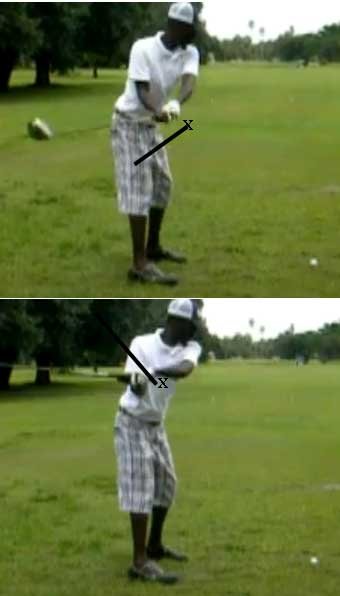
In the top picture, you’ll see that Dexter’s right elbow has bent very early in the swing. This causes his left arm to be pulled close to and across his chest, as you can see in the bottom pic. Compare this to these pics of Tiger (the 2007 swing) and Bubba, pulled from their slo-mo backswings at about the same position as Dexter’s top pic. (I added the black dots to show where the clubheads are. Bubba’s is a little misleading; unlike Dexter’s closed stance, Bubba’s stance is open so it looks like his right hand has actually twisted under his left. Watch the actual video and you’ll see it’s not as awkward as this pic makes it appear.)
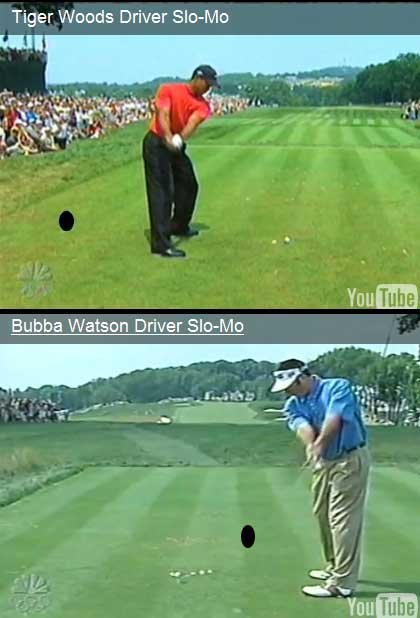
Now I know what you’re going to say: It looks like their hands are in about the same position as Dexter’s in that top picture… and you’d be right. However, if you look at their shoulders, you’ll realize that their shoulder position matches Dexter’s bottom picture! Tiger and Bubba coil their shoulders early in the backswing, while Dexter coils his much later.
This has a huge effect on the swing plane. See, Dexter’s hands in the top picture are actually about where they should be… but he hasn’t turned his shoulders yet. So what happens after this point, when he finally does coil his shoulders? He pushes his hands backward (or sideways, if you prefer that term) about 12-18 inches, which puts them below his swing plane. From there he has to push them straight up, causing him to loop over-the-top. While it’s a little difficult to see the upward movement of his hands clearly in this video, you can very clearly see the shaft being whipped around from pointing straight behind him (that’s in the bottom picture) to pointing toward the target… all in about 1 second of video! That’s where he shoves his hands up in an effort to get them up to the correct plane.
You can also see his right elbow, which is against his side through most of the backswing, suddenly move out from his side as he makes that “pushing up” move. Compare that to both Tiger and Bubba’s videos; you’ll see that their elbows are already well away from their sides as their hands move above shoulder height.
How much difference is there between the two takeaways? If you lift your hands, you’ll turn your shoulders maybe 1/4 to 1/3 of their full turn by the time your hands are waist high; but it you use a one-piece takeaway, you’ll turn your shoulders from 2/3 to 3/4 of their full turn by the waist high mark. We’re talking two to three times more coil early in the backswing.
Now, I don’t want you to think that “lifting your hands” is entirely useless as a takeaway. It’s extremely useful in your short game. When you don’t need much power and your hands aren’t going much above waist high anyway, you don’t need to turn your shoulders a lot. In fact, the less you turn them, the more accurate your short game shots will be. That makes “lifting your hands” an extremely useful takeaway for chips and pitches.
But not for a full swing. You need power in a full swing, which means you need that shoulder coil, plus you need accuracy as well. The less you move your hands and arms up and down during the backswing, the easier it is to stay on plane and the more accurately you can strike the ball.
Which begs the question: What does a proper one-piece takeaway look like? That will be the topic of the next post. But before I go, I want to address a comment Dexter made on the first post because it's important for all of you to understand that this isn't rocket science.
Dexter's comment started,
I can go out, take a tennis lesson or two, and have reasonable expectations that I can go play a decent game this weekend and have a good time. Same deal for softball. But once you utter the word "golf," you are told you will need to spend a fortune on lessons and hours on practice before you can even hope to be a duffer. Sure, there's a lot to learn about golf because you face so many different challenges in the game... but that doesn't mean it's so hard to learn. It's no wonder that golf isn't growing like other sports. Why spend a fortune on equipment, lessons, and greens fees when I can buy a basketball and a goal, have a friend teach me the basics of dribbling, passing, and shooting... and then I can have fun? Where is the simple instruction that would teach golfers how to just go out and hit decent shots?
Here is Dexter's problem in a nutshell:
And neither are any of you, no matter what kind of problems you're having with your swing. Hitting a golf ball is pretty simple. The vast majority of players who struggle with an over-the-top swing have exactly the same problem that Dexter has... and most just need a simple fix. Don't give up.
Today I want to look at the two most common ways players take the club away from the ball, and why one of them works and one doesn’t. We commonly refer to these methods as a “one-piece takeaway” and just “lifting the club.” Ask most people what the difference is and you’ll get an answer like “a one-piece takeaway is where your arms stay straight” and you’ll just get a puzzled look about the second.
The difference between the two is actually very simple. In a one-piece takeaway, the shoulders start coiling very early in the backswing; when you lift the club, the shoulders start coiling very late in the backswing. It doesn’t sound like much, but it makes a huge difference in where your hands end up. And make a note of this: Although your arms do stay fairly straight in a one-piece takeaway, it’s not because you stiffen up and try to make them stay straight. Your arms are relatively relaxed throughout; they stay straight because your shoulder turn means they don’t have to bend.
Let’s look at those stills I took from Dexter’s video again:
In the top picture, you’ll see that Dexter’s right elbow has bent very early in the swing. This causes his left arm to be pulled close to and across his chest, as you can see in the bottom pic. Compare this to these pics of Tiger (the 2007 swing) and Bubba, pulled from their slo-mo backswings at about the same position as Dexter’s top pic. (I added the black dots to show where the clubheads are. Bubba’s is a little misleading; unlike Dexter’s closed stance, Bubba’s stance is open so it looks like his right hand has actually twisted under his left. Watch the actual video and you’ll see it’s not as awkward as this pic makes it appear.)
Now I know what you’re going to say: It looks like their hands are in about the same position as Dexter’s in that top picture… and you’d be right. However, if you look at their shoulders, you’ll realize that their shoulder position matches Dexter’s bottom picture! Tiger and Bubba coil their shoulders early in the backswing, while Dexter coils his much later.
This has a huge effect on the swing plane. See, Dexter’s hands in the top picture are actually about where they should be… but he hasn’t turned his shoulders yet. So what happens after this point, when he finally does coil his shoulders? He pushes his hands backward (or sideways, if you prefer that term) about 12-18 inches, which puts them below his swing plane. From there he has to push them straight up, causing him to loop over-the-top. While it’s a little difficult to see the upward movement of his hands clearly in this video, you can very clearly see the shaft being whipped around from pointing straight behind him (that’s in the bottom picture) to pointing toward the target… all in about 1 second of video! That’s where he shoves his hands up in an effort to get them up to the correct plane.
You can also see his right elbow, which is against his side through most of the backswing, suddenly move out from his side as he makes that “pushing up” move. Compare that to both Tiger and Bubba’s videos; you’ll see that their elbows are already well away from their sides as their hands move above shoulder height.
How much difference is there between the two takeaways? If you lift your hands, you’ll turn your shoulders maybe 1/4 to 1/3 of their full turn by the time your hands are waist high; but it you use a one-piece takeaway, you’ll turn your shoulders from 2/3 to 3/4 of their full turn by the waist high mark. We’re talking two to three times more coil early in the backswing.
Now, I don’t want you to think that “lifting your hands” is entirely useless as a takeaway. It’s extremely useful in your short game. When you don’t need much power and your hands aren’t going much above waist high anyway, you don’t need to turn your shoulders a lot. In fact, the less you turn them, the more accurate your short game shots will be. That makes “lifting your hands” an extremely useful takeaway for chips and pitches.
But not for a full swing. You need power in a full swing, which means you need that shoulder coil, plus you need accuracy as well. The less you move your hands and arms up and down during the backswing, the easier it is to stay on plane and the more accurately you can strike the ball.
Which begs the question: What does a proper one-piece takeaway look like? That will be the topic of the next post. But before I go, I want to address a comment Dexter made on the first post because it's important for all of you to understand that this isn't rocket science.
Dexter's comment started,
"This is great Mike. I had no idea that I was that shallow on the takeaway. I am no where close to where I need to be huh? I was practicing today and I was trying to figure out how to get a little steeper without getting too steep."You should read the whole thing for yourself, because it really helps you understand why the average weekend player has trouble breaking 100. Dexter thinks he's a long way from a good swing simply because he's learned a lot about the golf swing... but very little that helps him solve his problem. You see, Dexter doesn't need to get any steeper -- an over-the-top swing is too steep to begin with!
I can go out, take a tennis lesson or two, and have reasonable expectations that I can go play a decent game this weekend and have a good time. Same deal for softball. But once you utter the word "golf," you are told you will need to spend a fortune on lessons and hours on practice before you can even hope to be a duffer. Sure, there's a lot to learn about golf because you face so many different challenges in the game... but that doesn't mean it's so hard to learn. It's no wonder that golf isn't growing like other sports. Why spend a fortune on equipment, lessons, and greens fees when I can buy a basketball and a goal, have a friend teach me the basics of dribbling, passing, and shooting... and then I can have fun? Where is the simple instruction that would teach golfers how to just go out and hit decent shots?
Here is Dexter's problem in a nutshell:
- Dexter has an over-the-top swing because he gets his hands in a bad position early on.
- He gets them in this bad position because he bends his right elbow too soon.
- He bends his right elbow too soon because he doesn't turn his shoulders early enough in the backswing.
- If we teach him how to turn his shoulders properly, then his elbow won't bend too soon, which means his hands won't go to that bad position and he'll stop swinging over the top.
And neither are any of you, no matter what kind of problems you're having with your swing. Hitting a golf ball is pretty simple. The vast majority of players who struggle with an over-the-top swing have exactly the same problem that Dexter has... and most just need a simple fix. Don't give up.
Friday, August 20, 2010
Dexter’s Coming Over the Top, Part 1
I was going to try making my first video for this post but the weather is not cooperating. (If you saw any of the Wyndham in nearby Greensboro, where they were playing LCP, you know it’s been pretty soggy here.) Since I’ve decided to break this post into more than one part, I may get a chance to make one for the other posts.
This first post focuses on understanding what makes a swing to go “over-the-top.” It’s hard to fix it if you don’t understand what you’re doing.
It’s kind of ironic. Just one week before Dexter made his first post about his over-the-top swing, I did an instructional article for Golfsmith.com about the correct way to make a one-piece takeaway. Not only that, but Michael Breed on The Golf Fix did a segment on how your takeaway affects your plane just a couple of days before Dexter’s post. (I don’t recall if he actually used the term “one-piece takeaway,” but that’s what he was demonstrating.) This is a common problem, and that’s why I want you to understand what’s happening.
First, you need to understand the difference between an over-the-top swing and any other kind of swing. It’s very simple, really:
But in an over-the-top swing, the hands are traveling almost directly straight up to the top of the backswing. When they get there, they can’t just stop; they have to change direction so they can head forward and downward again. So, just like the poor driver who missed his turn at the last intersection, they make a U-turn at the next opportunity, looping over and forward at the top of the backswing. Voilá! You’re in the wrong lane, and you’ve got a big pull working.
Dexter posted several videos of his swing, all showing a down-the-line view, in this post. Here’s the one I chose to focus on:
And here are a couple of stills I pulled from it, right around the :21-:22 second mark. I’ve added an X to each pic to show about where his hands ought to be, and a black line to show roughly where the club shaft would point. (They aren’t perfect, but they’ll give you an idea. To help fight his over-the-top swing, Dexter has closed his stance a little, which makes it difficult to get things perfect. I settled on making the marks relative to his chest position.)
As you can see, Dexter’s hands have traveled much farther around him (i.e., his backswing plane is too low) than they should be at these points in his swing. His hands are still below shoulder height, even though he can’t turn much further from the ball. They should be at or above shoulder height when he has turned this much. And see how the club shaft is pointing straight back, parallel to the ground? He’s swinging around, not up.
But his hands have to go up; they’re still not at the top of his backswing. So what will he do? He’ll lift his hands almost straight up to the top of his backswing (that’s really all he can do from this position). And now he’s got a problem, because his hands need to make a turn much sharper than 90-degrees to get back on plane and start down. So he does the only thing he can do—he makes a U-turn at the top, looping up and over so he can start down again.
In some cases, because a player is literally pushing his or her hands straight up, they’ve got so much momentum working against them that they have to use their hip (the right hip for a right-hander, the left hip for a left-hander) to counteract that momentum. The hip moves up and away from the target (rather than forward and around, as it would in a correct swing) and tilts the spine toward the target. As a result, the shoulder gets pushed up even higher and the hands loop even farther over-the-top.
Sounds like a real mess, doesn’t it?
But the problem isn’t the backswing per se. Rather, it’s the takeaway that starts the backswing... and that’s a much simpler problem to fix. I’ll explain how we do it in the next post.
This first post focuses on understanding what makes a swing to go “over-the-top.” It’s hard to fix it if you don’t understand what you’re doing.
It’s kind of ironic. Just one week before Dexter made his first post about his over-the-top swing, I did an instructional article for Golfsmith.com about the correct way to make a one-piece takeaway. Not only that, but Michael Breed on The Golf Fix did a segment on how your takeaway affects your plane just a couple of days before Dexter’s post. (I don’t recall if he actually used the term “one-piece takeaway,” but that’s what he was demonstrating.) This is a common problem, and that’s why I want you to understand what’s happening.
First, you need to understand the difference between an over-the-top swing and any other kind of swing. It’s very simple, really:
In most swings, your hands reach the top of your backswing and that's as high as they’re going to go; then they start down. In an over-the-top swing, your hands are going up when they reach the top of your backswing… and then they keep going up.It’s very easy to say, “Yes, yes, I understand” and totally miss what’s happening here. In a normal swing your hands are traveling toward the top of the backswing at an angle (i.e., your swing plane), stop traveling upward (even though they might still be moving back or down a little), and are then able to start forward and downward again, hopefully on a swing plane somewhat similar to the first one.
But in an over-the-top swing, the hands are traveling almost directly straight up to the top of the backswing. When they get there, they can’t just stop; they have to change direction so they can head forward and downward again. So, just like the poor driver who missed his turn at the last intersection, they make a U-turn at the next opportunity, looping over and forward at the top of the backswing. Voilá! You’re in the wrong lane, and you’ve got a big pull working.
Dexter posted several videos of his swing, all showing a down-the-line view, in this post. Here’s the one I chose to focus on:
And here are a couple of stills I pulled from it, right around the :21-:22 second mark. I’ve added an X to each pic to show about where his hands ought to be, and a black line to show roughly where the club shaft would point. (They aren’t perfect, but they’ll give you an idea. To help fight his over-the-top swing, Dexter has closed his stance a little, which makes it difficult to get things perfect. I settled on making the marks relative to his chest position.)
As you can see, Dexter’s hands have traveled much farther around him (i.e., his backswing plane is too low) than they should be at these points in his swing. His hands are still below shoulder height, even though he can’t turn much further from the ball. They should be at or above shoulder height when he has turned this much. And see how the club shaft is pointing straight back, parallel to the ground? He’s swinging around, not up.
But his hands have to go up; they’re still not at the top of his backswing. So what will he do? He’ll lift his hands almost straight up to the top of his backswing (that’s really all he can do from this position). And now he’s got a problem, because his hands need to make a turn much sharper than 90-degrees to get back on plane and start down. So he does the only thing he can do—he makes a U-turn at the top, looping up and over so he can start down again.
In some cases, because a player is literally pushing his or her hands straight up, they’ve got so much momentum working against them that they have to use their hip (the right hip for a right-hander, the left hip for a left-hander) to counteract that momentum. The hip moves up and away from the target (rather than forward and around, as it would in a correct swing) and tilts the spine toward the target. As a result, the shoulder gets pushed up even higher and the hands loop even farther over-the-top.
Sounds like a real mess, doesn’t it?
But the problem isn’t the backswing per se. Rather, it’s the takeaway that starts the backswing... and that’s a much simpler problem to fix. I’ll explain how we do it in the next post.
Subscribe to:
Posts (Atom)