ATTENTION, READERS in the 28 EUROPEAN VAT COUNTRIES: Because of the new VAT law, you probably can't order books direct from my site now. But that's okay -- just go to my Smashwords author page.
You can order PDFs (as well as all the other ebook formats) from there.
Showing posts with label golf politics and the ruling bodies. Show all posts

Friday, October 6, 2017

The New Era of Drug Testing Begins

Just a link today. Golf Channel posted an article about the new drug testing protocols that began this week at the Safeway Open.

Blood testing gear

What's new is blood testing, as opposed to just the urine testing that has been done in the past. Some performance enhancers only show up in blood tests, and that's critical if golf is to remain in the Olympics (among other things).

You can get the details from the article. I just wanted to make sure you know the new policy is now officially underway.

Tuesday, September 19, 2017

Why Randall Mell Might Be Wrong

It's become very popular over the last week to criticize how the Evian Championship played out, with the first round being wiped out, the event shortened to only 54 holes and the apparent mandate to finish the major in Sunday's broadcast slot. Randall Mell even wrote an opinion post called Randall's Rant: The Evian earned a major* asterisk to focus on what he sees as the problem.

He points to Mike Whan's belief that "We have to start thinking like title sponsors," that the LPGA needs to focus more on its sponsors than on the inherent integrity of the game.

photo for Mell's editorial

Now don't misunderstand. Mell isn't criticizing Whan's importance to the LPGA or the women's game in general. What he questions is whether Whan's approach works for majors as well as it works for women's golf in general.

And make no mistake, it has worked spectacularly.

As I see it, his question ignores a very important fact: The reason that the other four women's majors have become so respected is because Whan has adopted this approach. Let me explain, and I'll try to keep this short because I think the issue has been blown out of proportion but does deserve to be addressed.

Mell points out that, among Whan's other great achievements as LPGA commish, one of the things he has done successfully is convince (if you'll pardon the pun) major players in the men's game that the women deserve to be taken just as seriously. And the very reason Whan has achieved this "rise in status" for the women's game has been his attention to the sponsors. Let's look at some things that have happened since Whan became commish in late 2009.
  • More Open venues have become hosts of the RICOH Women's British Open, beginning with Carnoustie (2011) and Royal Liverpool (2012).
  • The PGA of America and the LPGA have begun working together, and that has resulted in the LPGA Championship becoming the KPMG Women's PGA Championship and expanding its play to the same championship venues that the men routinely play.
  • The PGA Tour and the LPGA Tour have begun working together, and this has also resulted in better quality events overall.
All of these advancements took time, but they happened in a much shorter timeframe than most expected. This is because Mike Whan has consistently taken gambles that appeared foolish, even contrary to the health of the women's game. Time after time, Whan's instincts have proven to be not only correct but successful to an inexplicable degree.

So when Mell ends his article with a medley of faults inherent in the Evian -- faults which he believes have become damaging to the LPGA -- and with the following statement:
Riboud’s working on it [the shortcomings], and Whan’s working on it, but we saw decisions last week that clash with major championship tradition.
I find myself laughing. As Mell himself notes, Whan declared the Evian a major just five years ago. I ask, what was the situation like at that time and how has it changed?

Evian was, at that time, considered a major by the LET although it wasn't accorded such status by the LPGA, and the sponsors had been the sponsors for a long time with little change made. Yet, in five short years, the Evian Championship course has undergone major renovations -- which are still continuing, as Mell notes in that previous quote -- the purse has gone up dramatically and the women themselves are taking it more seriously.

Is it perfect after five years? Of course not, and the tweets from the women themselves this past week indicate that they aren't satisfied yet. But this event has come much, much, MUCH further along than it would have without the "Whan approach." And we know that Mike Whan himself, as well as the sponsors -- who were satisfied with the event for so long -- we know that none of them are satisfied either.

In a word, we wouldn't even be having a discussion about how far this event has to go if it weren't for Mike Whan risking this sort of criticism. If not for Whan's somewhat radical approach, the LPGA would likely be in worse shape than the LET is right now... and the LET is willing to listen to Whan's ideas because Whan's involvement causes the Men's ET to get involved.

Randall Mell is wrong. The Evian doesn't get an asterisk for failing. Before long it will likely be seen as a major stepping stone in the growth of women's golf, because we know Mike Whan & his co-conspirators will use this as a goad to drive their game to higher levels of excellence.If this Evian gets an asterisk, it will be for inspiring new advancements in women's golf. And why am I so sure?

Because that's what Mike Whan has done time after time since he became LPGA commish. Given his success rate for meeting challenges so far, I see no reason to believe he won't meet this one as well.

Monday, May 1, 2017

The PGA Tour Makes It Harder for Injured Players

Obviously there's no Limerick Summary today because, at the time I'm doing this post, the Zurich Classic isn't finished. So I thought I'd comment on a recent turn of events that bothers me.

I'm talking about Brian Gay and Ian Poulter finally getting their Tour cards back. Don't get me wrong -- I'm very happy that they got them back. What bothers me is the Tour error that almost kept them off the Tour. It's time for a rant!


I'm linking you to a golf.com article that explains the whole thing in more detail, but the short version is that the Tour has changed the way they figure the points for the FedExCup. That's what the Tour is using to figure out when an injured player has played well enough to regain his card.

Again, short version: The Tour has made it harder to get those points since the two men were injured, so it's harder for players coming back from injury to regain their cards. If Brian Gay had not realized what had happened -- and that it shouldn't have applied to him and Poulter -- both men would have lost their cards DESPITE having done enough to get them back.

Brian Gay figured out that something was wrong, went to the Tour and, fortunately, common sense prevailed at Tour HQ and they awarded both men their cards. And I realize most folks would be happy and let it go at that.

But I'm bothered by the Tour's decision to make it harder for a player to come back from a major medical leave. Shouldn't a player trying to return from an injury be granted a slightly easier road back, allowing him to properly return to form?

After all, players keep saying that no matter how much you practice, you need time playing under competitive pressure to genuinely return to form. Logically, players will not finish as well during that "return to form" period.

Yet the Tour has reduced the points that are available for those lower finishes! That puts recovering players in the situation Gay and Poulter found themselves in, and that simply doesn't seem fair to me. If you really want to help players return to the Tour, why would you set the standards so high?

Presumably the Tour has changed the points structure to represent an improved level of play at the top levels of the Tour. I question how making it easier for the top players to gain points while the rank-and-file have to struggle even harder to keep their cards improves the makeup of the Tour. (But since when has the Tour made decisions that are easy to understand?) However, this seems draconian to me.

At the very least, it seems that the Tour should use a different point structure for players returning from a major medical leave -- one that allows them to ease back into the competitive environment of the Tour, rather than expecting them to return in the same form they had before they were injured. As it stands -- using the sample point totals from the golf.com article:
Gay began digging into his FedEx Cup totals for his 2016-17 finishes and only then noticed a lightly publicized change to this season’s points breakdown. The Tour has restructured the distribution, giving fewer points to finishes below 14th. For instance, a 20th-place finish last season was worth 51 points, but this season it brings only 45; 30th place has been devalued from 41 points to 28.
Note that Gay was 28 points short of his requirement, which was 464 (125th in ’14-15). But look at how the changes affect him:
  • Two 30th-place finishes -- just outside the Top25, and a reasonable expectation for a player returning from an injury but playing well -- now bring only 56 points rather than the original 82. That's 26 points right there!
  • With five Top20 finishes, he would only receive 225 points instead of the 255 awarded before the change -- 30 points less.
For comparison, Ryan Moore is currently 30th in FedExCup points with 538 points in 12 starts (one MC) this season. Moore has only one T3, one T9 and one T15... but he has 7 Top25 finishes. Most of his finishes are between 15 and 35 (plus a T39 at the Match Play and a T61 at the Phoenix Open).

Drop down to Branden Grace, also with 12 starts (one MC, one WD) this season. He's 64th with 359 points. He has a T10, T11 and T13... and only 4 Top25 finishes. Most of his finishes are between 20 and 35 (plus a T39 at the Match Play, same as Moore).

Neither of these players were on major medical.

Compare them with Brian Gay, currently at 83rd after 11 events (three MC). He has only 280 points for this season. He has two T6s and a T13 (that's three Top25s)... and nothing else higher than a T28. Yet this is better than he did last year when he first came back from the major medical, when he missed 9 cuts. He only had one Top10 last year, a 6th place finish.

You're probably thinking that Gay played so bad, it's no wonder he didn't get his card. But that's the whole point -- under the old system, HE DID! There are a number of healthy players, in no danger of losing their cards, who don't have three Top10s in that time period. Players coming back from a major medical leave simply don't have the consistency of healthy players, yet they have to conform to a new point system that requires consistency to keep one's card.

The Tour needs to fix this. Situations like Gay and Poulter's simply should not happen. Major medical exemptions should help players work their way back into shape, not penalize them for being injured.

End of rant.

Thursday, April 27, 2017

Here's How Lexi Accidently Mismarked Her Ball (Video & Pics)

After listening to Lexi's presser Wednesday -- and recreating the mismarking incident myself -- I think I can finally explain how Lexi could mismark her ball so badly by accident. And since Lexi seemed genuinely confused by the event when asked at the presser, perhaps it will help her as well.

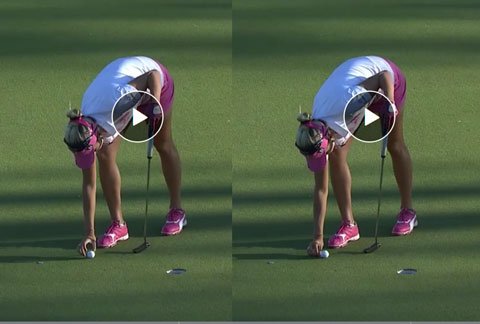
First, here's the now-notorious video of the event, currently posted on this page at the Golf Channel website. (In the photos below, please forgive the ever-present "arrow" -- it appeared every time I paused the video for a screen capture.) The footage I'm using is in the first 32 seconds of the video:


There are actually two things you need to know in order to understand this video, and Lexi told us both of them at her presser. You can find the quotes I'm using in this Golfweek post.

The first is her mental focus at the time. She had just missed a short putt on the last hole and, as she walked up to tap this putt in, she said she could hear her dad's voice telling her to slow down:
Thompson began by explaining how upset she was about her birdie effort from 20 feet in the third round. Terrible stroke, she said.
She initially thought about tapping it in, but because her father, Scott, has fussed about the number of short putts she has missed over the years by moving too hastily - “I’ve stubbed a few” - Thompson decided to mark the ball.
She walked along the line of the original putt to tap in the putt, then decided at the last second to mark it. You can see the momentary indecision in the video. That indecision is why she marked it from the side.

The second is how she marks her ball:
“The way I mark my ball, I mark my ball with a dot, and that’s where I focus my eyes on where I want to make contact,” she said. “So when I went to mark it, I just rotated my ball to line up my dot to where my putter would make contact.”
She uses a dot on the back of the ball, not a line on top, so she's looking at a tiny dot when she marks.

Now we're ready to go through the incident as it happened in the video.

Lexi has just made that "terrible stroke" and walks toward the ball, intending to just tap it in. But she thinks better of it -- her father's voice, if you will -- and decides instead to mark it. Perhaps because she's still frustrated by the miss on the previous hole and the bad stroke she just made, perhaps because she just didn't think things through because it's a spur-of-the-moment decision, perhaps because it's such a short putt, she doesn't walk around and mark the ball as she might for a longer putt. Instead, she marks it from the side. This is the mistake that sets the whole debacle in motion.

You see, Lexi may have thought about her dad's words, but she's still "moving too hastily." Her mindset hasn't changed from "this is just a tap-in." She's more concerned about the dot than the putt.

As we all know, it's very easy to miss the obvious when your mind is on something else. (How often have we heard an announcer say, "He fell in love with the line and forgot to hit the ball?" Same thing.) But because we don't want to be disturbed when we're trying to putt, we're advised to choose a very small target -- like a single dimple on the ball, or a dot -- and focus on that. Lexi's focusing pretty hard on that dot at this point, and not much else.

My first thought was that perhaps when Lexi tried to line up that dot, she tilted her head somehow and changed the way she saw the line. But as you can see from this comparison showing just after she put the coin down to reach for the ball and then just after she set the ball down to reach for the coin, her head is in the same position:

Comparison of Lexi before and after moving her ball

At this point I realized that I needed to try and recreate what she did. Often we watch things over and over without really seeing what's there, and we don't really "see" until we try it ourselves. And that's what happened to me.

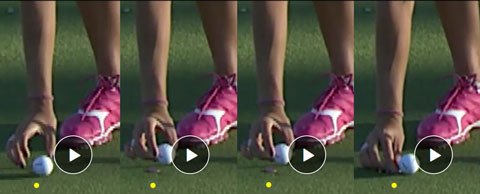
Because when I tried to mark the ball just like Lexi did, I suddenly discovered that I COULDN'T SEE THE BALL MARKER AT ALL AFTER I PUT IT DOWN. MY PALM WAS IN THE WAY.

Look, here are four stills from the close-up in the video. I've added a small yellow dot just below the position of the marker. The stills show:
  1. Lexi just after placing the marker
  2. Lexi rotating the ball
  3. Lexi placing the ball
  4. Lexi reaching to pick up the marker
The ball marker is under her palm -- hidden from view -- in all four stills. In fact, I found that rotating the ball as Lexi did actually made the marker even harder to see -- my fingers got in the way.

Sequence of Lexi marking her ball

Why didn't Lexi notice this? Because her attention was on the small dot she was trying to line up with the hole. And from her point of view, her hand never moved from its original position, so no alarms went off in her head.

Go back and watch the incident again at full speed. It's obvious, once you know what to look for.

Look, this doesn't mean that Lexi didn't break a rule, not even when you take the new "naked-eye" and "reasonable judgment" standards into account. The movement is clearly visible when viewed at full speed from the original broadcast footage. But this should put to rest any rumors that Lexi did it on purpose.

However, we should note the cause of this whole sad sequence of events. Once Lexi decided to mark the ball, if she had been thinking about making a normal putt instead of a tap-in, and had lined up the ball as if it were a longer putt, her hand would have been to the side of the marker, not covering it while she marked the ball. She would have had a clearer view and would likely have noticed if she positioned the ball incorrectly.

As much as I hate to say this -- given the current fuss about slow play -- Lexi simply didn't take enough time to gather herself. She probably should have put down her coin, picked up her ball and walked away. She should have taken a few deep breaths, a few practice strokes, and taken time to clear her mind of the bad putt she had just hit. And then she should have taken the time to line up her putt like normal.

In short, Lexi didn't treat this like an important putt. But it was.

There's no such thing as a tap-in at a major. I.K. Kim can tell you that. And now, so can Lexi. Hopefully she'll move past this sooner rather than later.

Of course, we'll get to watch her first tournament back starting today at noon ET when GC broadcasts the Volunteers of America Texas Shootout. You can get a quick overview of the event over at Tony Jesselli's blog.

Wednesday, April 26, 2017

Introducing... the Nordqvist Rule!

Yes, everybody was expecting a Lexi Rule. But what we got wasn't bad at all, in my opinion.


Decision 34-3/10 institutes two new criteria for judging rule breaches. They are the "naked eye" standard and the "reasonable judgment" standard.

In addition, a new "working group" has been created to examine the best way to deal with video and viewer-submitted evidence when enforcing the rules. That working group includes folks from the USGA, R&A and the major tours.

Personally, I was thrilled to see the "naked eye" test included. If you follow my blog, you know I've been arguing this for a while, as I did in my Why Armchair Officials Are Unneeded post right after the Lexi debacle, where I wrote:
I think that any "infraction of the rules" that can't be seen with the naked eye from a few feet away ISN'T an infraction. That's how the rules were enforced when The Rules of Golf were originally written.
And that's why I call this new rule the Nordqvist Rule -- because it specifically mentions the Nordqvist ruling at the US Women's Open last year:
...there are two situations in which the use of video evidence is limited: When a player unknowingly touches a few grains of sand in a backswing with a club in making a stroke from a bunker... In such situations, if the Committee concludes that such facts could not reasonably have been seen with the naked eye and the player was not otherwise aware of a potential breach of the Rules, the player will be deemed not to have breached the Rules, even when video technology shows otherwise.
The second example they quote happened several years ago. (I forget the name of the player, although GC mentioned him during their broadcast.) The point is that the USGA and the R&A agree that the rules need to evolve along with technology. That's a HUGE step forward, and the fact that they've decided to put it into effect immediately is also very promising. (Kendra Graham told GC that evolving the rules along with the technology is a guiding principle of the new rule revisions and, since it's so basic to the revision, they saw no reason not to put it into effect right now.)

Ironically, neither of the new standards would have actually helped Lexi. According to the video evidence that was used originally, you can see that the ball was moved perhaps two inches from its original position -- no closer to the hole, just sideways. But based on the standards, that's an amount that's observable by the naked eye of a competitor.

The "help" will be left up to the working group. They will work to decide what evidence will be allowed in the enforcement of the rules. And I suspect this will be somewhat messy for a while, as different methods are tried at different events in different circumstances.  Ironically, Kendra said she was all for eliminating video evidence entirely -- but noted that doing so would also eliminate using video to help players, as when it's used to determine where a ball entered a hazard.

MAKE NO MISTAKE -- THERE WILL BE SOME MISTAKES MADE DURING THIS PROCESS. As Kendra noted, there are going to be unforeseen consequences with any decision the group makes, and we'll just have to put up with them during the process.

But I think that's okay. The rules will be worked out in the crucible of the game itself, not in some remote office where only the carpets are green. The actual effects of proposed changes -- the often unexpected repercussions -- will be seen in the real world, not just in some theoretical debate.

In the end, there is no substitute for experience. As critical as I have been of the ruling bodies for some of their decisions, I think this is a necessary step if they really want to make the Rules of Golf work under actual circumstances. I'm applauding them for what they did Tuesday.

Saturday, April 15, 2017

To Call or Not to Call (Video)

Today I'd just like to make sure you all know both sides of the continuing argument about the Lexi Thompson ruling at the ANA a couple weeks back. I've got an article and a video for you.

The article is from Golf Digest and is called Viewer Discretion Advised. In it Jaime Diaz covers the discussions between the USGA, R&A, PGA Tour, LPGA and European Tour since the whole thing took place. It also discusses the rule that might change it -- the proposed Rule 1.3a(2).

The video is from Morning Drive's interview with Michael Bamberger about why viewer phone-ins should be allowed. Needless to say, his is going to be a controversial opinion!


The one thing I gathered from these two pieces is that a rule change may be a much bigger issue than many people expect. To me, this is an issue grounded in the history of the rules -- namely, that video was never considered when the rules were made because video wasn't even a possibility at the time. For that reason, I don't think "video police" who aren't on the premises of the event should be allowed to act as referees. Having tournament officials use video to confirm infractions -- including questionable behavior witnessed by fans attending the event -- would be allowed.

To me, that seems to fit the spirit of the rules.

But it's becoming more and more clear that this will be an issue about the "squeaky clean" image that the major golf organizations wish to maintain. Whether it's intended or not, that image is being called into question more and more as the debate goes on, especially with Jack Nicklaus having used the term cheating during a TV interview to describe a situation at the 2015 Presidents Cup. (That incident is mentioned in the article as well.)

As a result, I'm afraid this might get ugly before it's over. I guess we'll find out soon enough.

Tuesday, April 4, 2017

Why Armchair Officials Are Unneeded

I'll do my "5 to Watch" at the Masters post tomorrow. Today it's time for my promised rant about letting TV viewers affect tournament rulings. I think there are a number of things which are being ignored in the debate, even after the Thompson ruling at the ANA Sunday. I'd like to look at three of them in this post.

Point #1: Allowing armchair officials actually works against the ideal of creating a level playing field for all competitors.

The Rules of Golf, like the rules of most sports, were never designed to deal with a digital world. That's part of the reason we're having these struggles now, as are many other sports organizations like the NFL. Of course, golf is having a worse time than most, simply because the other organizations don't allow viewer input at all. For example, former Vice President of Officiating for the NFL Mike Pereira tweeted:


In fact, here's an interesting note on how the NFL will now treat video reviews, as expressed in a decision made at the NFL Owners' Meeting just this past March 28:
Most notable Tuesday was the change in handling officiating of video replays. Referees will now watch replays on the field using tablets, eliminating “going under the hood” to the watch on television monitors.

League officiating chief Dean Blandino and his staff in New York will make the final decisions on those calls, with input from the referee, who in the past was the ultimate arbiter after consulting with league headquarters.

“And I think that’s important to remember, we’re not taking the referee out of the equation,” Blandino has said. “The referee will still be involved, the referee will still give input, but will no longer have the final say.”
For those of you who don't understand why the NFL would want to minimize the part played by the actual refs on the field during a video review, you have to realize that NFL games are taking place all over the nation and each game has a different set of refs. What the NFL wants to do is have only one voice in EVERY game making the final decision during video reviews, in order to get one consistent set of rulings for the entire league.

In other words, the NFL decided that you make the game fairer for every player by MINIMIZING the number of people involved in officiating. And when the golf tours allow viewers -- who aren't even part of the appointed officiating crew -- to influence decisions, they actually increase the likelihood that players will be treated unfairly.

Lexi's ruling was a case in point. Millions of fans watched the same broadcast but saw no violation. However, one person who discovered a problem 24 hours later probably cost her a major. In no other sport -- where only the officials on the field are allowed to make such rulings -- would a travesty like that have been allowed. Which brings us to...

Point #2: Officials are unbiased. Fans are not.

I realize that this point is going to offend some people, but we have to deal with it. And while I don't mean to insinuate that every fan is motivated in the following ways, the nature of the violations that get reported are problematic. For when fans call tour officials to "report a violation" -- something that none of the officials, nor millions of other fans saw, and especially when finding said violation requires examination of extreme video close-ups to verify what happened (and those close-ups weren't shown as part of the broadcast) -- we have to ask what kind of fan goes to that much trouble.

And the answers aren't very pretty.

We may be dealing with people who feel powerless, and they boost their feelings of self-esteem by trying to effect the actions of "famous people." I think we'd all agree that these people have a psychological problem that requires therapy, not the validation of ruining things for the "famous person." Granted, this is less dangerous than stalking or attempting to murder a celebrity, but it's still not something we want to re-enforce.

We may be dealing with fans who will do anything to help "their" player win. In this case, the player has been specifically targeted, rather than the randomness of the previous example. And since a particular player has been targeted, the integrity of the field has clearly been compromised if we allow these "violations" to be heard.

But perhaps the darkest possibility is that the entire event is being manipulated. Whether the tours want to talk about it or not, we all know that a great deal of sports betting goes on around the world. I wonder how much money -- betted legally or not -- changed hands when Lexi was assessed a 4-stroke penalty and the odds on who might win the ANA changed dramatically?

Worse yet, imagine how much money could be made if the bettor KNEW that the odds were going to change because he or she orchestrated that change? This possibility simply can't be ignored.

One of the sides of the debate I've heard over the last day or so is that "golf is different from other sports, and this is part of what makes our game different." But I would argue that every decision we make has consequences, and we can't simply ignore some of them because we don't want to admit they exist. There is a reason why other sports don't allow the fans to influence the referees in this manner.

Tell me: Is the fear that someone may occasionally make a cut because of a missed penalty really worth risking such wholesale manipulation of the sport itself? I can't agree with that. The risk is too great.

When ANYONE can affect the officiating of a game, we open the door to all sorts of manipulation that can destroy the integrity of that game. The only way to prevent that is to stop it at the source. We simply MUST limit the number of people whose voices matter. If we don't, we're being irresponsible toward the players in the field and the vast majority of fans who are content to let the appointed officials do their jobs.

Point #3: Eliminating the outside voices will not allow more violators to "get away with it." Rather, the fix is rather simple to implement.

In listening to the debates over the last day or so, I've been amazed at how easily we are overwhelmed by technology. How many officials are needed in the TV truck, for example? Who will keep watch on the 30 or more video streams coming from the on-course cameras? Perhaps we need all the viewers to help us keep watch on the field, to make sure no one cheats!

There are so many flaws in this line of thinking that I almost don't know where to start. But I'll try.

First of all, we don't need to worry about all the cameras on the course. In case no one has yet realized it, all of those millions of fans are watching the exact same cameras -- namely, the network broadcast stream. I'm pretty sure the tours can find one or two officials who are willing to take a beer and some pretzels, head off into an air-conditioned room, and settle into comfy chairs in front of a large-screen TV to watch the broadcast! Since this is such a strenuous job, we can rotate the officials every hour or so. That way we'll always have fresh eyes watching.

We can even give them a direct intercom to the TV truck. That way, if our "official viewers" should see something, they can buzz the official in the truck: "Hey, can you take a look at Lexi's ballmark on 17? She might have marked it wrong. Thanks."

Is that really so hard?

As I said earlier, The Rules of Golf were never designed to deal with a digital world. But that really shouldn't be a problem when it comes to enforcing them. We talk constantly about the integrity of our players, and we build entire youth programs around the values our game teaches. But we seem compelled to contradict that by our actions...

After all, if our golfers are so honest, then why do we need super-magnification on our cameras to detect when the ball has been misplaced by a single inch? It's obvious, isn't it? It's because WE MUST PUNISH ANY IMPERFECTION WITH THE MAXIMUM ALLOWABLE PENALTY! WE MUST NOT TOLERATE LAWBREAKERS, EVEN IF THEY CLEARLY DO SO BY ACCIDENT AND THEIR TRANSGRESSION HAS NO MEASURABLE EFFECT ON THE GAME!

Our game has reached a point where it is no longer about having fun. It's about the paranoia of being perfect in every possible way:
  • We MUST have perfect mechanics, or our swings are subject to criticism.
  • We MUST hit every wedge shot within a statistically acceptable range, or our players look as if they just ate a live slug and they slam the ground with their clubs.
  • And we MUST call every penalty possible on ourselves, lest our integrity be called into question. You say that you caused that ball to shift position by ONE WHOLE DIMPLE? My God, man! Call that one-shot penalty on yourself or forever be a pariah among your peers!
Other sports -- all of which accept the fact that there will be occasional errors in the officiating -- continue to grow in popularity, much faster than golf. Apparently the fans are less concerned with perfection than with fair competition. Perhaps golf should adopt the same attitude, especially since we are so proud of our players' integrity. Why not trust them for a change?

But there is no longer any room for human frailty in our game, is there? We can't just present a good product; it has to be a perfect product. It doesn't matter whether the so-called violation has any effect on the outcome of the game or not. And in the process, we teach the youngsters coming up that nothing we do is ever good enough. We teach them that legalism and punishment are more important than logic and common sense. We teach them, in effect, to be "holier than thou."

I think that makes "growing the game" a good deal harder than it needs to be.

There has been a great deal of debate so far over the proposed rule changes being considered by the USGA and the R&A. Everyone is debating whether individual changes are integral changes to the game or just overdue logic. We're even beginning to ask if intent should matter when enforcing the rules. These debates are necessary. They're how we discover what is important in our rules.

But perhaps common sense should play a bigger part in our rules. Lexi was penalized 4 shots for placing her ball one inch to the left of her original line... on a flat putt measuring twelve inches in length. While we don't want our players to get sloppy about marking their ball, there has to be some point at which we simply say, "Oh well, it didn't make any difference to the outcome. But you need to be more careful from now on."

It happened 24 hours earlier, folks. It didn't affect how difficult Lexi's putt was, and the integrity of the field wasn't harmed. But that 4-shot penalty, assessed in the midst of the final round, DID affect the integrity of the field and tainted the whole event. Even So Yeon Ryu, who benefited from the ruling, stood there crying at the end and told Lisa Cornwell that it just didn't feel right.

When the Rules create the very problems they were meant to prevent, it's time for the Rules to change.

I think that any "infraction of the rules" that can't be seen with the naked eye from a few feet away ISN'T an infraction. That's how the rules were enforced when The Rules of Golf were originally written. If the infraction couldn't be seen, the players were expected to call it on themselves. And no one worried that someone would "get away" with breaking a rule. If we modern types believe they will, unless we use the most high-powered enforcement tools available...

Well, maybe we don't believe in personal integrity as much as we claim.

At the very least, we don't need millions of viewers all calling in about it. Video wasn't part of the Rules when they were originally set down. It DEFINITELY shouldn't be part of them now.

End of rant. For today, anyway. ;-)

Friday, March 17, 2017

Some Thoughts on the Muirfield Vote

Rory McIlroy made headlines this week (again) when he expressed his frustration with the Muirfield vote to allow women members, thus regaining their status on the Open rota. While he was glad the membership finally "saw sense" (as he put it), he wasn't impressed by how long it took them to finally get it right. The word he used was "obscene."

I think most of us agree with Rory that the concession was way overdue. But I feel that the whole debate has ignored something very basic about human beings, and that's what this post is about.
Let me be blunt about this: Although we'd all like things to be done for the "right" reasons, change is a messy operation because we humans don't like change and we are far from perfect when we deal with it. And in our frustration with the messiness of it all, we have a tendency to miss the positive aspects of the process.
Let's go back a year to the original Muirfield vote, where the required 2/3 majority was narrowly missed. I want to emphasize that phrase "narrowly missed," since I've heard it used several times by the media.

It's very easy to assume that organizations are little more than a single monolithic group of people who all believe EXACTLY the same way. But we all know that's not true, don't we? When a group we identify with is characterized as all having the same beliefs -- and we don't -- we get really upset for being "stereotyped." We complain that a "vocal minority" doesn't represent what we think, and we resent being grouped in with them.

But isn't that exactly what has been done to the membership of Muirfield?

Not every member at Muirfield voted at the original proposal. For the sake of this article, I'm going to assume that none of the nonvoters wanted women to join but didn't want to be publicly associated with that stance. I doubt that was true -- there could be any number of reasons that some members chose not to vote -- but since they didn't vote, it had the same effect as if they voted against the motion. Namely, there were fewer voters to be part of the 2/3 majority that was needed.

But in our condemnation of the result, we focused on the slightly-more-than-1/3 who voted against the motion, didn't we? In fact, A SUBSTANTIAL MAJORITY OF THE MEMBERSHIP VOTED TO ALLOW FEMALE MEMBERSHIP. I imagine the largest part of them were in favor of female membership all along... but overturning tradition is a hard thing in many institutions.

And clearly a large number voted to allow women simply to keep Muirfield's spot in the rota. These voters are being vilified for that. They should have been progressive, we argue, and allowed women to join simply because it's the right thing to do! But I think that's being a bit harsh. Just think about it for a moment...

A spot on the rota means you get the Open roughly once a decade. A decade is roughly 520 weeks, while the Open lasts for one week. If you're truly against having female members, how can you possibly believe that one week of the Open is worth 510 weeks of dealing with these hated female members ON A DAILY BASIS? I'd argue that these members said, in effect, that although they felt no compulsion to allow women members, THEY HAD NO PROBLEM WITH ALLOWING THEM EITHER. It was simply tradition and they'd had no reason to change. But now they had a reason, so they voted to change.

Given the normally messy process of change, I'd say that's actually a fairly progressive mindset! It may not satisfy those who want everything to happen as it would in a perfect world, but it still shows a willingness to move forward and accept change.

That's what probably happened a year ago. What happened in the meantime that led up to this week's vote?

I'd say that the "narrowly" outvoted majority -- both those who were vocal about accepting women and those who simply had no problem with accepting them -- became much more vocal at the club. How do I think that played out?

We heard that originally there were some members who resented being told what to do by the R&A. The vocal minority probably convinced them that the R&A wouldn't dare enforce the vote against the membership's will. THEY WERE PROVEN WRONG. Do you think that the members who voted to allow women hesitated to let them know that their stubbornness had cost Muirfield the Open? I don't, and I don't think it took much shaming to get a "yes" vote from them this time.

As for the true hardliners who resented letting women in, I suspect the rest of the membership made sure they felt the burden of tainting Muirfield's reputation. And I wouldn't be surprised if a few of their wives didn't let them know that, if they were too good to share a locker with a woman, they were too good to share a bed with one, as well! How many meals do you think those husbands missed? How many days did they have only dirty shirts to wear?

Yes, I suspect that happened to at least of few of them. Men who are that stubborn probably aren't the easiest to live with, and their wives had probably decided to let them know in no uncertain terms.

So Muirfield will now accept women members. Before you judge the club too harshly, simply because some of those hardliners will likely be less than friendly to the new women members, remember this:
Let me be blunt one more time: Eventually, those relics of antiquity will die from old age and no longer be members of the club. And when new members come in, they will do with the knowledge that women will also be members and there's not one damn thing they can do about it. If they don't like that, they'll go elsewhere.
In the end, Muirfield will be a place where female members are welcome for all the right reasons. It's how the rather messy process of change works in a world of imperfect human beings. Let's just be thankful that the vast majority of Muirfield members decided to embrace that process and let it take its normal course.

Saturday, July 2, 2016

And Then There's Muirfield

Unlike a lot of people, I'm not going to rag on Muirfield for not opening its membership to women. Muirfield is a privately-owned golf club and, as such, has a right to set its own policies -- including their decision concerning who they will allow to join their club.

But with Royal Troon's decision Friday to allow women members, it does leave Muirfield in the awkward position of being the only course in the Open rota that doesn't allow women.

Excuse me, I should amend that statement: Muirfield is the only course THAT USED TO BE in the Open rota that doesn't allow women.

Muirfield sign

In fairness, it should be pointed out that at least some women are allowed to play Muirfield as guests for free. In an article with the UK Telegraph, Peter Alliss said he believed women would balk at paying a fee to join. Here's one quote:
“The fact is if you talked to the wives of members of Muirfield they would be horrified at the prospect of being allowed to join. The wives can use all the facilities at the club but it doesn’t cost them anything. If they had to pay to join they would be horrified."
Do the perks of being the wife of a member extend to women who don't hold that position? The article doesn't say. But the rest of the article makes for interesting reading, as it certainly sounds as though other women wouldn't be as welcome as the wives.

After the Muirfield vote, it was reported that Troon intended to have a similar vote, in hopes of heading off a possible boycott of this year's Open, and many expected that the women would win the day. Were the results of the Troon vote further influenced by the R&A's decision to take Muirfield off the rota? It's hard to believe the ban wasn't at least a consideration, and the R&A wasted no time reassuring the club that they would remain on the rota going forward.

Muirfield is supposed to hold another vote sometime soon. The club’s captain, Henry Fairweather, was quoted in the Guardian as saying:
"The club committee believes that a clear and decisive vote in favour of admitting women as members is required to enable us to begin the task of restoring the reputation of the club that has been damaged by the earlier ballot outcome.”
But the damage may not be so easily undone. Even if a new vote gives women the nod, that doesn't mean that the attitudes of the members themselves have changed. And even though it appears that the first vote didn't represent the predominant attitude of the club members, it's hard to believe that the negative vote will be forgotten soon. It's just not human nature to forgive and forget.

Muirfield may find that lesson a hard one to learn.

The photo came from the Telegraph article quoted above.

Thursday, November 20, 2014

Does Tiger Have a Case?

Ever since Golf Digest published the Dan Jenkins piece My (Fake) Interview with Tiger and Tiger made it clear that he didn't like it at The Players' Tribune, a debate has been going on. Some of it concerns the fairness of the Jenkins piece while some concerns the legality. Does Tiger have any recourse if he doesn't get the apology he'd like?

To put it simply, no, he doesn't. But since this particular issue may be in the news for a while, you might like to know the hows and whys behind that answer. In this post I'm going to give you a quick lesson in the legal aspects of parody and satire. After all, you don't need to be a lawyer or even stay at a Holiday Inn to understand this stuff.

All you need is an authoritative website -- in this case, the very impressive site of the Reporters Committee for Freedom of the Press.

Dan Jenkins

First -- and this doesn't come from the rcfp.org website -- parody is generally humorous and focuses on form while satire tends to be less humorous and focuses more on a topic or person. Some of the comments made about the Jenkins article have protested that it isn't even funny, but satirists are rarely after a laugh.

A classic example of satire is A Modest Proposal (you can read it for free at this Project Gutenberg page), written in 1729 by Jonathan Swift, who is probably better known for Gulliver's Travels -- which is itself, according to Wikipedia, both "a satire on human nature and a parody of the 'travellers' tales' literary sub-genre."

In the same way, the Jenkins piece is both satire and parody -- a satire on Tiger's behavior (or at least the Jenkins perception of it) and a parody of magazine interviews.

About A Modest Proposal Wikipedia says, "This satirical hyperbole mocks heartless attitudes towards the poor, as well as Irish policy in general." Even now Swift's "proposal" -- which suggests that starving Irish beggars sell their babies to the rich as food -- remains a remarkably disturbing read, with very little humor. You can imagine how it was received when it was first published!

What Jenkins has done with his "interview" is mount a personal attack on Tiger, much the same way Swift attacked the uncaring members of Irish society in his day. It's not meant to be funny; it's meant to hurt. It's no secret that Jenkins has been, shall we say, a longtime antagonist where Tiger is concerned, and his pet peeve has been Tiger's refusal to grant him an interview -- hence, the interview format.

The question becomes, does this in some way classify as libel? The Reporters Committee site has a page called Protection for Satire and Parody, which says in part:
Satire and parody are important forms of political commentary that rely on blurring the line between truth and outrageousness to attack, scorn and ridicule public figures. Although they may be offensive and intentionally injurious, these statements contain constitutionally protected ideas and opinions, provided a reasonable reader would not mistake the statements as describing actual facts. Put another way, subjects of even the most biting satire or criticism cannot successfully sue unless the irreverent comments contain a provably false fact. Moreover, public officials and figures must prove that the defendant published the statement with actual malice.
Note that the comments may be "offensive and intentionally injurious" but still be protected under the First Amendment.

Another page, Avoiding Libel in Satire, lists a number of steps that a writer or publisher can take to make sure they're protected -- among them, making it clear from the outset that the piece in question would never be mistaken for a literal truth (a condition also referred to in the above quote). Among the other things Golf Digest did, they included the word fake in the article title, which certainly fulfills this criterium.

A particularly interesting page is called Defining "Actual Malice." (That page links from the final words in the quote.) The US Supreme Court defines actual malice as either purposely or negligently printing lies (aka "reckless disregard for the truth"). Interestingly, the page lists a number of things which do NOT constitute actual malice, and these include:
  • ill will or intent to harm
  • extreme deviation from professional standards
  • publication of a story to increase circulation
So in the end, even if you believe Dan Jenkins wrote the piece because he "had it in for" Tiger, or that he wrote it solely to boost magazine sales, or just that it was an unprofessional thing to do, the fact remains that he was totally within his rights to write the piece and Golf Digest was totally within their rights to publish it... and there is nothing Tiger can do about it.

Of course, that doesn't mean Jenkins should have written it... but that's why the debate will go on.

The photo comes from this ESPN story about the "interview."

Tuesday, October 28, 2014

Ted Bishop's Side of the Story

Ted Bishop is scheduled to be on Morning Drive today but, in case you miss it or would rather read Bishop's side of the story for yourself, here's the link to Jaime Diaz's article at golfdigest.com.


According to Bishop, he was set up to take a fall... and if Bishop is telling Diaz the truth about the chain of events that followed that infamous tweet, it's a reasonable accusation that the PGA will be forced to respond to.

Based on what Diaz has written in this column, I have a feeling that this story isn't going to go away very soon. It's worth taking time to read it, just to be aware of the issues that are going to shape this dispute.