ATTENTION, READERS in the 28 EUROPEAN VAT COUNTRIES: Because of the new VAT law, you probably can't order books direct from my site now. But that's okay -- just go to my Smashwords author page.
You can order PDFs (as well as all the other ebook formats) from there.
Showing posts with label pga. Show all posts

Tuesday, March 6, 2018

Some Thoughts on the Distance Debate

As I was watching Golf Central yesterday, I couldn't help but be surprised at some of the things that Geoff Shackelford, Jaime Diaz and Matt Adams said about the various statements that have come out from the USGA, the R&A, the PGA Tour and the PGA regarding the distance study. So I thought I'd note a few things that I believe have been forgotten in this discussion.


In case you haven't heard, the USGA and the R&A released a report Monday which they say shows an unusual jump in the distances golf balls carry on six of the seven tours that were studied. Most thought this report indicated consideration of new rules to "roll back" the golf ball. Here's a link to Golf Channel's post about that report, with a link to the report itself in it.

The first thing that surprised me was the panel's general belief that the statements from the PGA Tour and the PGA probably meant that any meaningful discussions would be stymied. Why? Because the statements made it pretty clear that the ruling bodies and the "playing bodies" had opposing views.

That makes no sense at all to me. We all know that each of the interested parties in this discussion has their own agenda. That's nothing new in any situation like this because the movers and shakers in any discussion have something at stake, and we know that they're always going to take stances to defend those stakes.

In my opinion, knowing what those stances are in advance make it easier to discuss things, not harder. If they made statements that indicated they didn't care one way or the other about the outcome, they would only be saying what they thought others wanted to hear and not what they meant. Knowing where everyone stands up front should make it easier for them to uncover the issues — the real issues — and perhaps make progress toward a solution.

Of course, it's unlikely that any real progress will be made toward a solution anytime soon. The reason? Because the only logical solution involves bifurcation of the rules, and to do that eliminates one of the things that really differentiates our sport from other sports. As it stands, amateurs and pros can compete against each other using handicaps, because handicaps take into account the things that differentiate an amateur's game from a pro's game.

You know, things like differences in driving distance.

But once you bifurcate the equipment, you eliminate even the possibility of a handicap. In fact, you eliminate the very thing which allows amateurs and pros to compete together. Because if they use different equipment, their games don't have enough in common to allow a usable comparison of their games. So the argument that bifurcation of the equipment is necessary to maintain the integrity of the game is actually a faulty one, because the ability of pros and amateurs to compete together is an integral part of our sport.

But that's only the beginning of the problems. Because the basic assumption — that rolling back the ball's distance will mitigate some of the challenges our game faces — is shortsighted.

One of the concerns is that classic courses are becoming obsolete because of the golf ball's distance. However, distance is the least of the problems. Most classic golf courses, having a smaller footprint as they do, don't have the space to handle a modern golf tournament. They weren't built to handle modern crowds, nor the parking that crowd will require, nor the rest of the infrastructure a modern event requires.

Things like grandstands, executive boxes, merchandising tents, and even sufficient trash cans and recycling receptacles to handle the waste a modern crowd creates take up far more ground space than the designers of those golf courses ever expected to need.

Rolling back the distance a modern golf ball travels will have absolutely no impact on those problems.

But can we even be so certain that rolling back the golf ball will have a major impact on the other issues that depend directly on the golf ball? By that I refer to the actual factors involved in the launching and landing of a golf ball. For the sake of this post, I'll ignore the agronomy issue, because hard and fast fairways certainly influence how far the ball travels once it lands.

Let's go back in time to 1997, Tiger's first year as a pro. That's the year the distance became something of an issue as Tiger rewrote the entire concept of the power game. This is before the introduction of the Titleist Pro V1, which debuted in October 2000. I pulled the driving distance of a few big-name pros that year from the PGA Tour's website.
  • Tiger Woods, 294.8 yards (2nd)
  • Phil Mickelson, 284.1 yards (5th)
  • Mark Calcavecchia, 279.1 yards (14th)
  • Ernie Els, 271.6 yards (52nd)
  • Mark O'Meara, 261.7 yards (153rd)
The reason for choosing Tiger and Phil is obvious, but perhaps the others are not so clear. Calc was in one of his better stretches of golf, winning three times from 1995 to 1998; Els was in a dominant stretch which spanned several years, and had won his second U.S. Open that year; and O'Meara won twice that year, with his two majors to follow in 1998. (In case you're curious, the longest driver on tour that year was John Daly at 302.0 yards.)

What's interesting here is that both Mickelson and Els were noticeably taller than Tiger, while Calc and O'Meara will roughly the same height. (Daly was the only one of this crew under 6 feet in height.) The changeover from persimmon drivers was nearly complete, with Davis Love being one of the last holdouts; 1997 was the last year any significant number of players used one.

Note that Woods was significantly longer than Mickelson — and Daly significantly longer than Woods, for that matter — although the major new ball technology had not been introduced yet. All three of these players used swings which were distinctively different from most other players — Woods used a very powerful, muscular swing while Daly and Mickelson both used swings which were much longer and more flowing than the standard tour swing. While it's possible to lay some of the credit for this distance on driver technology, it's clear that strength and flexibility were a much bigger influence on their results.

Look, I'm not saying that the distance golf balls travel these days is an unimportant consideration, nor that we can ignore the challenges it poses to the future of our game. The costs involved in maintaining longer golf courses are a real cause for worry. (As an aside, I suspect that indoor golf courses using simulators may become the next great source of growth for the golf industry. They have far less overhead, it doesn't take any more time to play a long course than a short one, and they are more easily located in population centers where they might attract casual players.)

But I do think the golf ball is receiving far more than its share of blame for modern golf's problems. And I hope the industry proceeds slowly as it pursues possible solutions because, if this is mishandled, we could harm the future of our game far more than we'll help it.

Wednesday, August 9, 2017

A Good Move for the European Tour as Well

In the midst of the buzz about the PGA Championship moving to May and THE PLAYERS to March in 2019, you may have missed the ET's announcement. These moves stand to benefit the ET in a big way, and their response demonstrates that they recognize it.

BMW-PGA promo photo

When the PGA moves to May, that will make the Open Championship the final major of the year. Think about it -- the last major of the year will now be the oldest championship in golf, and the final act of the major season will be crowning the Champion Golfer of the Year. Somehow, that just feels right to me.

The promotional benefits of this new position also make perfect sense, as it will increase the perceived importance of the Open. (Let's face it, it seems like a bit of a letdown to have one more major after the Open is over. The Open is... foundational to the game. That's no insult to the PGA, it's just that the Open is about 50 years older. Foundational.) And now, there will be a nine-month gap until the Masters, not just eight. There will definitely be an increased feeling of necessity to get that last major.

But there's more. The ET will be moving the BMW-PGA to September in 2019, and I think that's going to help them as well. As it stands, the BMW-PGA -- the ET's equivalent of THE PLAYERS -- has been played the week after THE PLAYERS, and it put some stress on players wanting to play both events. Some would skip one or the other. That will no longer be a problem.

Ken Schofield even suggested that the ET might seek a co-sanction with the PGA Tour, thus improving the strength of the field. It's already played at Wentworth, a course with a long history. It's the headquarters of the PGA ET and has hosted the flagship event since 1984. In addition, it was the host of the 1953 Ryder Cup and the home of the HSBC World Match Play Championship from 1964 through 2007 A lot of big names won trophies there, and the event deserves more attention.

Even better, the BMW-PGA will probably be played after the FedExCup and will certainly be much closer to the final stretch of the Race to Dubai, lending even more importance to it. With the big events of the PGA Tour finished for the season, many more players will likely take some time to play the ET, which will help balance the world points rankings.

While it remains to be seen how all the necessary event shuffling will be handled by the three organizations, this new era of cooperation looks to be very promising for all parties. And that's good for all of us fans.

Tuesday, August 8, 2017

My "5 to Watch" at the PGA

The final major of the year is finally here. While the news that the PGA Championship will move to May in 2019 set everyone abuzz on Monday, our concern now is August 2017... and my "5 to Watch."

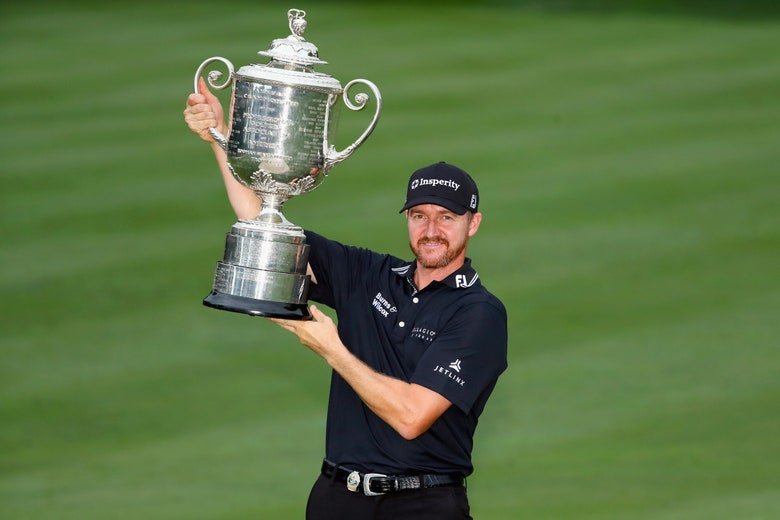
Defending champion Jimmy Walker

The revamped Quail Hollow course is only a few dozen yards longer -- PGATOUR.com is listing it at 7600 yards -- but it's been toughened up. The Green Mile is already considered the hardest final stretch on tour, and now the course opens with a 524-yard par-4. No rest for the weary, it seems.

No one is quite sure how the changes will affect play, especially with the major setup the pros will face this week. One thing's for sure -- Quail Hollow will be a real handful! The only question is who will be able to handle it the best. Since this course normally hosts the Wells Fargo Championship, we do have some recent history that might give us some clues.
  • I have to agree with Jordan that Rory McIlroy is the favorite this week. Rory's the only player in the field with two wins at Quail Hollow (2010 and 2015), and the weather will likely suit him as well. I live about 90 minutes north of the course, and rain is expected in North Carolina virtually every day this week. Need I remind you that most of Rory's majors have been wet ones?
  • While Dustin Johnson may not have returned to his pre-Masters form yet, he's still playing pretty well and he was one of the runners-up last year at the Wells Fargo. Even if he's off a bit, you have to think he'll have a good -- if not exceptional -- showing.
  • Brian Harman was last year's champion at the Wells Fargo, and he gave Brooks Koepka a run for his money at the US Open this year. Had Brian's driver not deserted him on Sunday, that event might have gone differently. Brian's got to have good feelings coming back this week, and I wouldn't be surprised to see him play well.
  • Has Hideki Matsuyama begun another streak with his win at the WGC-Bridgestone? We won't know until we see him in action... but it's hard to bet against him, after that run he put together late last year.
  • And my flier is... Webb Simpson. True, Webb's game has been somewhat sketchy since the anchoring ban went into effect. But he plays Quail Hollow quite a bit, and he's been runner-up at the Wells Fargo before.
My pick this week is... Matsuyama. He was T11 at the Wells Fargo last year, before his streak began. I think this may be the week Japan gets its first-ever major winner.

Remember, this major "belongs" to TNT and CBS. The first round is Thursday from 1pm-7pm ET on TNT.

Thursday, March 30, 2017

A Quick Listing of Tournament Times Today

This is just a quick reminder of how GC plans to broadcast the LPGA and PGA Tour events today. Remember, the women are playing a major while the men are warming up for a major. All times are ET (Eastern Standard Time).
  • 10am: Golf Central Pre-Game
  • Noon: ANA Inspiration (LPGA)
  • 4pm: Shell Houston Open (PGA)
  • 7pm: ANA Inspiration (LPGA)
  • 9pm: Golf Central
  • 9:30pm: Shell Houston Open (PGA)
And while I'm not sure that the second time slot for the ANA is more live coverage, bear in mind that 9pm on the East Coast is only 6pm on the West Coast. We'll have to wait and see.

Thursday, January 26, 2017

Your LPGA and Tiger Reminders

This is just a reminder that both the LPGA and Tiger start their 2017 seasons today.

Pure Silk promo shot

The LPGA live coverage of the Pure Silk Bahamas LPGA Classic starts today at 11:30am ET, right after Morning Drive's live coverage from the PGA Merchandise Show.

Then Golf Central Pre-Game starts at 2:30pm ET, followed by the live coverage of the Farmers Insurance Open at 3pm ET. Tiger's threesome, with Dustin Johnson and Jason Day, tees off at 1:40pm ET, so they'll be a few holes into their round when Pre-Game starts.

You don't want to miss either, so make sure your clocks are set!

Tuesday, January 10, 2017

The Joint PGA/LPGA Tournament Buzz

On the off chance you missed it, new PGA Commissioner Jay Monahan did an interview with Rich Lerner over the weekend and casually mentioned a desire to make the SBS Tournament of Champions a joint event with the LPGA Tour.

Rickie Fowler and Jessica Korda at the US Open at Pinehurst in 2014

The exact details of this proposed joint event haven't been explained. At this point, the most likely format would seem to be separate events contested at the same time. That would allow the men and women to play together on the same course, likely in mixed groupings. With each tour's field limited to around 45 players max -- after all, it would be unusual not to have a few multiple winners -- the shorter January days wouldn't pose a problem.

Plus, with the time difference between Hawaii and the mainland US, it would be a primetime event.

Given how often the pros on both tours have expressed their desire for chances to play together, this seems like an undeniable opportunity for everyone involved, from players to tours to broadcasters to sponsors. And since Monahan has already shown a willingness to break with convention -- this year's Zurich Classic has already been changed into a team event -- and since Mike Whan has done little else but innovate since he took the reins of the LPGA, this could happen sooner rather than later.

When it comes to taking the golf excitement meter up a notch, it looks like 2017 might actually give 2016 a run for the money.