ATTENTION, READERS in the 28 EUROPEAN VAT COUNTRIES: Because of the new VAT law, you probably can't order books direct from my site now. But that's okay -- just go to my Smashwords author page.
You can order PDFs (as well as all the other ebook formats) from there.
Showing posts with label book reviews. Show all posts

Thursday, July 7, 2016

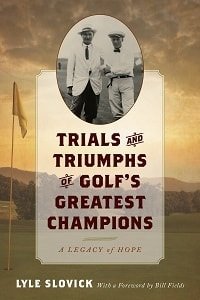
Book Review: Trials & Triumphs of Golf's Greatest Champions

Trials & Triumphs book coverI haven't done a book review in a while, and I think a lot of you may be interested in this one. It's called Trials & Triumphs of Golf's Greatest Champions and it's by Lyle Slovick, who is a consultant for the USGA and a historian. It contains in-depth biographies of six different players and one caddie.

First, I need to give you the customary disclaimer, which is basically telling you how I came to be reviewing this book. There are companies that specialize in getting new books reviewed at a number of blogs on sequential days. It's called, not surprisingly, a blog tour. (This particular company is TLC Book Tours.) I agreed to do this one for a couple of reasons:
  • One, I wasn't required to give a good review if I didn't like the book. (Of course, if they're willing to give you that freedom, you can be pretty sure you won't get a bad book, you know?)
  • Two, because there are so many blogs reviewing the book, I didn't have to do the standard type of review. That means I can do the review in a way I think will give you the best idea of whether this book is for you or not.
And that's what I'm doing. Rather than reviewing the entire book, I'm only going to review one of the biographies and try to give you a perspective that other reviews probably won't. So let's get on with it.

As I said, this book gives biographies of seven golf figures:
  • Harry Vardon
  • Bobby Jones
  • Ben Hogan
  • Babe Didrikson Zaharias
  • Charlie Sifford
  • Ken Venturi
  • Bruce Edwards
All of them dealt with unusually difficult struggles in their lives -- illnesses, accidents and racial discrimination. And Slovick does a good job of uncovering all sorts of interesting facts about their lives, and giving us a sense of the person we might have known had we been friends with them.

To demonstrate this, I'm going to focus on only one of the biographies -- that of Harry Vardon. Again, I picked Vardon for two reasons:
  • One, because Vardon was born in 1870 and therefore he's going to be the hardest to find in-depth information about.
  • Two, because I've been studying Vardon's swing in considerable depth, so I have some idea of which information is easily available and which is difficult to uncover.

And I have to say, I am suitably impressed with the information in this book.

Author Lyle SlovickThere are 127 different footnotes in the section about Vardon... and a huge number of them come from sources I had not uncovered. There are facts not only about Vardon's life -- some of which weren't known widely even during his lifetime -- but about key aspects of his golf swing, playing strategies, and even why he dressed the way he did when he played. (I had reasoned out some of it in my own studies, but Slovick found outright explanations that confirmed them.)

Slovick has sprinkled all kinds of little jewels throughout his work. As just one example, I learned that Vardon had two nicknames. One was "the Stylist" because his style was so smooth and rhythmical. The other was "the Greyhound," given to him by St. Andrews pro Andrew Kirkaldy because "at the height of Harry's career other players were unable to catch him." To me, those are the kind of memorable touches that make a book stand out.

To say that I was amazed at the sheer amount of info he found that I had not come across thus far would be a huge understatement!

Slovick has done similar research on all the persons in his book. And in many cases he has found that they had interesting interactions with each other. For example, he writes:
Venturi befriended Charlie Sifford in those days when racism dogged him. When the restaurant at the Pensacola Country Club wouldn't let Charlie eat there, Venturi spoke up, then took his own breakfast and joined Charlie in the locker room to eat. (page xxviii)
Trials & Triumphs of Golf's Greatest Champions is a fascinating book by a historian who apparently approached this as a real work of love. This book may eventually become a reference book simply because of the amount of information it gathers in a single place. (I know it will be for me.) And even if you only get it for the biography of one favorite player (or caddie!), I don't think you'll feel that you wasted your money.

Tuesday, June 2, 2015

Book Review: The A Swing

I've been promising you a book review and here it is.

The A Swing coverThe A Swing is David Leadbetter's new book, a book that he says he hopes will shake up the golf teaching community. The "A" stands for "alternative," and the swing is certainly that. In some ways it's not all that radical, as it continues to emphasize principles that Leadbetter has taught for many years... but there are some, shall we say, "unique" principles at work as well.

A couple of weeks ago I did a post about this swing -- right around the time I got my copy of the book -- and I linked you to a page at Golf Digest's website with videos demonstrating the basics of it. The primary concept that makes the swing "alternative" is what Leadbetter has nicknamed the V Plane, which is best explained by the following photo from the website.

At the halfway point of the backswing, the shaft of the club leans forward toward the target line. Then the club is rerouted during the change of direction at the top so it's on a more typical downswing plane. And this motion is very compact, requiring a shorter backswing to create more clubhead speed.

Leadbetter says that you don't even have to get the V quite as pronounced as the photo demonstrates. Rather, any swing that creates this V -- even with the shaft almost vertical on the backswing -- tends to help players get better results from their own swings. And after my original post about the swing I got some feedback that backed up Leadbetter's claim. In fact, this review has taken me longer than expected simply because I've been experimenting with this swing to get an idea how it works.

And I'll be honest with you -- I can't get the darn thing to work. I understand the concepts and, while I think the forearm rotation it requires between the top of the swing and halfway down is excessive, I don't think it's a bad approach to the golf swing. Leadbetter has eliminated a lot of the exaggeration that I believe makes Hogan's swing so hard for weekend golfers, and I think that's a good thing. But I still can't get it to work. Although I can get to the top just fine, I end up with a horrible in-to-out swing no matter what I try.

However, I think I know the reason why. On page 114 of the book Leadbetter writes:
It's not a perfectly symmetrical V, but it is a great image to understand how the shaft should move. This change of plane is important for the many golfers who lack energy and flow in their swing and swing steeply from out-to-in. (emphasis mine)
I haven't had a problem with an out-to-in swing in 25 years! Since then when I've had plane problems it's always been an exaggerated in-to-out swing. Those of you who read my blog regularly know that I consider the Hogan swing a fix for a duck hook, which is why it causes so many weekend players to slice badly -- most weekend players don't start with a duck hook. And the A Swing is a fix for an over-the-top swing, so it creates an exaggerated in-to-out swing if you aren't starting with an over-the-top swing. Makes perfect sense to me, and I appreciate that Leadbetter's book is detailed enough that I could figure that out.

The book begins with a foreward by Michelle Wie and an explanation of the biomechanics of the swing written by J.J. Rivet, a biomechanist who works with Leadbetter. Then the bulk of the book is a well-illustrated explanation of how the swing works, followed by a chapter on how to use the A Swing in the short game and such. Finally there's a chapter with the 7-Minute Practice Plan that everybody's been so curious about and some appendices with extra info.

Look, the A Swing isn't for everybody and, regardless of what anyone says, I'm not convinced this is something you can just dabble with. The basic positions in the swing -- and that rerouting move at the top of the swing -- are going to take a commitment if you really want to get good at them. But I think the overall concept is sound and it's definitely a better choice for most folks than the traditional Hogan swing. (I mean, which one better describes the swing flaw you're trying to fix -- a duck hook or an over-the-top swing?) Leadbetter should get his wish; this book is going to get people talking, that's for sure.

But if you don't have a problem with an over-the-top move, I'd advise you to look elsewhere. The exaggerated push shot it created for me, a player whose swing is already on a decent plane, would be unplayable on the course.

Thursday, September 4, 2014

Book Review: Draw in the Dunes

Draw in the Dunes coverIt's been a while since I did a book review but with the Ryder Cup just around the corner, I feel this is a timely one.
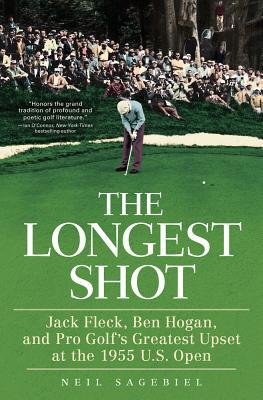
Some of you will recognize Neil Sagebiel's name. He writes the Armchair Golf Blog (he has for many years, and I've had a link to it in my blog sidebar since I launched this blog) and you may also be familiar with his first book, The Longest Shot, which was about the upset victory of Jack Fleck over Ben Hogan at the 1955 US Open.

Neil recently released (actually, it's scheduled to start shipping next Tuesday) a new book called Draw in the Dunes, about the 1969 Ryder Cup at Royal Birkdale. This event is probably best remembered for the legendary concession Jack Nicklaus made to Tony Jacklin on the final hole of the final match, which resulted in the first tie in Ryder Cup history.

If you saw the recent Ferherty episode with Sam Torrence, you heard Sam say that it was the 1969 Ryder Cup that truly got him interested in the event. And yet it was an event that nearly didn't happen. It was in 1968 that the tournament-playing members of the PGA became dissatisfied with their parent organization and tried to secede from the PGA, a bitter battle that eventually resulted in the creation of the current PGA Tour. The Ryder Cup, dominated by the American players up until that time, was on the verge of becoming irrelevant and possibly even ended.

Knowing how big and important the Ryder Cup has since become, that can be a hard thing for newer generations to believe. And most of those who are aware of the history of the event would probably name 1979 -- the year that the GB&I Team added Continental Europe to the mix, with legends-to-be like Ballesteros and Langer -- as the pivotal year in Ryder Cup history. But had it not been for the 1969 event, the Ryder Cup might not have survived that long.

Unlike many history writers, Neil's prose is never boring. Personally, I thought his decision to frame the story itself within another related story that happened 30 years later really made the importance of this event clearer. And if you want to know how the book is being received by the folks involved, consider that Jack Nicklaus and Tony Jacklin themselves wrote the book's foreword.

I'm fortunate. Neil got me an advance copy, so I can tell you this firsthand: If you enjoy golf history, his book is definitely one you'll want to read. Although it's not shipping until next Tuesday, you can pre-order it online now.

Thursday, May 24, 2012

The Armchair Golfer Gets Published

I'm sure a lot of you read The Armchair Golf Blog, Neil Sagebiel's little baby. It's one of the longer running golf blogs around -- 7 years now -- and there's always something interesting to read there.

The Longest Shot coverWell, Neil isn't satisfied with that. No, he wants you to read his book too!

That's right, Neil has joined the ranks of published authors with his new book, The Longest Shot, which is subtitled Jack Fleck, Ben Hogan, and Pro Golf's Greatest Upset at the 1955 U.S. Open. (On the outside chance you're a bit slow on the uptake, it's a book about how Jack Fleck beat Ben Hogan at the 1955 U.S. Open. Funny how that works out, isn't it?) The easiest way for me to sum it up is with the official blurb from the book's Amazon page:
The inspirational story of the unknown golfer from Iowa who beat his idol in the 1955 U.S. Open

With the overlooked Jack Fleck still playing the course, NBC-TV proclaimed that the legendary Ben Hogan had won his record fifth U.S. Open and signed off from San Francisco. Undaunted, the forgotten Iowan rallied to overcome a nine-shot deficit over the last three rounds—still a U.S. Open record—and made a pressure-packed putt to tie Hogan on the final hole of regulation play. The two men then squared off in a tense, 18-hole playoff from which Fleck emerged victorious in one of the most startling upsets in sports history.

On par with the classic golf narratives of Mark Frost and John Feinstein, The Longest Shot will surprise and delight fans as they trace the improbable journey of an unheralded former caddie who played his way into the record books by out-dueling the sport's greatest champion of his time.
Look, I'm not going to drop a huge sales pitch on you because I don't need to. If you read Neil's blog, you don't need me to tell you he can write. And since he's got links to the book's page at several booksellers, why don't you just pop on over and get yourself a copy? It'll be a nice way to spend your time during all that slow play at the Colonial. (Of course, that won't be Kevin Na's fault... ;-)

Sunday, August 21, 2011

Review: The Caddie Who Won the Masters

Here's another of my occasional book reviews, and this one's unusual because it's a novel.

Although John Coyne's most recent novels have been golf-oriented (The Caddie Who Knew Ben Hogan and The Caddie Who Played With Hickory), some of you may may actually know him better as a horror novelist. One of his novels, The Legacy, was made into a movie back in the late 1970s.

Coyne book coverThe Caddie Who Won the Masters actually has some of the trappings of a supernatural novel, what with the ghosts of some legendary people from Masters history walking the course along with some of today's superstars... although the superstars are completely unaware of their spectral companions.

But an amateur who qualified for the Masters -- a caddie from the Midwest, Tim Alexander -- can see them. All of them. These legends have a problem and they need Alexander's help. And they have some advice for him as well -- not just advice about playing Augusta National, but advice that could save his wife's life...

I don't know exactly how to review a novel like this, since I don't want to give away too much. The blurb on the back of the book likens it to Field of Dreams, and that seems as good a description as any to give you an idea of what it's like.

And I can tell you that Coyne's a good writer. Perhaps it's his background writing genre horror, which has given him a lean narrative style that doesn't get bogged down in description or the sound of his own voice. Maybe it's his past experience as a caddie, which gives him an appreciation for the game that a lot of other people might not have.

But it's a very different sort of golf novel from anything you may have read before. If you're looking for a fun read, you might want to give it a look.

Click the pic to go to the paperback page at BN.com. It's also available as a NOOK book, and Amazon has a Kindle version.

Saturday, May 21, 2011

Review: Play Your Best Golf Now

As I mentioned a couple of weeks ago, every now and then I receive books to review. Sometimes I hold off on them because there are a lot of reviews being made, and sometimes I'm just busy with other things and reading takes a back seat.

Cover of Play Your Best Golf NowI'm still reading this book, but it's pretty cool so I thought I'd go ahead and pass it on.

Most of you are probably familiar with the authors, Pia Nilsson and Lynn Marriott. They're the founders of VISION54, the program built around the idea that it's possible to birdie every hole in a round of golf -- to shoot a 54. Annika Sorenstam has been one of the most vocal supporters of the program, and several other pros have picked up on it. Lynn and Pia have already done a couple of books about VISION54 but this one, Play Your Best Golf Now, is the newest. (In fact, it was just released at the end of April.)

As a general rule, I'm not big on books that focus on the mental approach. Golf is just a game, and keeping perspective is just a normal life skill. What's cool about PYBGN is that it merges practical golf skills with a mental approach that fits in with my goals for this blog. For example, I encourage you to focus on developing a predictable swing rather than a perfect one, and to focus on scoring rather than technique. Nilsson and Marriott feel the same way:
"Having a great swing is not playing great golf. That is only part of the puzzle of peak performance. Our goal is to unify the elements of the game that have become splintered into swing coaches, long-game coaches, short-game coaches, putting coaches, mind coaches and more. We are performance coaches. The point of the game is to get the ball in the hole in as few strokes as possible." (p10, their emphasis)
Or how about this:
"It can be just as destructive to be totally obsessed with swing theory and swing mechanics as it can be to be obsessed with visualization, strength training or any other piece of the game. We reduce the game to its simplest, most accessible -- and therefore most attainable -- elements, and it is these elements, when combined, that produce great golf." (p11)
And I love this one:
"To score, you need to have a good enough swing and a good enough putting stroke, but you don't need to be perfect. In fact, the obsession with perfection can be detrimental to performance." (p12, their emphasis)
Those quotes could have been part of my own "about" page for this blog! Can you tell why I'm loving this book?

The book focuses on 8 Essential Playing Skills (some are more mental, some are more technique) and 2 Practice Essentials that are basic to VISION54. There are short practice sections at the end of each chapter, and they cover things from physical skills like balance and rhythm to mental skills like decision-making and commitment to your shot.

I'm well into the book and it's maintained a very practical tone so far. It's even fairly fun to read! Because of this, I feel pretty good recommending it. Play Your Best Golf Now seems to have the same goals I do on this blog -- to help you learn how to use your existing swing to actually play good golf, post good scores, and have more fun with less work. What more could you ask for?

Click the pic to go to the hardback page at BN.com. It's also available as a NOOK book, and Amazon has a Kindle version. Apparently there is no paperback edition yet.

Saturday, May 7, 2011

Review: Straight Down the Middle

Every now and then I receive books to review. Often I don't review them right when I get them, primarily because reviews tend to pop up in clusters. Since I worked in the book industry for a couple of decades, I can tell you that publishers often give a new book massive publicity for a few months before dropping down their priority list in an unfairly quick manner. So I like to wait a while on my reviews and see if I can't give the book a boost after the initial excitement dies down.

Straight Down the Middle book coverOne such book is Josh Karp's Straight Down the Middle, which I confess I've had for a while. (If you click the cover to the right, you'll go to its BN.com page.) To tell you the truth, I haven't been quite sure how to review this one.

Don't get me wrong, SDTM isn't a bad book at all. It's a golf book that claims to be part instruction, part mental guide, and part memoir. Josh Karp is a journalist and pretty much a lifelong golfer who decided to try and improve his game, so he started exploring some of the different "paths" that are being touted as a way to improve your game. This book is his record of that journey.

When a golf instruction book is subtitled "Shivas Irons, Bagger Vance, and How I Learned to Stop Worrying and Love My Golf Swing," you'd probably guess that journey didn't include guys like Harmon, Haney, or Foley... and you'd be right. And while Karp is clearly familiar with sports psychologists like Parent and Rotella... well, they weren't really on the trip either. Josh makes no bones about it:
"My quest, the quest that became this book, was one toward two goals -- better golf and a better life via the non-traditional Eastern route. I would sample various Eastern approaches to life -- meditation, martial arts, and all other manner of instruction both on the course and off -- hoping to lower my handicap and find my true, calm, happy self, or vice versa." (page 15)
Even as a Christian who has explored some Eastern mysticism -- and make no mistake, the roots of Christianity are at least partially Eastern -- as well as some martial arts, and as one who has found considerable help for my game in my faith, Josh's approach seems a bit "out there." So I can't really recommend his book as a golf instructional book.

However, SDTM is a good read. The blurb on the book flaps call it a "hilarious memoir," and I have to agree. If Dave Barry decided to write a book on how to become a "mystical golfer," I think he might have written this book! Josh Karp writes enjoyable prose. I don't know if he intended the book to be read this way, but I give it high marks as a very entertaining read. So if you enjoy personal stories, you may want to give Straight Down the Middle a look.

However, if you're looking to improve your golf game, you might want to look somewhere else. Personally, given a choice between Shivas Irons and a new set of Callaway RAZRs... no contest.