ATTENTION, READERS in the 28 EUROPEAN VAT COUNTRIES: Because of the new VAT law, you probably can't order books direct from my site now. But that's okay -- just go to my Smashwords author page.
You can order PDFs (as well as all the other ebook formats) from there.
Showing posts with label hitting from the rough. Show all posts

Tuesday, February 20, 2018

Adam Kolloff on Hitting Hybrids

Golf Digest instructor Adam Kolloff recently wrote a short article called Get The Most Out Of Your Hybrid. It focuses on hitting hybrids from the rough.

Gripping a hybrid

Kolloff has four tips to improve your hybrid play from the rough.
  1. Keep a firm grip so the face doesn't twist open or closed.
  2. Play the ball in the center of your stance.
  3. Don't sway off the ball. Try to stay very steady over the shot so you can hit down sharply on it.
  4. Be sure to accelerate through the rough.
That tip about playing the ball in the center of your stance is important. Kolloff says that too many players try to play the ball forward like a fairway wood, but I imagine just as many set up with the ball too far back in their stance like a wedge. Hybrids have straighter faces than wedges, so playing the ball too far back can drive it deeper into the rough rather than popping it out of the grass.

These are simple things, I know. But it's usually the simple things that trip us up.

Friday, February 16, 2018

Zach Allen on Playing Flier Lies (Video)

PGA instructor Zach Allen did a really nice video explaining exactly what a flier lie is and how to play it. It's short and to the point, which is what you need when facing a trouble shot like this.


First, Zach says a flier lie generally sits in light rough and the grass is growing toward the target. Very important, that -- if the grass was growing against you, it would help hold the ball in place when you hit it, not send it squirting forward. Instead, the grass gets between the ball and clubface, and that makes it come out lower and hotter.

But it's hard to know just how much. We just have to guess.

So here's what Zach says to do: Take one less club than you normally would and make a smooth swing. What he means is that you don't try to swing out of your shoes, as the ball is going to come out quicker and with less spin anyway. Then you just have to hope for the best, since fliers are unpredictable.

All-in-all, a very helpful video for handling a difficult shot.

Monday, January 8, 2018

The Limerick Summary: 2018 Sentry Tournament of Champions

Winner: Dustin Johnson

Around the wider world of golf: I don't know of any other events this week. The year is young!

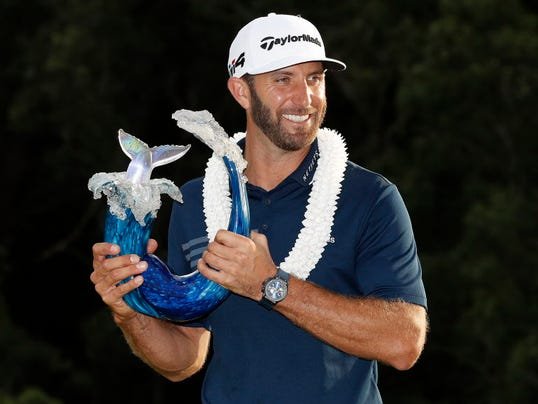
Dustin Johnson with Sentry ToC trophy

Well, yesterday I wrote that if Dustin Johnson was "on" at the Tournament of Champions, he could take the title easily. However, I thought there might be an upset in the making, simply because big leads -- especially in the first event of the year -- can be tricky to hold. My feeling was based on him possibly being rusty.

Shows how much I know. DJ posted the biggest win of his career, winning by eight shots in warm but soggy weather.

Now I wasn't the only one who considered a possible upset. Some analysts wondered if DJ's collapse at the WGC-China would eat at his confidence. They mentioned his record of 4-7 when leading after 54 holes. But THAT Dustin Johnson doesn't exist anymore.

At least, it's not a mental issue when he loses these days. It may be equipment problems or physical problems or simply the fact that nobody wins all the time. But DJ has enough positive performances in his memory banks that he isn't going to just crack under pressure.

The rest of the field might have had a chance if he did. Don't be counting on that, folks. DJ is healthy again and he knows he's not going to re-injure himself. This year may end up being the year we expected from him in 2017.

I think this Limerick Summary is only his first of the 2018 season. The rest of the Tour better buckle their seat belts -- it may be a rough ride for them!
With his back pain a thing of the past,
DJ’s lead at the start grew so fast
That the field groaned in shock—
‘Cause the golf course he walked
Didn’t play like the course where THEY crashed!
The photo came from this page at usatoday.com.

Sunday, September 24, 2017

Charley Hull on Playing from the Rough (Video)

I'm back from Disneyworld, back in North Carolina. (And for the curious among you, I took a plane, not a banshee.) But I'm much more tired than I expected, so this post will be a short one.

Hopefully it's still a helpful one.

Here's Charley Hull with some tips on playing from the rough. She should be an expert on that!


Most of the tips are standard stuff -- 56° sand wedge, ball back in stance, weight more on front foot, etc. -- but her advice to chop down like a bunker shot is a bit unusual. Watch the video closely and you'll see that Charley is leaning the clubshaft forward at address, which is a different approach from most who say this is like a bunker shot.

Charley is focusing less on distance control and more on just getting the ball out of there. This is a shot you play to get safely back in play; if the ball gets close to the hole, that's a bonus.

And now I'm headed to bed. I'll be back on schedule with the Limerick Summary on Monday, and then we'll see what we can turn up going forward. But right now, I need sleep!

Tuesday, June 20, 2017

Improve Your Chances of Getting Out of the Rough

It figures. Golf Digest did an article on getting out of the rough after the US Open. (I can think of some big names who could have used this earlier...) This article is pretty detailed so you'll want to read it all, but I'll give you the high points. (Rough, high points... get it?)

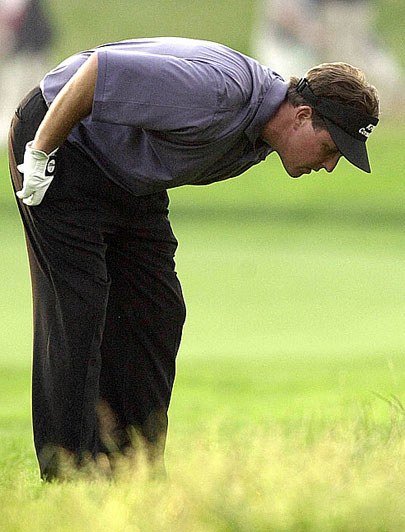
Phil making some rough calculations

First of all, ignore the yardage and take a club that will actually get the ball out of the rough. Obviously you don't want to hit the ball into a hazard because it didn't travel far enough, but neither do you want to leave it in the rough because it didn't travel at all!

Bill Schmedes III (the instructor featured in this article) also says you need to move the ball back in your stance at address. He specifically says "an inch and a half." It's nice when a teacher gives you a specific number. I suppose he means an inch and a half back of your normal ball position for the club you choose, not just an inch and a half back of center.

Coupled with the ball position change, he says to aim more to the right (for a rightie; more to the left for a leftie) because the rough will likely grab your club and cause a hook.

Finally he says to make sure you hit down on the ball. If you try to help it up, you'll come in too shallow and get too much grass between the ball and clubface. He has a short list of things that might help you do this more easily; you'll want to read the article and see which one will help you the most.

While few of us have to deal with fescue, thick rough is just a fact of life. This article should give you some tools -- and some hope -- for the next time you end up there.

Friday, October 28, 2016

Butch Harmon on Pitching from a Buried Lie (Video)

Hey, a new Butch Harmon video! In this Golf Digest video, Butch shows the basics for hitting a high soft pitch shot when your ball is buried in the rough.


It's just five simple steps:
  • Take your most lofted wedge
  • Set up with the ball in the middle of your stance
  • Open the clubface... VERY open
  • Take the club up sharply (notice how much wrist cock he creates for a short shot)
  • No followthrough
I think the most unexpected part is the "no followthrough" finish. But I'm guessing that's what makes the ball go up so sharply, since any effort to get all the way through the grass would probably make you hit the shot thin.

This looks like a good shot to experiment with. That "no followthrough" finish from the rough might be useful with some other shots from the rough as well.

Saturday, September 17, 2016

Charlie Rymer on the 100-Yard Approach from the Rough (Video)

Here's a video Charlie Rymer did for Morning Drive. This is a shot not often covered in teaching videos -- the 100-yard approach shot from the rough.


Charlie gives you four steps:
  • Take a longer club. Charlie's taking one longer.
  • Open the clubface. You want to the ball to go up.
  • Put the ball forward in your stance. Same reason -- get the ball up.
  • Make a three-quarter swing at your normal full swing speed. In other words, this isn't some sort of soft shot.
As Charlie notes, your lie affects what you can do. But assuming that you have a decent lie, his pointers are a good place to start.

Sunday, August 7, 2016

Butch Harmon on Flyers

Butch Harmon has a new article over at Golf Digest about how to avoid hitting flyers from the rough. Now, you're probably not too impressed by this news. After all, everybody knows that you move the ball back a bit in your stance ("about middle for a short iron," Butch says) so the shaft leans forward a little, and then you hit down on it so you don't catch grass between the clubface and ball. Everybody knows this, correct?

But there's one small thing in the article that I bet you DON'T know... and that small thing is important.

Butch hitting from the rough

Most of us expect a flyer when the ball sits down in the rough. Butch is warning you against balls that sit on top of the rough.

That's a bit of a shocker, isn't it? If the ball is on top of the rough, that's a good break. And if you were using a wood out of the rough, it probably wouldn't be that big of a deal because there's less loft on the club. That means you're going to hit more toward the midpoint of the ball.

But with a short iron, the extra loft contacts the ball down below that midpoint. In fact, the face catches the ball much closer to the bottom of the ball... and if you catch it just a bit low, you're going to get grass between the clubface and ball.

And since the ball is coming out higher (because of the extra loft), with less spin (because of the grass between the clubface and ball), it's going to fly a bit farther.

So, even though the ball is perched on top of the rough, you need to be careful if you're playing a short iron. Read that article closely, folks -- it's the short iron that can cause the trouble.

Thanks for the tip, Butch!

[UPDATE: Yeah, I know I posted a video from Butch on how to hit irons perched on the rough a couple weeks back. However, that video doesn't have the warning against short irons causing flyers. That's the reason I posted this. But I know it looks a little weird. I blame Butch for doing them separate! ;-)]

Friday, July 22, 2016

Butch Harmon on Hitting Irons Perched on Short Rough (Video)

A quick note about GC's golf schedule today: I did a post with a complete schedule yesterday. If you ignore the 6am listing for Golf Central and then move all the other times up a half-hour (for example, the 7am Senior OPEN to 6:30am), everything is in the same order.

Here's another Golf Digest video from Butch Harmon on something you don't hear much about -- how to hit an iron shot when you got a lucky lie in short rough. Your technique has to change just a bit.


The simple summary here is that you sweep the ball off the grass with your iron, just as you sweep the ball off a tee with your driver. But it's not exactly the same.

With an iron, your stance is considerably narrower than it is with a driver. All things being equal, it's more natural to hit down on the ball with an iron. (Yeah, I know many of you struggle with hitting down. But that's because you exaggerate your leg movements, and it causes you to hit the ball thin or fat. You probably aren't hitting your driver well either, are you? It's the same problem.)

I've done a couple of posts that can help you get better at keeping your height during impact, which is what you need to do when you use Butch's advice.
Both of them will teach you to "pick the ball" while making solid contact. If you move the ball slightly back in your stance you'll hit down more solidly on the ball, but if you move the ball slightly forward you'll be able to sweep the ball cleanly without hitting it thin. I recommend both because you may find that one of them is easier for you to use. They're just different mental approaches for the same technique.

Give them both a try. One or the other should help you develop that sweeping motion that Butch wants you to use when you get a nice lie in the rough.

Friday, January 22, 2016

Paige Mackenzie's Tip for Shots from the Rough

A couple days back, Morning Drive gave Paige Mackenzie and Chris DiMarco a quiz over who was better with different shots, Rory or Jordan, and then the two gave tips on how to best play those shots. Paige gave a tip for playing from the rough that was so simple, I thought I'd post the video here. Most players would think it should be common sense but what Paige suggests is a bit different from what you're probably thinking...

Yes, you probably thought about tightening your grip. But note that Paige doesn't recommend tightening BOTH hands. Instead, she suggests only tightening your lead hand. This keeps the clubface from flipping over when the grass tries to grab the hosel.

But why not tighten both hands, you ask? (Yes, I know you ask. Go ahead... ask.) I have three reasons for you:
  • When you tighten your muscles, you lose clubhead speed. By leaving your trailing hand grip more relaxed, you can generate more speed -- not as much as you would if both hands were relaxed, but more than if both hands were tight.
  • It's easier to keep your swing on plane than if both hands were gripping tightly. Remember, when you tighten your grip you also tighten the muscles in your forearms. That's going to affect how your trailing elbow moves during your downswing, and that elbow does a lot to keep you on plane.
  • And in addition, you have a better chance of avoiding injury if the rough turns out to be particularly tough.
So remember: If you're hitting out of the rough, only tighten your grip with your lead hand. If you can't hit a decent shot that way, the lie was probably too bad for a good result anyway.

Sunday, December 6, 2015

Hitting High Soft Shots from the Rough

Today I have a short video from Golf Digest and Golf Magazine teacher James Sieckmann (he has his own golf academy as well). This video is on how to hit a high soft SPINNING shot from the rough... and Sieckmann says it works from the sand as well.


Sieckmann says the two keys are:
  • lower body stability
  • getting the speed from your arms and hands
Note that he's creating that lower body stability by bowing his legs a bit. That's not essential but it's a good way to learn how to turn your shoulders without excess leg movement. In swings this short, you don't need much lower body movement to create speed at impact. Also note that his knees DO move, but that's it -- they move, they don't drive. That's a key difference between proper use and overuse of the legs.

That second key is a classic swing technique -- most good short game players use classic technique in the short game because it makes it easier to get feel and control. Note that Sieckmann emphasizes that you have to start your downswing SLOWLY; speed happens late in the swing and is greatest JUST AFTER you've hit the ball. Also, as long as your shoulders continue to turn into your finish, you won't flip the clubhead with your forearms.

Creating clubhead speed in a short game swing should NOT take a lot of effort. If you're grunting when you hit a pitch shot, you're just trying way too hard!

Friday, September 25, 2015

An Unusual Drill to Improve Pitching from the Rough

This drill from Golf Digest Teaching Pro Josh Zander is one of the most unusual pitching drills I think I've ever seen. It's part of an article called Practice in the Rough, where Josh says practicing from the rough will really help your ball-striking.

The article itself focuses on maintaining connection and a grip that's firm enough to get solid contact. But this drill is just crazy! Basically you're using a 6-iron to hit a flop shot...


You'll recognize some of the techniques as those being used for certain sand shots -- opening the club face dramatically and lowering your hands much closer to the ground than usual. (Of course, this entails squatting down quite a bit as well.)

But it's the wrist action that will really get your attention. Josh wants you to "throw" the club head at impact, getting the club shaft in line with your trailing forearm. That puts your hands WA-A-A-AY behind the ball when the club head slides under the ball.

It looks very unorthodox but I can see how it would help you learn to control the club head better, to learn the difference between what it feels like when you want to use the leading edge of the sole versus the bounce. It should certainly improve your ability to play flop shots. This is the kind of shot Seve routinely practiced, and it certainly helped him become a real wizard around the greens.

And if nothing else, you can impress your friends with your newly-gained short game prowess.

And just a head's-up: I'll be traveling during the weekend so the Saturday and Sunday posts may show up a bit early or a bit late, especially on Facebook. But the posts WILL be posted, one way or the other.

Sunday, September 13, 2015

The Problem with Wet Rough

Today's post is short but it's a subject that doesn't get talked about very much, even though it trips up even the best golfers. It affected several players at the Evian on Saturday but it was most noticeable with Minjee Lee and Morgan Pressel.

That problem is how unpredictable wet rough can be. Both Minjee and Morgan drove their balls in the rough on 18, then inexplicably tried to go for the green despite seeing a huge pond fronting it. As a result, both posted double-bogey 6s.

As Judy Rankin said during GC's broadcast, those are shots the girls could probably have made without a problem if the rough was dry. But a lot of rain got dumped on the course very quickly, much of it while they were playing, and those normally routine shots became dangerous risks.

What exactly happened? Even though both players are pretty strong -- and Morgan has a fairly upright swing plane that lets her dig the ball out of the rough better than most -- the extra water in that thick rough made it almost impossible to make good contact with the ball.

When rough is wet, the ball doesn't behave as you might normally expect:
  • In thick rough that's dry, you worry that the grass will wrap around the hosel of the club and flip it over. When that happens, the ball can duck-hook pretty quickly and will often travel farther than the player expected.
  • But in thick rough that's wet, the hosel may slide right through the grass (because wet grass clumps together) and leave the clubface open. Combine that with thick wet grass that gets between the ball and grooves and prevents the ball from spinning, and you end up with a knuckle ball -- a low-flying shot that shoots out like a push and drifts even farther away from you.
That's what happened to both women. The ball squirted out farther to the right than either expected, flying low without enough spin to keep the ball aloft in the damp air, and then plunged into the pond I mentioned.

And unlike Minjee, who was aiming at the pin and thought she could carry the water, Morgan was aiming AWAY from the pond. Her plan was to leave it short and to the left of the pond, opening up the green for an easier pitch shot. But the ball squirted out low and right anyway, curving into the water and leaving her a difficult pitch across the pond to a pin set close to the water.

The safest play when your ball is laying in thick wet rough is to pitch it out safely into the fairway, on the short grass where you can get a clean clubface on the ball... and that's true whether you're a weekend player or a Tour pro. Don't try to be a superhero and expect to play the shot as if the grass was dry. It just ain't gonna happen, no matter who you are.

Friday, May 29, 2015

Blair O'Neal from the Thick Greenside Rough

Yes, it's another Sexiest Shots in Golf video from Golf Digest. This time Blair is showing you how to get the ball up and down from thick greenside rough, which is something we all find ourselves in far too often.


Look, I know you've heard this before: Play this shot like a bunker shot. And Blair tells you how to play this as if it was a bunker shot:
  • Take a high-lofted wedge.
  • Open your stance slightly.
  • Open the club face.
  • Put the ball forward in your stance.
  • Hinge your wrists early.
  • Release the club head as you hit the ball.
But you need to make sure you understand that last one. If you're used to thinking like a chipper then you're used to trying to keep your hands slightly ahead of the club head. NOT HERE! You want to hit the ground a little behind the ball and you want the club head to start passing your hands just before you hit the ball. And when you fling the club head past your hands, that gives you more club head speed.

Let me repeat that: The bounce of the wedge should hit the ground just behind the ball and the shaft of the club should be vertical when it does. That means your hands are just behind the ball as well, and the club head will whip past your hands as it contacts the ball. I can't emphasize that enough. That lets you use the full loft of the club and makes the ball climb up quickly so it will come down softer, and the speed will give you a bit more spin to help it stop even faster.

Blair doesn't mention -- although it shows in the video -- that this isn't a full backswing shot. This is a pitch shot; your hands only go waist high or a bit higher on the backswing. However, your hands go almost to a full finish. That's because you want as much speed and height on the shot as possible, so you don't want to restrict your finish in any way.

One other quick note: This tip assumes that the ball is nestled down in the rough. If the ball is suspended in the grass above the ground, you'd need to do essentially the same things without the bounce of the club hitting the ground because then you'd go right underneath the ball. But in that case you'd have more options and might be able to choose a simpler shot. Blair is showing you a worst-case approach here.

Just make sure you practice it a few times before you try it on the course.

Friday, March 7, 2014

Playing to Hard Greens

While watching the WGC-Cadillac Thursday it became glaringly obvious that even the pros have trouble playing to hard greens. In some ways it was reassuring to see them getting upset over good shots that didn't end up good -- after all, we've all been there.

Still, it got me thinking about the best way to play hard greens. We'll start at the green and work our way back.

Obviously the putter is your best friend when you're on a hard green or just off the edge. Since it's hard to get any spin on the ball when you hit it, it makes putting a safer bet than chipping.

Moving back from the green a bit... I found a new tip from Butch Harmon on the Golf Digest site about how to hit high pitches that land softly. Essentially it's about using your lead hand to control the club face -- turning your knuckles up at impact to keep the face open and hit it high, turning them down toward the ground for a running shot.

Even if you don't manipulate the club like Butch suggests, focusing on lead hand control makes sense. That's the hand that's farthest away from the club head, so it allows the head to swing most freely. The club behaves most like a pendulum that way; once you get the feel of the swing's rhythm, it's easier to hit any high shot accurately. (And remember that all high shots, whether flops or full approach shots, are a bit easier if you have a little grass under the ball.) But you'll have to practice if you want to hit a decent flop shot -- there's no quick fix.


When you have to hit an approach from the fairway -- especially if there's a bunker or pond in the way -- you have to make some choices. Again, as the pros at Doral proved, even the best players have trouble with hard greens when you've got to carry a hazard. We mere mortals need a few tricks.

You may have seen Victor Dubuisson roll the ball around a front bunker early in the round, which the announcers called a links shot. Victor demonstrated three ideas you can use:
  1. the bump-and-run shot, popular on links courses but you'll need a reasonably firm fairway to make it work
  2. choosing your approach angle -- if you can go around trouble, you have more options
  3. using the terrain to your advantage -- Victor didn't fire straight at the green, he aimed for a slope at the side
If you simply have to go over a hazard, you might consider laying up short so you can use a wedge to attack the green. More loft equals a higher shot, making it a bit easier to stop the ball. Also, because the shot is shorter, you don't need as much club head speed so the ball won't run so far after it lands.

One other possibility besides landing the ball short of the green and bouncing it on -- a dicey situation if the green is hard but the fairway is soft -- is to hit a higher shot. You set up with the ball more forward in your stance -- an inch ahead of your normal position is probably enough -- open the club face and try to hit a high cut. You want to try and catch the ball right at the bottom of your swing arc. Again, you'll need a bit of cushion under the ball to pull that one off.

Of course, sometimes getting a good result on hard greens is just a matter of luck, no matter what you do. But at least you can console yourself with the knowledge that the pros have the same problem -- they just get paid for having it. ;-)

Tuesday, February 25, 2014

Playing Lessons from the Match Play

The golf world is still buzzing about the finals of the WGC-Accenture Match Play. Jason Day got a big win, Victor Dubuisson got unlimited sponsor invites, and Victor's runner-up finish gave me the best results I've had in a long time when picking this event. ;-)

Day and Dubuisson

But there's more that we can learn from the Final Four in this tournament. Today I thought we'd take a quick look at some easy-to-apply lessons we can all use.

From 4th place Ernie Els we can learn the importance of proper equipment. Ernie has been struggling to regain the putting prowess he used to have, trying almost anything to make putts. However, he finally moved to a shorter, counterweighted putter (I talked about them in detail a couple of days ago) and found a piece of equipment that suits him to a tee. It allows him to rely on the same rhythm that makes his full swing so smooth and dependable. Many of us are using sticks that we just aren't comfortable with, and that's a problem that's easily corrected.

From 3rd place Rickie Fowler we can learn to double-check our fundamentals when we have swing problems. Far too often, our response to a persistent swing problem is to try an entirely different way to swing -- and as a result we just end up with a swing that's a mix of different techniques that don't work together. When Rickie went to Butch Harmon, Butch didn't rebuild his swing, according to Rickie in this Golf Digest article:
"[There are] no major changes, just taking what I have and cleaning it up, making it consistent and more repeatable."
Fowler says the essence of the effort is to get started in the right takeaway position and to shorten his backswing a bit. "My tendency," he says, "is to get a little long and the club gets stuck behind me."
No major changes, just cleaning things up. Note that Rickie specifically mentions working on a proper takeaway position. That's why I keep harping on a properly-done one-piece takeaway; even the pros tend to get into bad habits there. Keep your eyes on your fundamentals.

From runner-up Victor Dubuisson you can learn to trust what you know. A number of people on social media felt that Victor was too careless over those amazing shots he hit to keep the match going. But Victor's nickname is "Golden Hands" and the word is that he doesn't practice as much as the other guys; he prefers to play more. You don't find those kind of lies on the range, but you can end up in all kinds of bad lies out on the course so Victor has a good sense of what he has to do when he hits into something unusual like teddy bear cholla. As a result, he doesn't second guess himself; he decides what he's going to try and then he tries it. And he doesn't beat himself up if it doesn't come off the way he planned -- as he said, "I just played it like I had nothing to lose." Don't overthink your game.

Finally, from winner Jason Day we can learn simple mental toughness. After a couple of miraculous saves by Victor, Jason said he started to wonder if he should just hand over the trophy right then. But as Helen Ross wrote for PGATOUR.com:
After all the shots that left him shaking his head in disbelief like the rest of us on Sunday afternoon, especially Victor Dubuisson's stunning escape from beside that small cholla and the other ball he liberated from the branches of a bush, Jason Day was still focused on one thing.
He wanted to win the World Golf Championships-Accenture Match Play Championship.
Yes, it was that simple. Jason simply didn't give up. You don't have to, either. Just keep your head in the game, trying to make the best score you can. You might be surprised what you can do.

These aren't complex techniques that let these players triumph over 60 other players. But then, victory usually comes down to just not quitting. And you can do that as well as they can.

Sunday, December 15, 2013

Dave Pelz on Recovering from Trouble

This video from the golf.com "Pelz Vault" shows Dave Pelz's advice on dealing with tree trouble... but listen carefully because this short clip is full of strategic help for all kinds of problems:


I'll summarize his tips here, but these are the kinds of things that take strokes off your game without any practice at all!
  • Sometimes you just get bad breaks; they happen to everybody. Don't let them get to you and cause you to make bad decisions.
  • Play the percentage shot, the one you KNOW you can pull off. If you choose the shot that gets you safely back in play, you may still avoid the penalty. (That's what he means by "making the penalty less than a shot;" sometimes you'll get up and down without any penalty if you leave yourself in position to do so!)
  • Choke down a little on the club to give yourself better control of the shot.
  • Very important: Check where the bottom of your swing is! No matter how well you plan the shot, if you don't make good contact you're just wasting your time.
As I said, these are all things that you can do without any extra practice. When you can save shots for free, by all means do so!

Tuesday, December 3, 2013

Dig It Out of the Deep Stuff

Yes, another video! This one is from Golf Magazine Top100 Teacher Mark Hackett. He has 4 tips to help you get your ball out of the deep rough -- a place we all find ourselves far too often.


Just to make sure you didn't miss them, here are the 4 checkpoints:
  1. Stand a bit farther from the ball
  2. Lower your hands a bit
  3. Set your weight more on your lead leg
  4. Make an even-paced swing (i.e., don't try to swing faster by jerking the club -- you won't get accurate contact that way)
Doing this will move your hands slightly ahead of the ball and steepen your downswing plane. It's the steeper downswing -- and the resultant downstrike -- that gets the ball to pop up and out. The last thing you want to do is try to help the ball out and swing upward; if you do, you'll top the ball. Hit down on it!

And if for some reason the video won't run properly, here's the original link at golf.com.

Sunday, September 29, 2013

Playing a Sidehill Downhill Lie

I found this neat video over at golftipsmag.com. PGA teaching pro Jeff Johnson left this video with a very simple tip to improve your shots from a sidehill lie.


This is really simple, folks; it's all about posture. While this lie requires you to bend your knees a bit more -- so you can get down closer to the ball -- you have to make sure that you don't "sit back" into the hill too much. If you do, you'll end up swinging too flat, too much along the line of the slope, and that will make it hard to get the ball up in the air. If you don't get it up in the air, you aren't going to hit it very far!

On the other hand, you don't have to lean toward the ball so much that you lose your balance. Just make sure that you lean forward enough to get an upright swing. That's how you dig down and make solid contact with the ball.

Don't forget that the ball is going to curve down along the side of the slope. (That's a slice, no matter whether you're a leftie or a rightie. They included a trace of the ball's flight near the end of the video. See how much it curved?) You'll probably need to aim more uphill so the ball doesn't curve into even worse trouble.

Saturday, June 15, 2013

Are You Stuck in the Deep Stuff?

Since the big boys struggled so much up at Merion during the first two rounds of the U.S. Open -- and will probably continue to do so over the weekend -- I thought this might be a good time to look at ways to escape the deep stuff.

And I do mean DEEP stuff. There is plenty of instruction on how to play out of the rough, but the videos rarely ever show the instructor hitting out of SERIOUS rough. For example, Martin Hall has video showing the techniques but he's in a studio. Other teachers demonstrate techniques out of only 2- or 3-inch rough.

But not Irish golf instructor Barry Power. He's in some seriously deep rough here and, while it may look a bit sparse compared to the green stuff at Merion, the color of the grass is misleading. You can barely even see the ball...


He has three main keys to pulling this shot off, and they're very simple: Take your grip so the club face is open about 45 degrees, just like in a sand shot, position yourself so the ball is about an inch back of the center of your stance, and then make a "confident" swing -- which means you don't have to swing out of your shoes.

The idea is to hit the ball without catching any more rough than necessary. Moving the ball back in your stance helps with that because it gives you a steeper swing down onto the ball. Likewise, opening the club face presents less of the leading edge to get hung up as you swing down.

Then, once you're down into the rough, the grass snags the hosel and twists the face square so you get a solid hit. You don't swing out of your shoes because you need to make solid contact, not jerk away while pretending you're a bodybuilder, and making solid contact in the rough is hard enough as it is.

This is an easy-to-use method for getting out of the deep stuff. Some of the pros could use it this week at Merion!